Department of Microbiology and Immunology, The Geisel School of Medicine at Dartmouth, Lebanon, New Hampshire, USA.
Department of Microbiology and Immunology, The Geisel School of Medicine at Dartmouth, Lebanon, New Hampshire, USA
mSphere. 2020 Jan 15;5(1):e00851-19. doi: 10.1128/mSphere.00851-19.
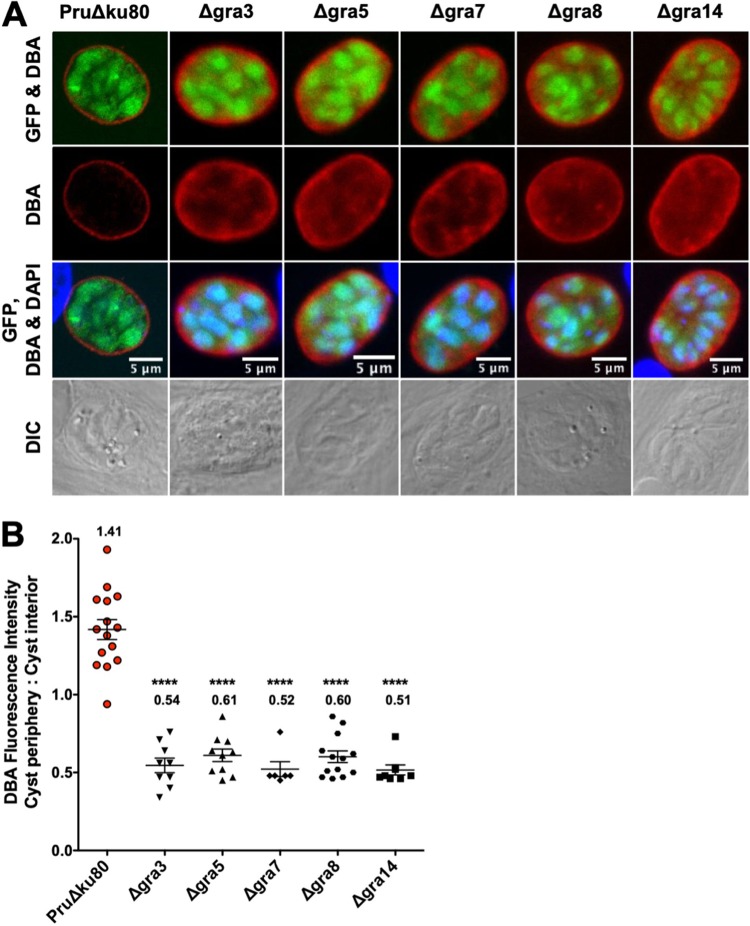
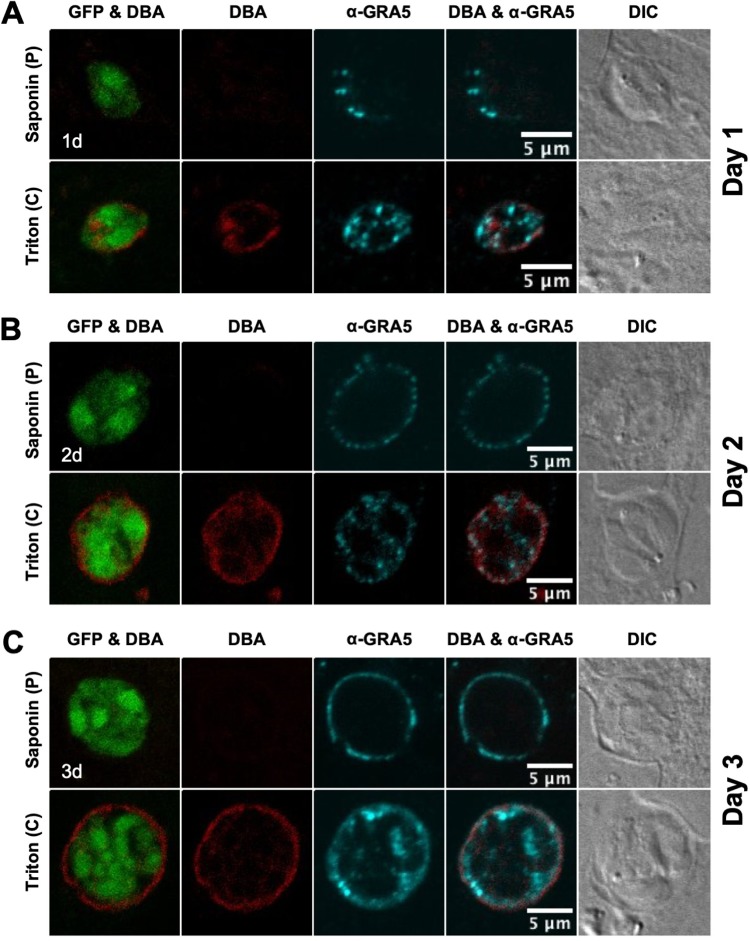
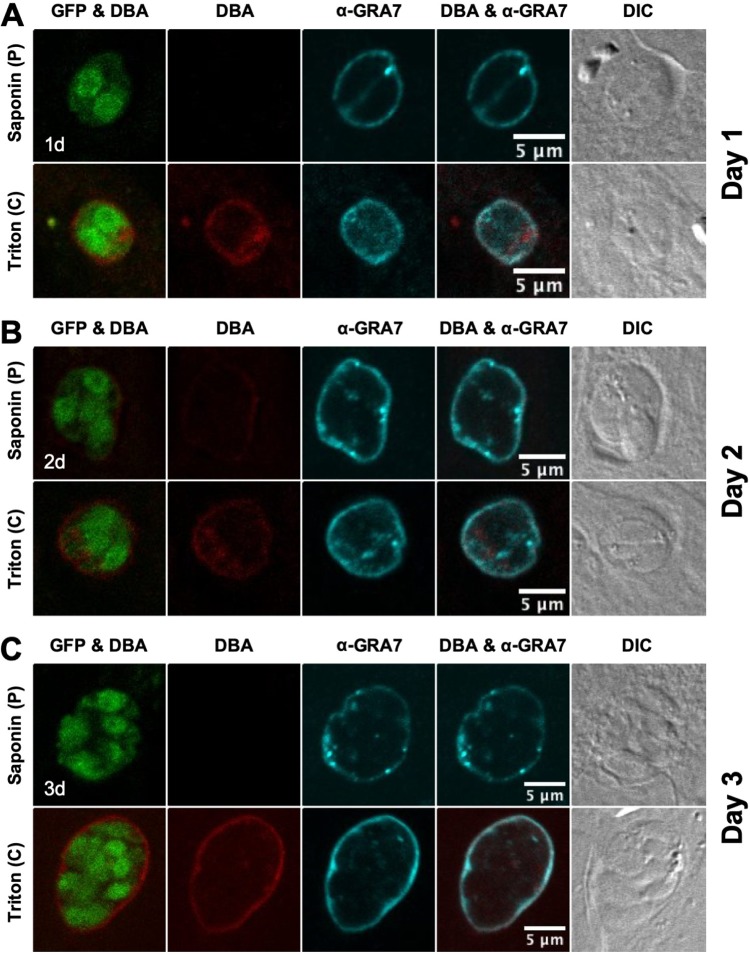
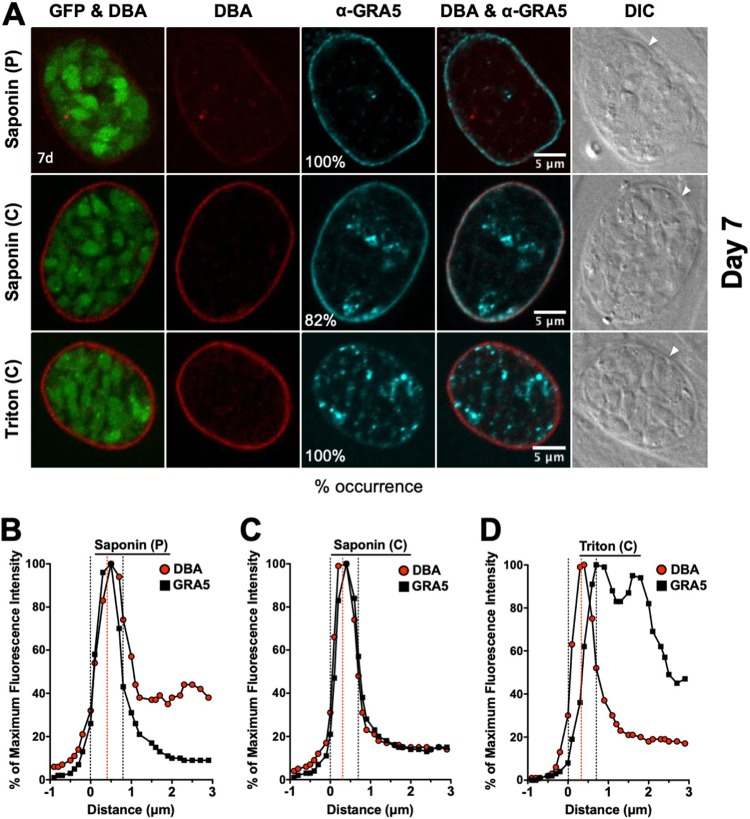
After differentiation is triggered, the tachyzoite-stage parasitophorous vacuole membrane (PVM) has been hypothesized to transition into the cyst membrane that surrounds the cyst wall and encloses bradyzoites. Here, we tracked the localization of two PVM dense granule (GRA) proteins (GRA5 and GRA7) after differentiation of the tachyzoite stage parasitophorous vacuole into the mature cyst. GRA5 and GRA7 were visible at the cyst periphery at 6 h and at all later times after differentiation, suggesting that the PVM remained intact as it transitioned into the cyst membrane. By day 3 postdifferentiation, GRA5 and GRA7 were visible in a continuous pattern at the cyst periphery. In mature 7- and 10-day-old cysts permeabilized with a saponin pulse, GRA5 and GRA7 were localized to the cyst membrane and the cyst wall regions. Cysts at different stages of cyst development exhibited differential susceptibility to saponin permeabilization, and, correspondingly, saponin selectively removed GRA5 from the cyst membrane and cyst wall region in 10-day-old cysts. GRA5 and GRA7 were localized at the cyst membrane and cyst wall region at all times after differentiation of the parasitophorous vacuole, which supports a previous model proposing that the PVM develops into the cyst membrane. In addition, evaluation of Δ, Δ, Δ, Δ, and Δ mutants revealed that PVM-localized GRAs were crucial to support the normal rate of accumulation of cyst wall proteins at the cyst periphery. establishes chronic infection in humans by forming thick-walled cysts that persist in the brain. Once host immunity wanes, cysts reactivate to cause severe, and often lethal, toxoplasmic encephalitis. There is no available therapy to eliminate cysts or to prevent their reactivation. Furthermore, how the cyst membrane and cyst wall structures develop is poorly understood. Here, we visualized and tracked the localization of parasitophorous vacuole membrane (PVM) dense granules (GRA) proteins during cyst development PVM-localized GRA5 and GRA7 were found at the cyst membrane and cyst wall region throughout cyst development, suggesting that the PVM remains intact and develops into the cyst membrane. In addition, our results show that genetic deletion of PVM GRAs reduced the rate of accumulation of cyst wall cargo at the cyst periphery and suggest that PVM-localized GRAs mediate the development and maturation of the cyst wall and cyst membrane.
在分化被触发后,速殖子阶段的滋养体空泡膜(PVM)被假设会转变为围绕囊壁并将缓殖子封闭在其中的囊膜。在这里,我们跟踪了两个 PVM 致密颗粒(GRA)蛋白(GRA5 和 GRA7)在速殖子阶段的滋养体空泡分化为成熟囊后在囊内的定位。GRA5 和 GRA7 在分化后 6 小时可见于囊的周边,并在随后的所有时间点都可见,这表明 PVM 在转变为囊膜时保持完整。在分化后第 3 天,GRA5 和 GRA7 在囊的周边呈现连续模式。在用皂素脉冲处理的成熟 7 天和 10 天龄的囊内,GRA5 和 GRA7 定位于囊膜和囊壁区域。处于不同囊发育阶段的囊对皂素渗透的敏感性不同,相应地,皂素选择性地从 10 天龄的囊的囊膜和囊壁区域中去除 GRA5。在滋养体空泡分化后的任何时间,GRA5 和 GRA7 都定位于囊膜和囊壁区域,这支持了先前提出的 PVM 发育成囊膜的模型。此外,对Δ、Δ、Δ、Δ和Δ突变体的评估表明,定位于 PVM 的 GRAs 对于支持囊壁蛋白在囊周边的正常积累速度至关重要。在人类中建立慢性感染,形成在大脑中持续存在的厚壁囊。一旦宿主免疫力下降,囊就会重新激活,导致严重且常常致命的弓形体脑炎。目前尚无消除囊或预防其重新激活的治疗方法。此外,囊膜和囊壁结构的发育方式知之甚少。在这里,我们在囊发育过程中可视化和跟踪了滋养体空泡膜(PVM)致密颗粒(GRA)蛋白的定位。在囊发育过程中,定位于 PVM 的 GRA5 和 GRA7 位于囊膜和囊壁区域,表明 PVM 保持完整并发育成囊膜。此外,我们的结果表明,PVM GRAs 的遗传缺失降低了囊周边囊壁货物的积累速度,并表明 PVM 定位于 GRAs 介导囊壁和囊膜的发育和成熟。