van Vuuren Rustelle Janse, Botes Mandie, Jurgens Tamarin, Joubert Anna Margaretha, van den Bout Iman
1Department of Physiology, University of Pretoria, Pretoria, 0084 South Africa.
2Centre for Neuroendocrinology, University of Pretoria, Pretoria, 0084 South Africa.
Cancer Cell Int. 2019 Jan 3;19:1. doi: 10.1186/s12935-018-0719-4. eCollection 2019.
The estrogen metabolite 2-methoxyestradiol (2ME2) and a number of synthesised derivatives have been shown to bind to microtubules thereby arresting cancer cells in mitosis which leads to apoptosis. In interphase cells, microtubules play an important role in the delivery of proteins to subcellular locations including the focal adhesions. In fact, focal adhesion dynamics and cell migration are in part regulated by microtubules. We hypothesised that novel 2ME2 derivatives can alter cell migration by influencing microtubule dynamics in interphase cells. In this report we describe 2ME2 derivatives that display anti-migratory capabilities in a metastatic breast cancer cell line through their effects on the microtubule network resulting in altered focal adhesion signalling and RhoA activity.
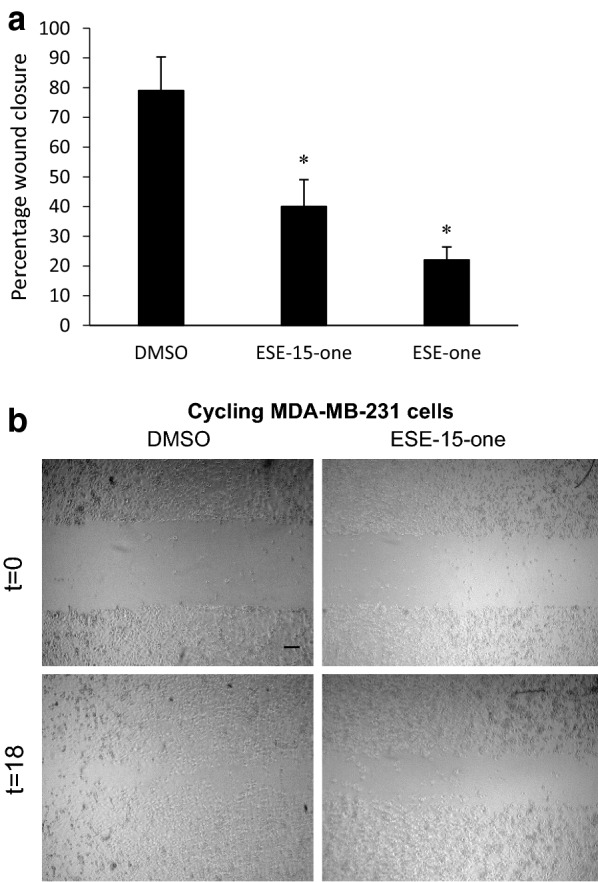
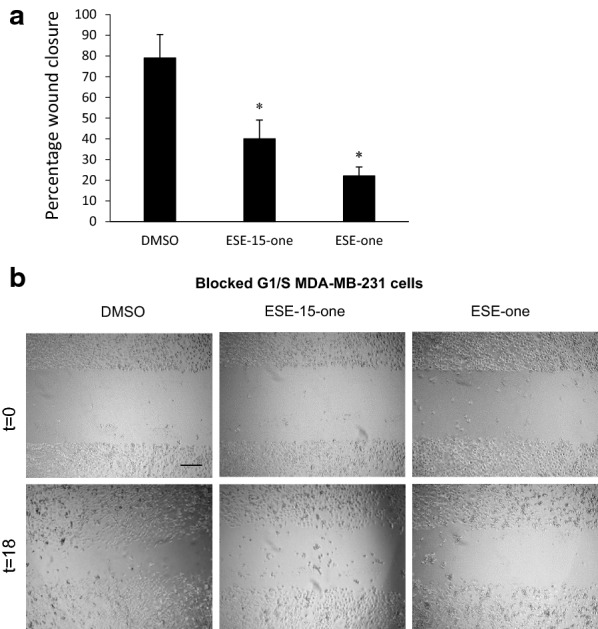
Cell migration was assayed using wound healing assays. To eliminate mitosis blockage and cell rounding as a confounding factor cell migration was also assessed in interphase blocked cells. Fluorescence confocal microscopy was used to visualise microtubule dynamics and actin cytoskeleton organisation while western blot analysis was performed to analyse focal adhesion signalling and RhoA activation.
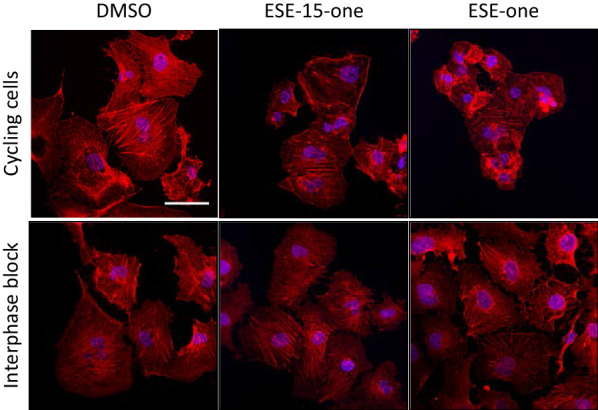
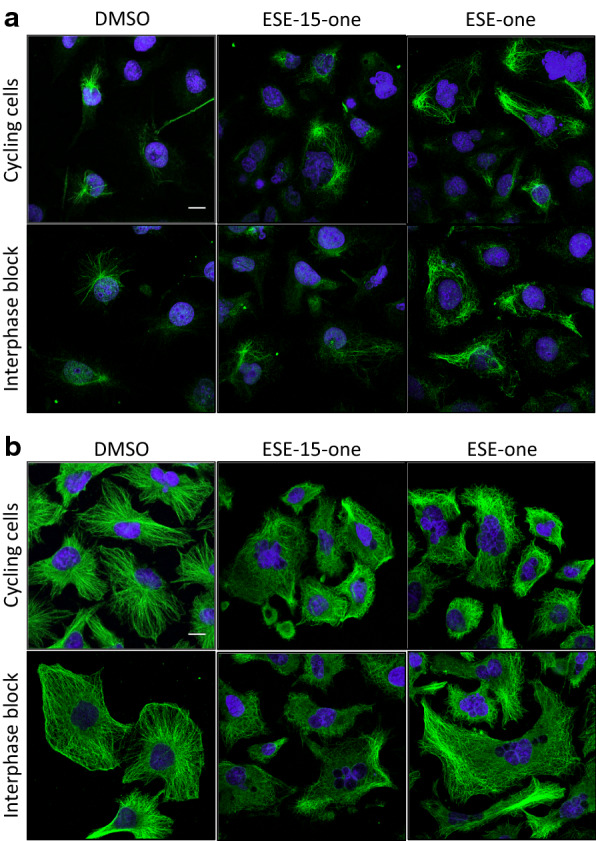
2ME2 derivatives, ESE-one and ESE-15-one, inhibited cell migration in cycling cells as expected but equally diminished migration in cells blocked in interphase. While no significant effects were observed on the actin cytoskeleton, focal adhesion kinase activity was increased while RhoA GTPase activity was inhibited after exposure to either compound. Microtubule stability was increased as evidenced by the increased length and number of detyrosinated microtubules while at the same time clear disorganisation of the normal radial microtubule organisation was observed including multiple foci.
ESE-15-one and ESE-one are potent migration inhibitors of metastatic breast cancer cells. This ability is coupled to alterations in focal adhesion signalling but more importantly is associated with severe disorganisation of microtubule dynamics and polarity. Therefore, these compounds may offer potential as anti-metastatic therapies.
雌激素代谢物2-甲氧基雌二醇(2ME2)以及一些合成衍生物已被证明可与微管结合,从而使癌细胞在有丝分裂中停滞,进而导致细胞凋亡。在间期细胞中,微管在将蛋白质输送到包括粘着斑在内的亚细胞位置中发挥着重要作用。事实上,粘着斑动态变化和细胞迁移部分受微管调控。我们推测新型2ME2衍生物可通过影响间期细胞中的微管动态变化来改变细胞迁移。在本报告中,我们描述了2ME2衍生物,它们通过对微管网络的作用,改变粘着斑信号传导和RhoA活性,从而在转移性乳腺癌细胞系中展现出抗迁移能力。
使用伤口愈合试验检测细胞迁移。为消除有丝分裂阻滞和细胞变圆这一混杂因素,还在间期阻滞的细胞中评估了细胞迁移。利用荧光共聚焦显微镜观察微管动态变化和肌动蛋白细胞骨架组织,同时进行蛋白质印迹分析以分析粘着斑信号传导和RhoA激活。
如预期的那样,2ME2衍生物ESE-one和ESE-15-one抑制了循环细胞中的细胞迁移,但同样减少了间期阻滞细胞中的迁移。虽然未观察到对肌动蛋白细胞骨架有显著影响,但暴露于任一化合物后,粘着斑激酶活性增加,而RhoA GTP酶活性受到抑制。去酪氨酸化微管的长度和数量增加,证明微管稳定性增强,同时观察到正常的放射状微管组织明显紊乱,包括多个焦点。
ESE-15-one和ESE-one是转移性乳腺癌细胞的有效迁移抑制剂。这种能力与粘着斑信号传导的改变有关,但更重要的是与微管动态变化和极性的严重紊乱有关。因此,这些化合物可能具有作为抗转移疗法的潜力。