Luyten Tine, Van de Heyning Paul, Jacquemin Laure, Van Looveren Nancy, Declau Frank, Fransen Erik, Gilles Annick
Faculty of Medicine and Health Sciences, Campus Drie Eiken, University of Antwerp, Antwerp, Belgium.
University Department of Otorhinolaryngology and Head and Neck Surgery, Antwerp University Hospital, Wilrijkstraat 10, 2650, Edegem, Belgium.
Trials. 2019 Jan 9;20(1):32. doi: 10.1186/s13063-018-3121-6.
Patients suffering from chronic, subjective tinnitus are on a quest to find a cure or any form of alleviation for their persistent complaint. Current recommended therapy forms provide psychotherapeutic interventions that are intended to train the patient how to deal with the tinnitus sound. Pharmaceutical managements are used to reduce secondary effects of the tinnitus sound such as sleep deprivation, emotional and concentration difficulties, but these treatments do not cure the tinnitus. Recent studies have shown that Tinnitus Retraining Therapy (TRT) significantly improves the quality of life for tinnitus patients. Furthermore, several studies have reported that cognitive behavioral therapy (CBT) relieves a substantial amount of distress by changing dysfunctional cognitions. However, when the tinnitus causes great interference with daily functioning, these treatment methods are not always sufficiently effective. Recent insights show that Eye Movement Desensitization Reprocessing (EMDR) is a highly effective therapy for medically unexplained symptoms such as chronic pain and phantom pain. In scientific research, tinnitus is compared to phantom limb pain. Starting from tinnitus as a phantom percept we therefore aim to demonstrate that the operating mechanisms of EMDR may also be an effective treatment method for patients with subjective tinnitus. The aim of this randomized controlled study with blind evaluator is to examine the effect of EMDR compared to CBT in chronic tinnitus patients. To our knowledge, there are no other studies that evaluate both methods simultaneously.
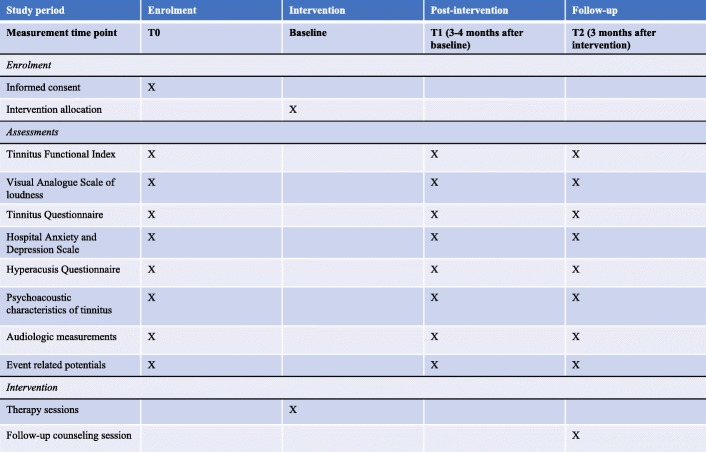
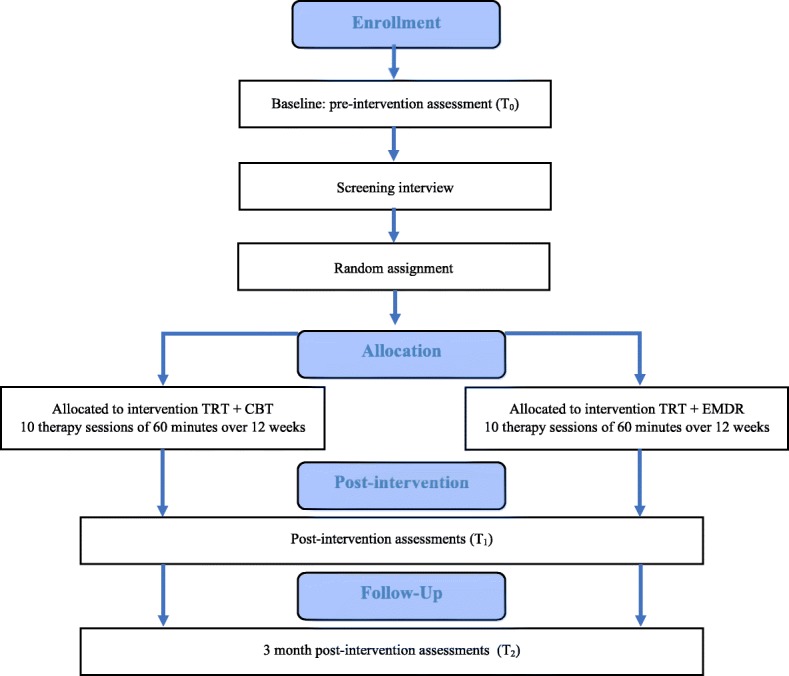
METHODS/DESIGN: A total of 166 patients with subjective, chronic, non-pulsatile tinnitus will be randomized in two treatment groups: TRT + CBT versus TRT + EMDR. The experimental group will receive the bimodal therapy TRT/EMDR and the active control group will receive the bimodal therapy TRT/CBT. Evaluations will take place at baseline before therapy, at the end of the treatment and 3 months after therapy. The score on the Tinnitus Functional Index (TFI) will be used as the primary outcome measurement. Secondary outcome measurements are the Visual Analogue Scale of Loudness (VAS), Tinnitus Questionnaire (TQ), Hospital Anxiety and Depression Scale (HADS), Hyperacusis Questionnaire (HQ), psychoacoustic measurements and event-related potentials (ERP).
The objective is to evaluate whether the bimodal therapy TRT and EMDR can provide faster and/or more relief from the annoyance experienced in chronic tinnitus patients' daily lives compared to the bimodal therapy TRT and CBT. So far there has been no prospective, randomized controlled, clinical trial with blind evaluator that compares CBT and EMDR as a treatment for tinnitus.
ClinicalTrials.gov, ID: NCT03114878 . April 14, 2017.
患有慢性主观性耳鸣的患者一直在寻求治愈方法或缓解其持续性症状的任何形式。目前推荐的治疗方式提供心理治疗干预,旨在训练患者如何应对耳鸣声。药物治疗用于减轻耳鸣声的继发性影响,如睡眠剥夺、情绪和注意力问题,但这些治疗并不能治愈耳鸣。最近的研究表明,耳鸣再训练疗法(TRT)能显著提高耳鸣患者的生活质量。此外,多项研究报告称,认知行为疗法(CBT)通过改变功能失调的认知来缓解大量痛苦。然而,当耳鸣对日常功能造成极大干扰时,这些治疗方法并不总是足够有效。最近的见解表明,眼动脱敏再处理疗法(EMDR)是治疗慢性疼痛和幻肢痛等医学上无法解释的症状的一种高效疗法。在科学研究中,耳鸣被比作幻肢痛。因此,从耳鸣作为一种幻听感知出发,我们旨在证明EMDR的作用机制也可能是治疗主观性耳鸣患者的一种有效方法。这项由盲法评估者参与的随机对照研究的目的是检验EMDR与CBT相比对慢性耳鸣患者的疗效。据我们所知,尚无其他研究同时评估这两种方法。
方法/设计:总共166例患有主观性、慢性、非搏动性耳鸣的患者将被随机分为两个治疗组:TRT+CBT组与TRT+EMDR组。实验组将接受TRT/EMDR双模式治疗,活性对照组将接受TRT/CBT双模式治疗。评估将在治疗前的基线、治疗结束时以及治疗后3个月进行。耳鸣功能指数(TFI)得分将用作主要结局指标。次要结局指标包括响度视觉模拟量表(VAS)、耳鸣问卷(TQ)、医院焦虑抑郁量表(HADS)、听觉过敏问卷(HQ)、心理声学测量和事件相关电位(ERP)。
目的是评估与TRT和CBT双模式治疗相比,TRT和EMDR双模式治疗是否能更快和/或更有效地减轻慢性耳鸣患者日常生活中所经历的烦恼。到目前为止,尚无一项由盲法评估者参与的前瞻性、随机对照临床试验来比较CBT和EMDR作为耳鸣治疗方法的效果。
ClinicalTrials.gov,标识符:NCT03114878。2017年4月14日。