From the Department of Neurology (V.F., W.D., K.W., R.A.-B., A.L.O., F.E.), Biostatistics Center, Department of Medicine (E.A.M.), and Department of Pathology (Neuropathology) (A.L.O.), Massachusetts General Hospital, Harvard Medical School, Boston; Clinical Chemistry (S.S., T.H.), University Hospital Zurich, Switzerland; and University of Massachusetts Medical School (P.N., D.M.-Y., R.B.), Worcester.
Neurology. 2019 Jan 22;92(4):e359-e370. doi: 10.1212/WNL.0000000000006811. Epub 2019 Jan 9.
To evaluate the safety and efficacy of l-serine in humans with hereditary sensory autonomic neuropathy type I (HSAN1).
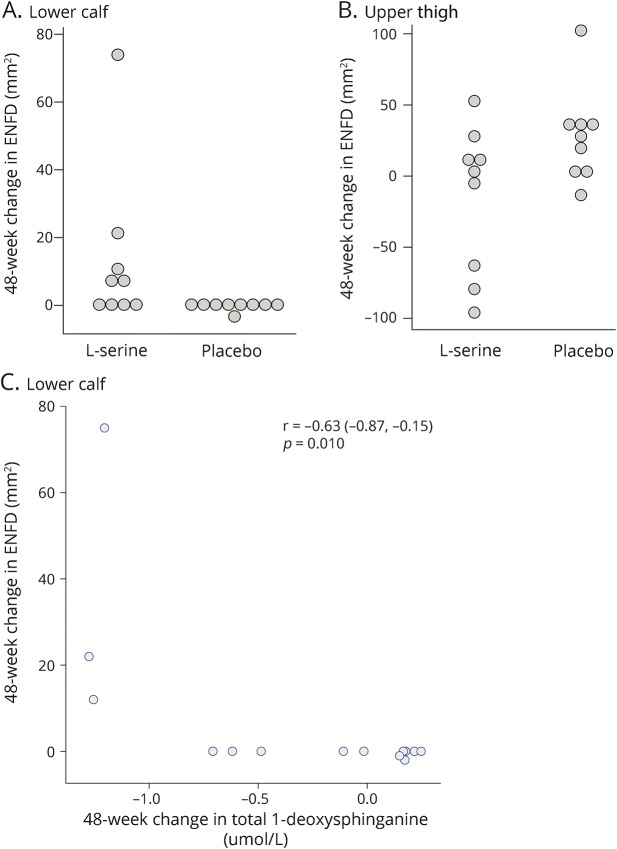
In this randomized, placebo-controlled, parallel-group trial with open-label extension, patients aged 18-70 years with symptomatic HSAN1 were randomized to l-serine (400 mg/kg/day) or placebo for 1 year. All participants received l-serine during the second year. The primary outcome measure was the Charcot-Marie-Tooth Neuropathy Score version 2 (CMTNS). Secondary outcomes included plasma sphingolipid levels, epidermal nerve fiber density, electrophysiologic measurements, patient-reported measures, and adverse events.
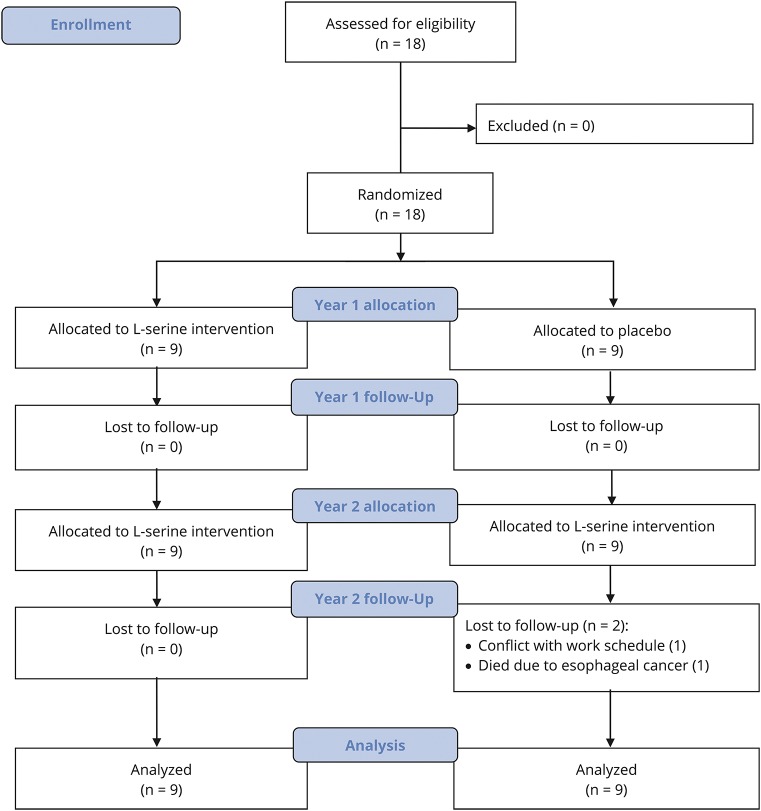
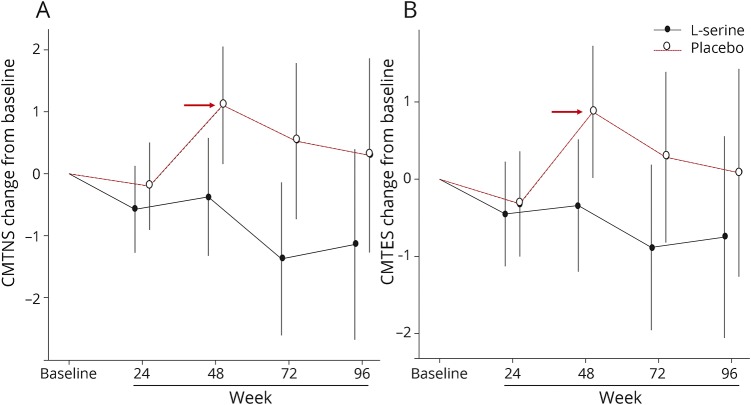
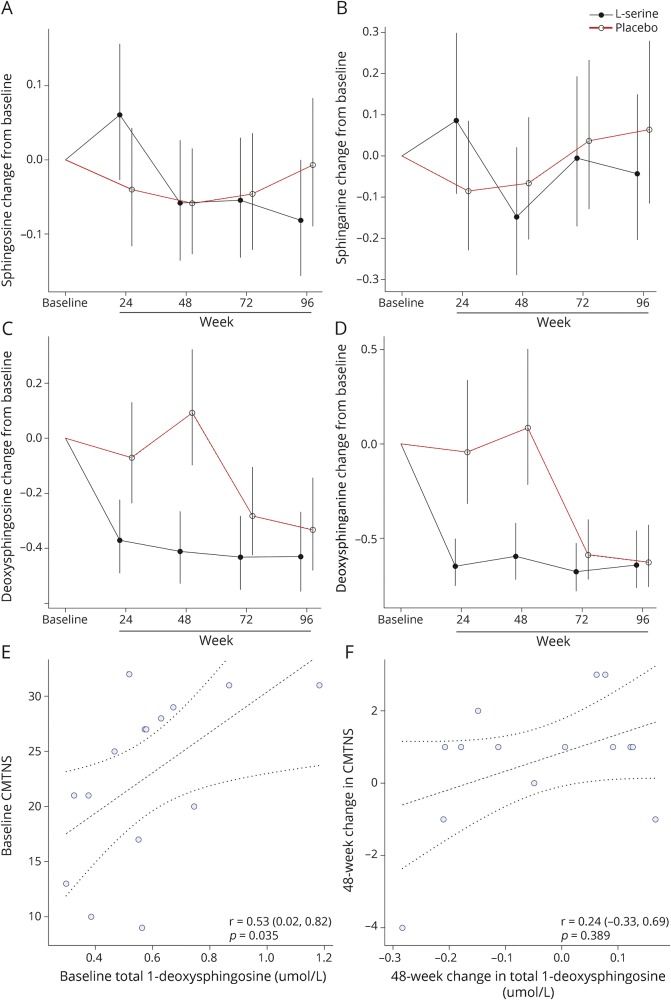
Between August 2013 and April 2014, we enrolled and randomized 18 participants, 16 of whom completed the study. After 1 year, the l-serine group experienced improvement in CMTNS relative to the placebo group (-1.5 units, 95% CI -2.8 to -0.1, = 0.03), with evidence of continued improvement in the second year of treatment (-0.77, 95% CI -1.67 to 0.13, = 0.09). Concomitantly, deoxysphinganine levels dropped in l-serine-treated but not placebo-treated participants (59% decrease vs 11% increase; < 0.001). There were no serious adverse effects related to l-serine.
High-dose oral l-serine supplementation appears safe in patients with HSAN1 and is potentially effective at slowing disease progression.
NCT01733407.
This study provides Class I evidence that high-dose oral l-serine supplementation significantly slows disease progression in patients with HSAN1.
评估 l-丝氨酸在遗传性感觉自主神经病 I 型(HSAN1)患者中的安全性和疗效。
这是一项随机、安慰剂对照、平行组试验,伴有开放标签扩展,纳入年龄在 18-70 岁、有症状的 HSAN1 患者,将其随机分为 l-丝氨酸(400mg/kg/天)或安慰剂组,治疗 1 年。所有参与者在第二年都接受 l-丝氨酸治疗。主要结局指标为 Charcot-Marie-Tooth 神经病评分 2 版(CMTNS)。次要结局包括血浆神经酰胺水平、表皮神经纤维密度、电生理测量、患者报告的测量和不良事件。
2013 年 8 月至 2014 年 4 月,我们纳入并随机分配了 18 名参与者,其中 16 名完成了研究。1 年后,与安慰剂组相比,l-丝氨酸组 CMTNS 评分改善(-1.5 分,95%CI-2.8 至-0.1, = 0.03),在第二年的治疗中,仍有改善趋势(-0.77,95%CI-1.67 至 0.13, = 0.09)。同时,l-丝氨酸治疗组的去氧神经酰胺水平下降,而安慰剂组则上升(59%下降,11%上升;<0.001)。与 l-丝氨酸相关的无严重不良事件。
高剂量口服 l-丝氨酸补充剂在 HSAN1 患者中似乎安全,并有潜在的减缓疾病进展的作用。
临床试验.gov 标识符:NCT01733407。
本研究提供了 I 级证据,表明高剂量口服 l-丝氨酸补充剂可显著减缓 HSAN1 患者的疾病进展。