Department of Anatomy and Cell Biology, Nagoya University Graduate School of Medicine, Nagoya 466-8550, Japan.
eNeuro. 2018 Nov 29;5(6). doi: 10.1523/ENEURO.0312-18.2018. eCollection 2018 Nov-Dec.
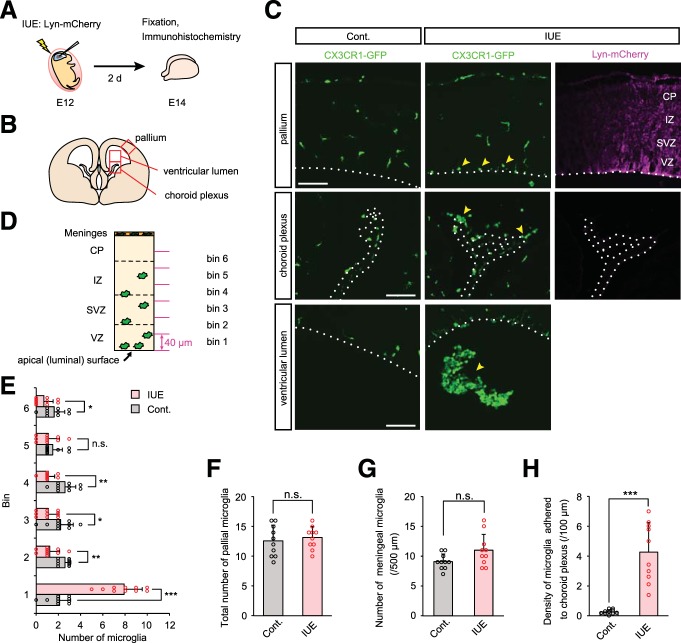
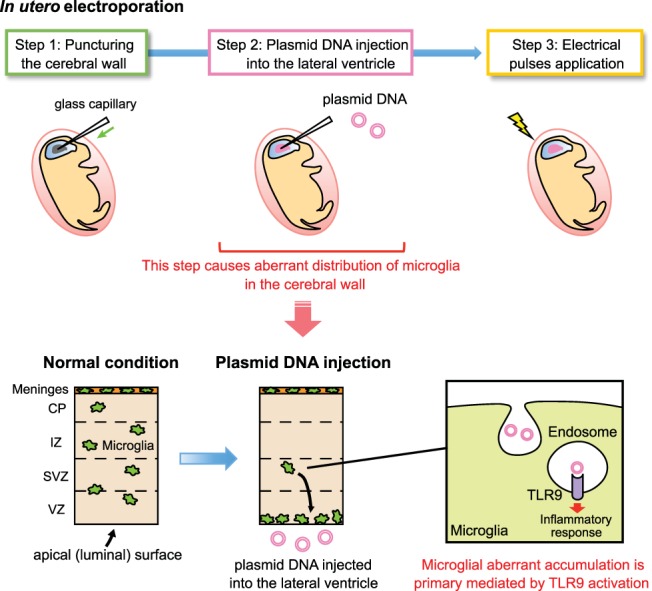
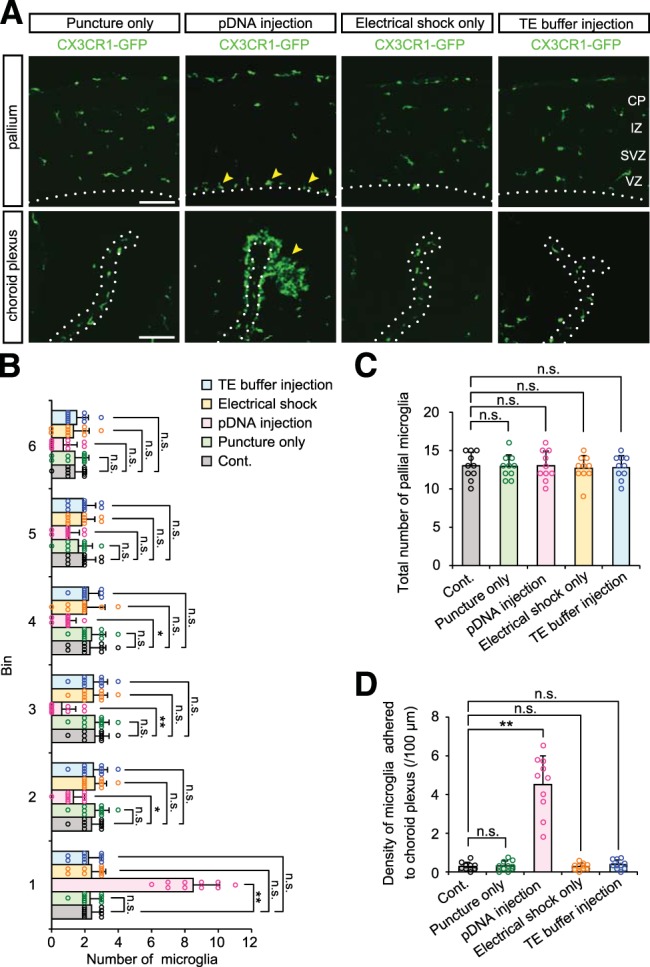
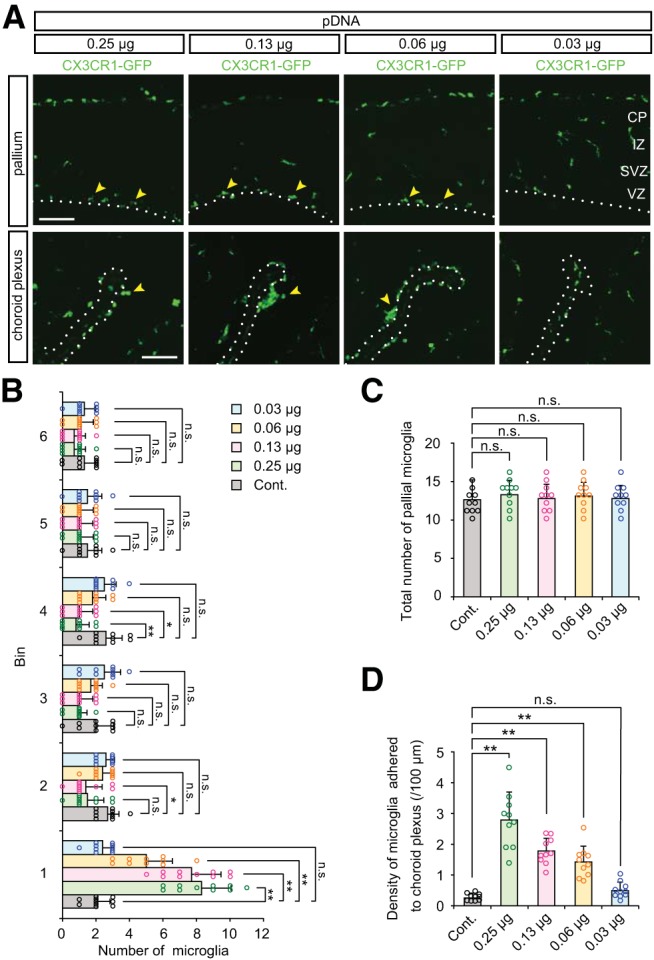
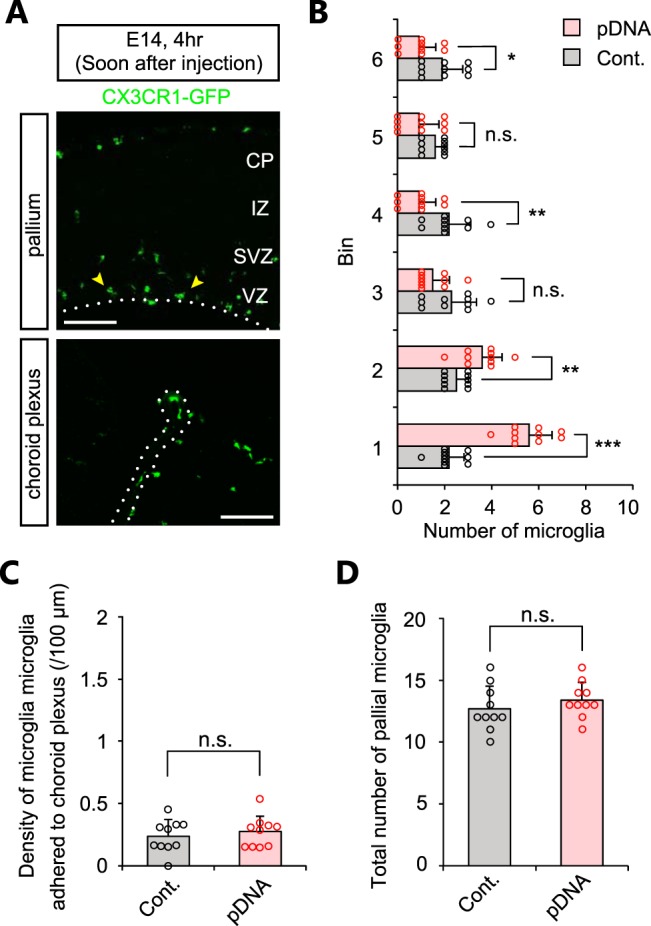
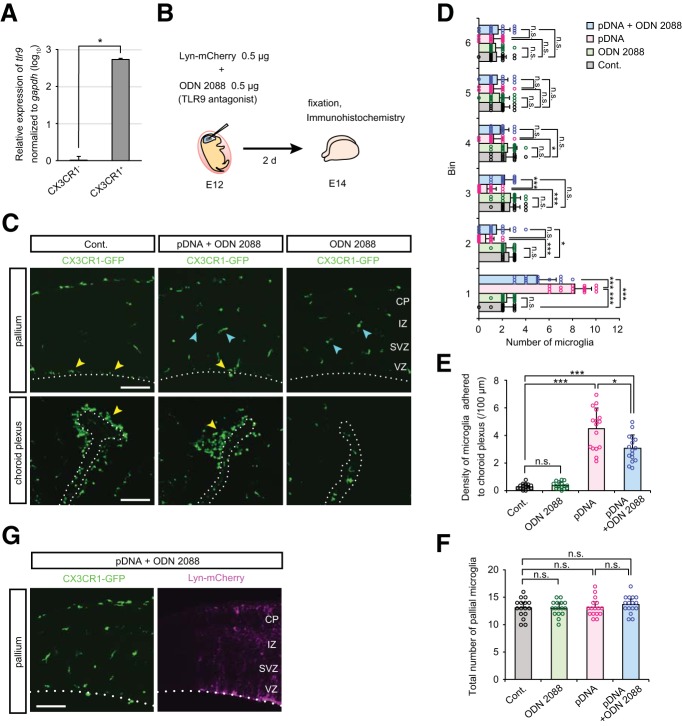
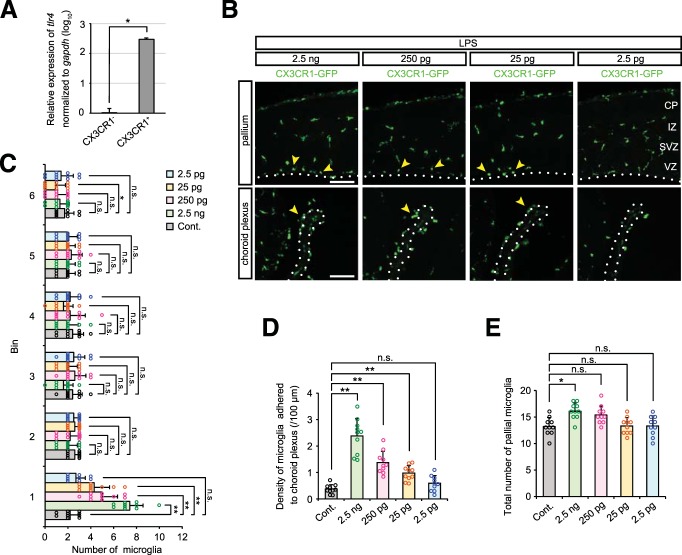
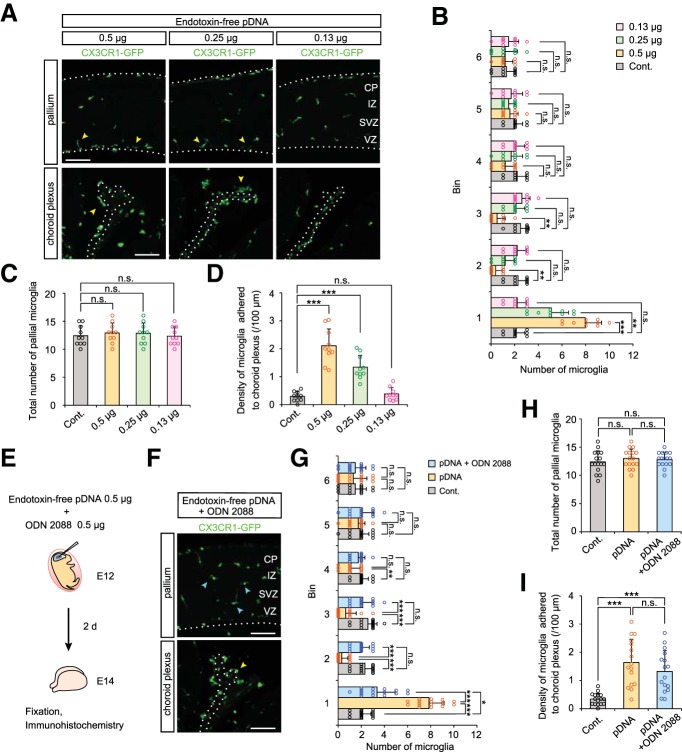
Microglia, the resident immune cells in the CNS, play multiple roles during development. In the embryonic cerebral wall, microglia modulate the functions of neural stem/progenitor cells through their distribution in regions undergoing cell proliferation and/or differentiation. Previous studies using CX3CR1-GFP transgenic mice demonstrated that microglia extensively survey these regions. To simultaneously visualize microglia and neural-lineage cells that interact with each other, we applied the electroporation (IUE) technique, which has been widely used for gene-transfer in neurodevelopmental studies, to CX3CR1-GFP mice (males and females). However, we unexpectedly faced a technical problem: although microglia are normally distributed homogeneously throughout the mid-embryonic cortical wall with only limited luminal entry, the intraventricular presence of exogenously derived plasmid DNAs induced microglia to accumulate along the apical surface of the cortex and aggregate in the choroid plexus. This effect was independent of capillary needle puncture of the brain wall or application of electrical pulses. The microglial response occurred at plasmid DNA concentrations lower than those routinely used for IUE, and was mediated by activation of Toll-like receptor 9 (TLR9), an innate immune sensor that recognizes unmethylated cytosine-phosphate guanosine motifs abundant in microbial DNA. Administration of plasmid DNA together with oligonucleotide 2088, the antagonist of TLR9, partially restored the dispersed intramural localization of microglia and significantly decreased luminal accumulation of these cells. Thus, via TLR9, intraventricular plasmid DNA administration causes aberrant distribution of embryonic microglia, suggesting that the behavior of microglia in brain primordia subjected to IUE should be carefully interpreted.
小胶质细胞是中枢神经系统中的固有免疫细胞,在发育过程中发挥多种作用。在胚胎大脑皮层中,小胶质细胞通过在经历细胞增殖和/或分化的区域中分布来调节神经干细胞/祖细胞的功能。使用 CX3CR1-GFP 转基因小鼠的先前研究表明,小胶质细胞广泛地对这些区域进行了探测。为了同时可视化与彼此相互作用的小胶质细胞和神经谱系细胞,我们应用了电穿孔(IUE)技术,该技术已广泛用于神经发育研究中的基因转移。然而,我们出人意料地面临了一个技术问题:尽管小胶质细胞通常均匀分布于整个中胚层皮层壁中,只有有限的管腔进入,但外源性来源的质粒 DNA 的脑室存在诱导小胶质细胞沿着皮层的顶表面聚集并在脉络丛中聚集。这种效应与脑壁的毛细血管针穿刺或电脉冲的应用无关。小胶质细胞的反应发生在低于通常用于 IUE 的质粒 DNA 浓度下,并且由 Toll 样受体 9(TLR9)的激活介导,TLR9 是一种先天免疫传感器,可识别微生物 DNA 中丰富的未甲基化胞嘧啶-磷酸鸟嘌呤基序。与 TLR9 的拮抗剂寡核苷酸 2088 一起施用质粒 DNA,部分恢复了小胶质细胞的分散性壁内定位,并显著减少了这些细胞的管腔积累。因此,通过 TLR9,脑室中质粒 DNA 的给药导致胚胎小胶质细胞的异常分布,表明应仔细解释接受 IUE 的脑原基中小胶质细胞的行为。