Department of Neurosurgery, Affiliated Huaian No. 1 People's Hospital of Nanjing Medical University, Huai'an, Jiangsu 223300, P.R. China.
Mol Med Rep. 2019 Mar;19(3):1613-1621. doi: 10.3892/mmr.2019.9801. Epub 2019 Jan 2.
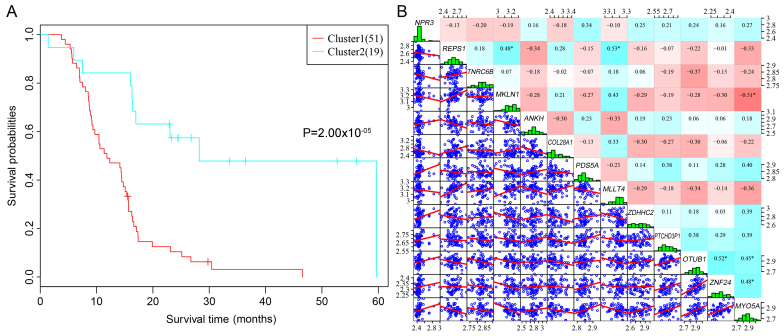
Glioblastoma multiforme (GBM) is the most common type of brain cancer; it usually recurs and patients have a short survival time. The present study aimed to construct a gene expression classifier and to screen key genes associated with GBM prognosis. GSE7696 microarray data set included samples from 10 recurrent GBM tissues, 70 primary GBM tissues and 4 normal brain tissues. Seed genes were identified by the 'survival' package in R and subjected to pathway enrichment analysis. Prognostic genes were selected from the seed genes using the 'rbsurv' package in R, unsupervised hierarchical clustering, survival analysis and enrichment analysis. Multivariate survival analysis was performed for the prognostic genes, and the GBM data set from The Cancer Genome Atlas database was utilized to validate the prognostic genes. Of the 1,785 seed genes analyzed, 13 prognostic feature genes, including collagen type XXVIII α1 chain (COL28A1), PDS5 cohesin‑associated factor A (PDS5A), zinc‑finger DHHC‑type containing 2 (ZDHHC2), zinc‑finger protein 24 (ZNF24), myosin VA (MYO5A) and myeloid/lymphoid or mixed‑lineage leukemia translocated to 4 (MLLT4), were identified. These genes performed well on sample classification and prognostic risk differentiation, and six pathways, including adherens junction, cyclic adenosine 3',5'‑monophosphate signaling and Ras signaling pathways, were enriched for these feature genes. The high‑risk group was slightly older compared with the low‑risk group. The validation data set confirmed the prognostic value of the 13 feature genes for GBM; of these, COL28A1, PDS5A, ZDHHC2, ZNF24, MYO5A and MLLT4 may be crucial. These results may aid the understanding of the pathogenesis of GBM and provide important clues for the development of novel diagnostic markers or therapeutic targets.
胶质母细胞瘤(GBM)是最常见的脑癌类型;它通常会复发,患者的生存时间很短。本研究旨在构建一个基因表达分类器,并筛选与 GBM 预后相关的关键基因。R 中的“survival”包确定了种子基因,并对其进行了通路富集分析。R 中的“rbsurv”包用于从种子基因中选择预后基因,进行无监督层次聚类、生存分析和富集分析。对预后基因进行多变量生存分析,并利用癌症基因组图谱数据库中的 GBM 数据集对预后基因进行验证。在分析的 1785 个种子基因中,确定了 13 个预后特征基因,包括胶原 XXVIII 亚基α1 链(COL28A1)、PDS5 着丝粒相关因子 A(PDS5A)、锌指 DHHC 型包含蛋白 2(ZDHHC2)、锌指蛋白 24(ZNF24)、肌球蛋白 VA(MYO5A)和髓系/淋巴或混合谱系白血病易位蛋白 4(MLLT4)。这些基因在样本分类和预后风险分层方面表现良好,富集到的 6 个通路包括黏着斑、环磷酸腺苷 3',5'-单磷酸信号和 Ras 信号通路。高风险组的年龄略大于低风险组。验证数据集证实了这 13 个特征基因对 GBM 的预后价值;其中,COL28A1、PDS5A、ZDHHC2、ZNF24、MYO5A 和 MLLT4 可能是关键基因。这些结果可能有助于理解 GBM 的发病机制,并为开发新的诊断标志物或治疗靶点提供重要线索。