Na Jinhyuk, Choi Soo An, Khan Adnan, Huh Joo Young, Piao Lingjuan, Hwang Inah, Ha Hunjoo, Park Youngja H
College of Pharmacy, Korea University, Sejong 30019, Republic of Korea
College of Pharmacy, Chonnam National University, Gwangju 61186, Republic of Korea
Biomol Ther (Seoul). 2019 Mar 1;27(2):134-144. doi: 10.4062/biomolther.2018.175.
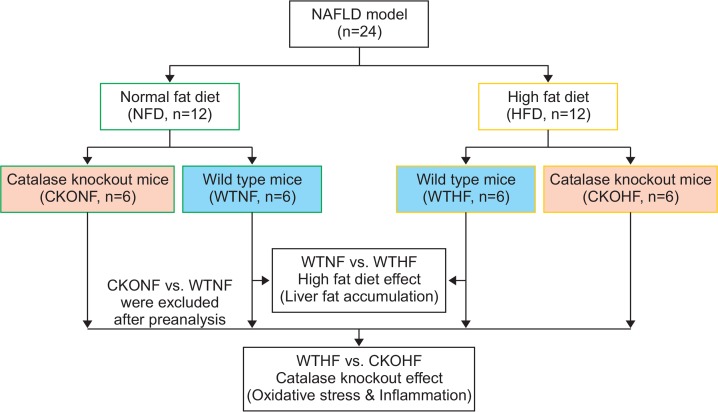
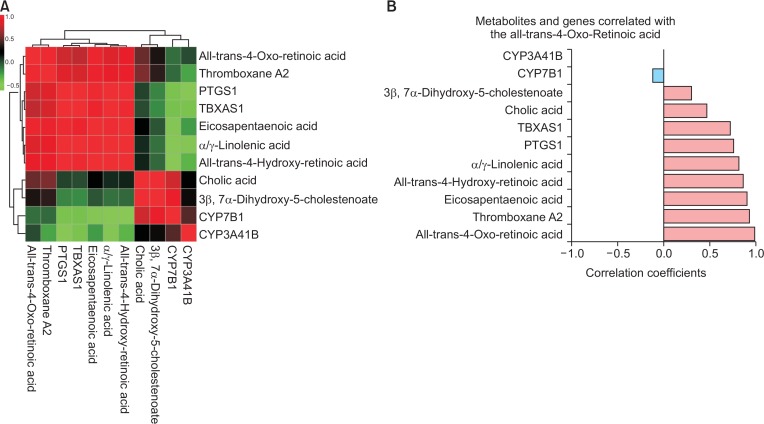
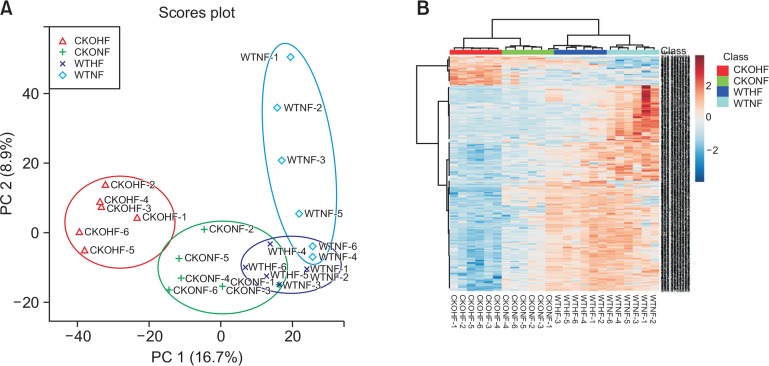
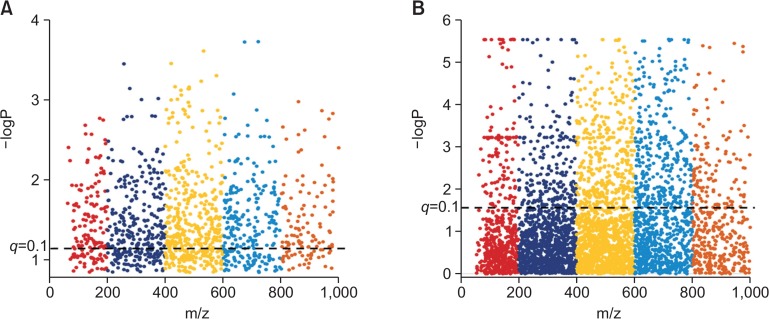
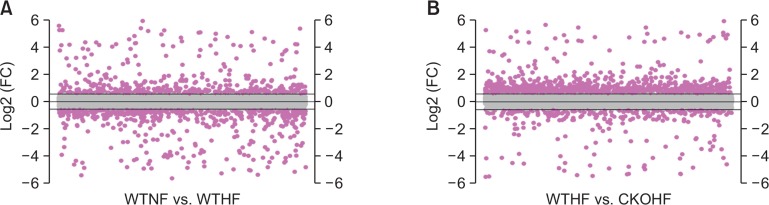
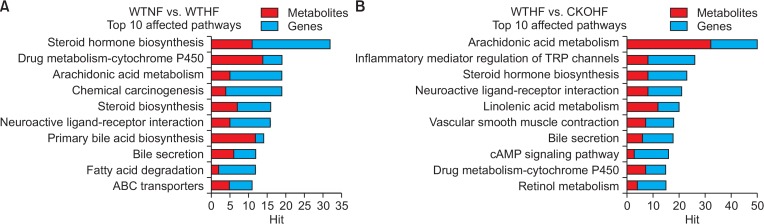
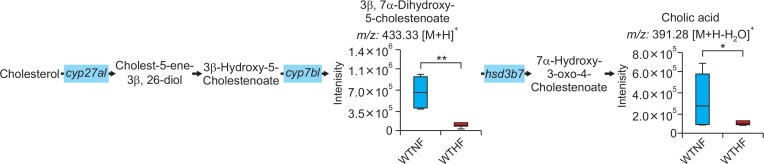
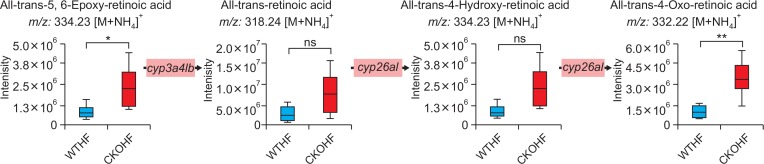
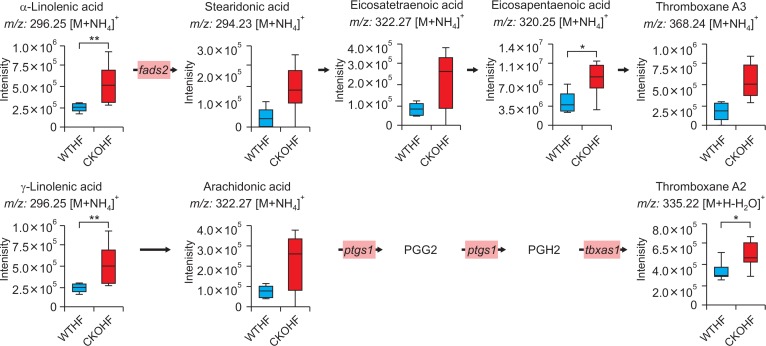
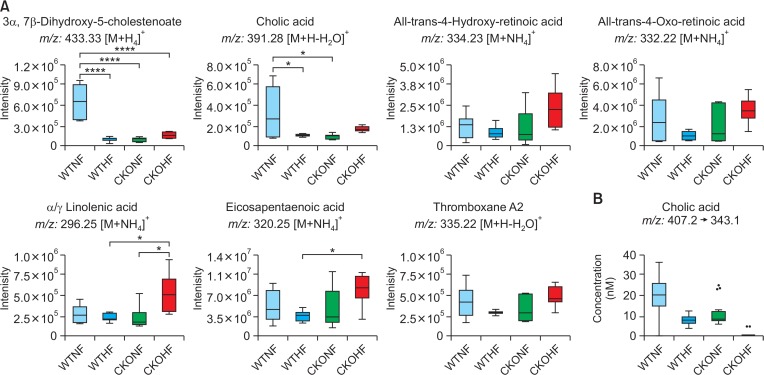
The prevalence of nonalcoholic fatty liver disease (NAFLD) has increased with the incidence of obesity; however, the underlying mechanisms are unknown. In this study, high-resolution metabolomics (HRM) along with transcriptomics were applied on animal models to draw a mechanistic insight of NAFLD. Wild type (WT) and catalase knockout (CKO) mice were fed with normal fat diet (NFD) or high fat diet (HFD) to identify the changes in metabolic and transcriptomic profiles caused by catalase gene deletion in correspondence with HFD. Integrated omics analysis revealed that cholic acid and 3β, 7α-dihydroxy-5-cholestenoate along with cyp7b1 gene involved in primary bile acid biosynthesis were strongly affected by HFD. The analysis also showed that CKO significantly changed all-trans-5,6-epoxy-retinoic acid or all-trans-4-hydroxy-retinoic acid and all-trans-4-oxo-retinoic acid along with cyp3a41b gene in retinol metabolism, and α/γ-linolenic acid, eicosapentaenoic acid and thromboxane A2 along with ptgs1 and tbxas1 genes in linolenic acid metabolism. Our results suggest that dysregulated primary bile acid biosynthesis may contribute to liver steatohepatitis, while up-regulated retinol metabolism and linolenic acid metabolism may have contributed to oxidative stress and inflammatory phenomena in our NAFLD model created using CKO mice fed with HFD.
非酒精性脂肪性肝病(NAFLD)的患病率随肥胖发生率的增加而上升;然而,其潜在机制尚不清楚。在本研究中,高分辨率代谢组学(HRM)以及转录组学被应用于动物模型,以深入了解NAFLD的机制。给野生型(WT)和过氧化氢酶基因敲除(CKO)小鼠喂食正常脂肪饮食(NFD)或高脂肪饮食(HFD),以确定过氧化氢酶基因缺失与HFD相关联所引起的代谢和转录组学变化。综合组学分析表明,参与初级胆汁酸生物合成的胆酸、3β,7α-二羟基-5-胆甾烯酸以及cyp7b1基因受到HFD的强烈影响。分析还表明,CKO显著改变了视黄醇代谢中的全反式-5,6-环氧视黄酸或全反式-4-羟基视黄酸和全反式-4-氧代视黄酸以及cyp3a41b基因,以及亚麻酸代谢中的α/γ-亚麻酸、二十碳五烯酸和血栓素A2以及ptgs1和tbxas1基因。我们的结果表明,初级胆汁酸生物合成失调可能导致肝脏脂肪性肝炎,而视黄醇代谢和亚麻酸代谢上调可能导致了我们使用喂食HFD的CKO小鼠建立的NAFLD模型中的氧化应激和炎症现象。