Kim Yang-Hyun, Kim Seon Mee, Han Kyung-Do, Jung Jin-Hyung, Lee Seong-Su, Oh Sang Woo, Park Hye Soon, Rhee Eun-Jung, Lee Won-Young, Yoo Soon Jib
Department of Family Medicine, Korea University College of Medicine, Seoul 02841, Korea.
Department of Medical Statistics, Catholic University College of Medicine, Seoul 06591, Korea.
J Clin Med. 2019 Jan 10;8(1):72. doi: 10.3390/jcm8010072.
Waist circumference (WC) is an index of abdominal obesity and associated with co-morbidities and mortality. Higher WC is positively associated with increased mortality; therefore, we examined the relationship between WC and mortality in Korean populations with the interaction of body mass index (BMI) and WC for mortality.
A total of 23,263,878 subjects (men = 11,813,850 and women = 11,450,028) who were older than 20 years and underwent the National Health Insurance Service health checkup were included. WC was divided into six categories by 5 cm increments and level 3 (85⁻90 cm in men and 80⁻85 cm in women) was referenced. Multivariable Cox proportional hazard models were used to obtain the hazard ratios (HRs) and 95% confidence intervals for all-cause mortality according to the six levels of WC.
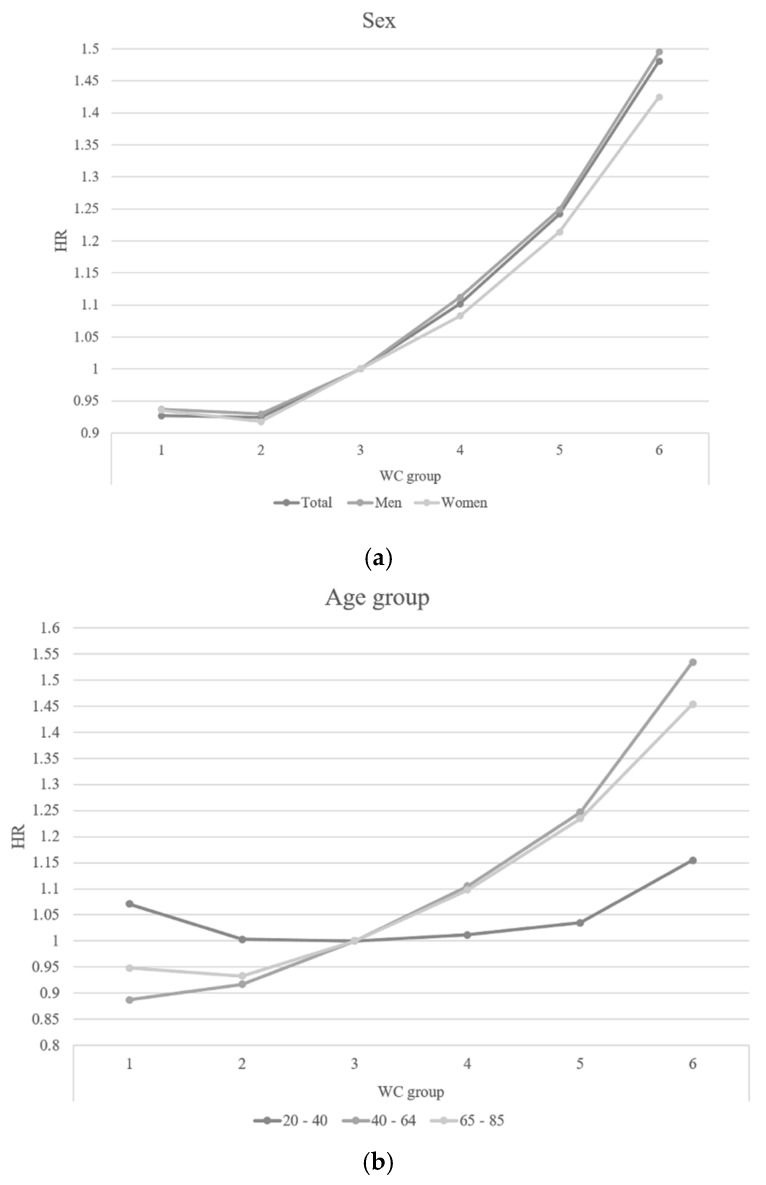
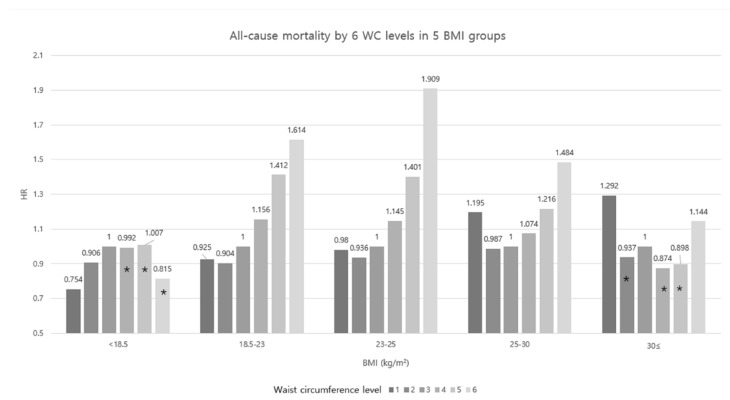
WC in 5 cm increments showed a positively increased all-cause mortality after adjusting for all covariates including BMI. Men showed higher HRs for mortality than women as WC increased, and the HRs were higher in the lower WC levels, but lower in the higher WC levels among the subjects aged 65⁻85 years than subjects aged 40⁻65 years. Even in subjects with normal weight and overweight, increased WC (levels 4, 5, and 6) showed increased HRs for mortality (HRs = 1.156, 1.412, and 1.614 in normal BMI and 1.145, 1.401, and 1.909 in overweight, respectively).
There was a linear association between WC and all-cause mortality across all BMI categories even in the subjects with normal or overweight BMI. Physicians should check WC routinely even in the subjects with normal weight or overweight.
腰围(WC)是腹部肥胖的一个指标,与合并症及死亡率相关。较高的腰围与死亡率增加呈正相关;因此,我们研究了韩国人群中腰围与死亡率之间的关系,并探讨了体重指数(BMI)和腰围对死亡率的交互作用。
纳入了23263878名年龄在20岁以上且接受了国民健康保险服务健康检查的受试者(男性 = 11813850名,女性 = 11450028名)。腰围按5厘米增量分为六类,并以第3级(男性85至90厘米,女性80至85厘米)作为参照。使用多变量Cox比例风险模型,根据腰围的六个水平获得全因死亡率的风险比(HRs)和95%置信区间。
在调整了包括BMI在内的所有协变量后,腰围每增加5厘米,全因死亡率呈正向增加。随着腰围增加,男性的死亡率HRs高于女性,且在65至85岁的受试者中,较低腰围水平的HRs较高,但在较高腰围水平时低于40至65岁的受试者。即使在体重正常和超重的受试者中,腰围增加(第4、5和6级)也显示出死亡率的HRs增加(正常BMI时的HRs分别为1.156、1.412和1.614,超重时分别为1.145、1.401和1.909)。
即使在BMI正常或超重的受试者中,所有BMI类别中腰围与全因死亡率之间均存在线性关联。医生即使在体重正常或超重的受试者中也应常规检查腰围。