Wells Ruth, Lawsin Catalina, Hunt Caroline, Said Youssef Omar, Abujado Fayzeh, Steel Zachary
Clinical Psychology Unit, School of Psychology, University of Sydney, Sydney, Australia.
Trauma and Mental Health Unity, School of Psychiatry, University of New South Wales, Sydney, Australia.
Glob Ment Health (Camb). 2018 Dec 20;5:e42. doi: 10.1017/gmh.2018.30. eCollection 2018.
There is a need for ecological approaches to guide global mental health programmes that can appropriately address the personal, family, social and cultural needs of displaced populations. A transactional ecological model of adaptation to displacement was developed and applied to the case of Syrian refugees living in Jordan.
Syrian and Jordanian psychosocial workers ( = 29) supporting the Syrian refugee community in Jordan were interviewed in three waves (2013-2016). A grounded-theory approach was used to develop a model of key local concepts of distress. Emergent themes were compared with the ecological model, including the five ADAPT pillars identified by Silove (2013).
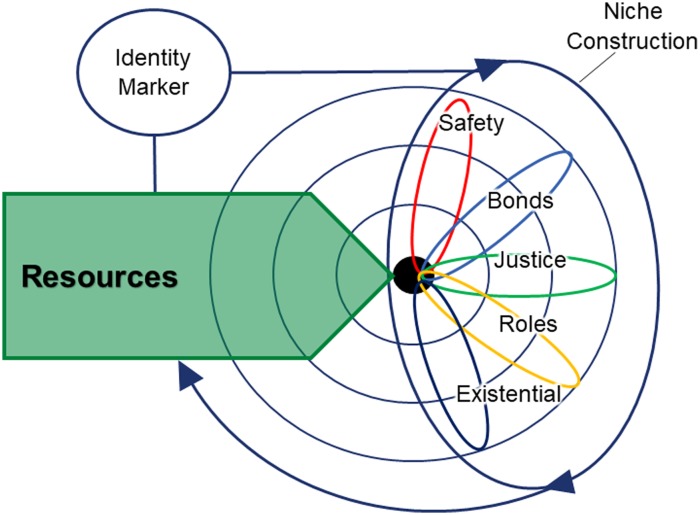
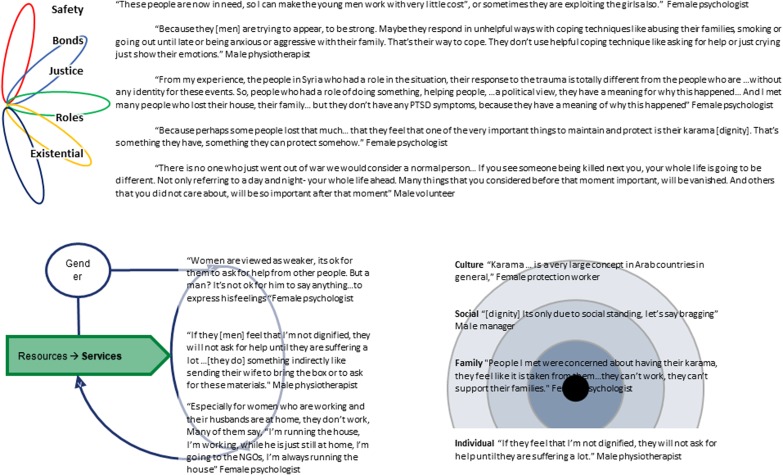
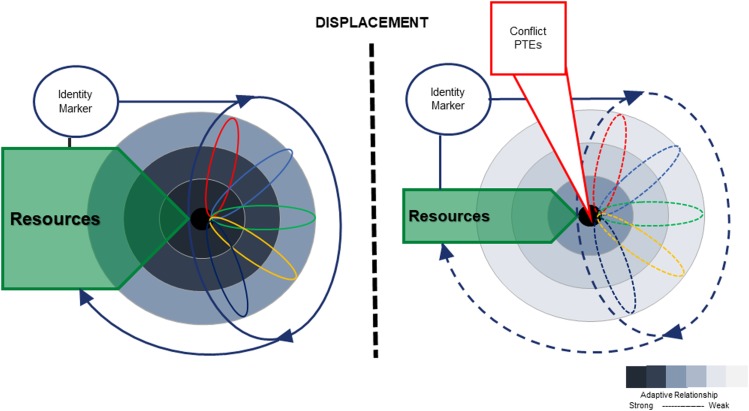
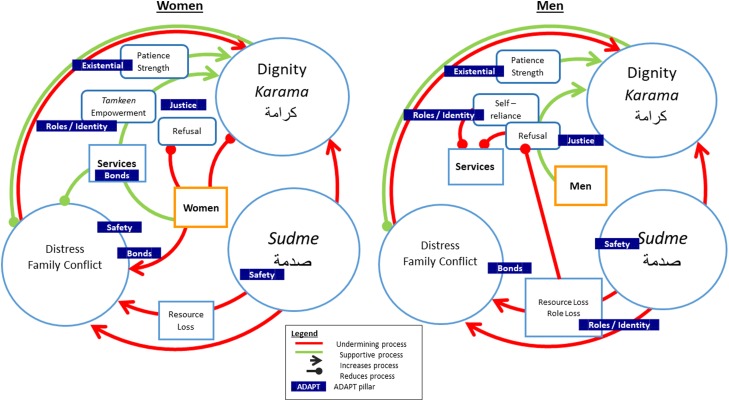
The application of the ecological concept of niche construction demonstrated how the adaptive functions of a culturally significant concept of dignity () are moderated by gender and displacement. This transactional concept brought to light the adaptive capacities of many Syrian women while highlighting the ways that stigma may restrict culturally sanctioned opportunities for others, in particular men. By examining responses to potentially traumatic events at the levels of individual, family/peers, society and culture, adaptive responses to environmental change can be included in the formulation of distress. The five ADAPT pillars showed congruence with the psychosocial needs reported in the community.
The transactional concepts in this model can help clinicians working with displaced people to consider and formulate a broader range of causal factors than is commonly included in individualistic therapy approaches. Researchers may use this model to develop testable hypotheses.
需要采用生态方法来指导全球心理健康项目,以妥善满足流离失所人群的个人、家庭、社会和文化需求。我们开发了一种适应流离失所的交互生态模型,并将其应用于生活在约旦的叙利亚难民案例。
对在约旦为叙利亚难民社区提供支持的叙利亚和约旦心理社会工作者(n = 29)进行了三轮访谈(2013 - 2016年)。采用扎根理论方法来构建一个关于痛苦的关键本土概念模型。将浮现出的主题与生态模型进行比较,包括西洛夫(2013年)确定的五个适应支柱。
生态位构建这一生态概念的应用表明,具有文化重要性的尊严概念的适应功能如何受到性别和流离失所的调节。这个交互概念揭示了许多叙利亚女性的适应能力,同时突出了耻辱感可能限制其他人(尤其是男性)获得文化认可机会的方式。通过在个人、家庭/同伴、社会和文化层面考察对潜在创伤性事件的反应,可以将对环境变化的适应性反应纳入痛苦的表述中。五个适应支柱与社区报告的心理社会需求相符。
该模型中的交互概念可以帮助为难民提供服务的临床医生考虑并制定比个人主义治疗方法中通常包含的更广泛的因果因素。研究人员可以使用这个模型来提出可检验的假设。