Riddle Misty, Martineau Brian, Peavey Megan, Tabin Clifford
Harvard Medical School.
Harvard Medical School;
J Vis Exp. 2018 Dec 28(142). doi: 10.3791/58972.
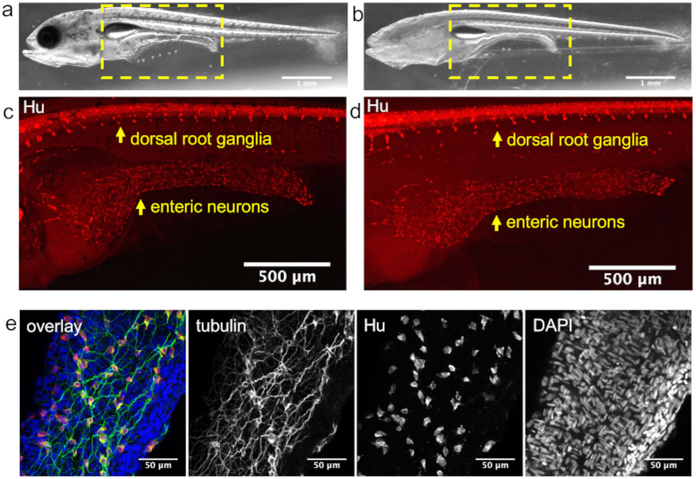
River and cave-adapted populations of Astyanax mexicanus show differences in morphology, physiology, and behavior. Research focused on comparing adult forms has revealed the genetic basis of some of these differences. Less is known about how the populations differ at post-larval stages (at the onset of feeding). Such studies may provide insight into how cavefish survive through adulthood in their natural environment. Methods for comparing post-larval development in the laboratory require standardized aquaculture and feeding regimes. Here we describe how to raise fish on a diet of nutrient-rich rotifers in non-recirculating water for up to two-weeks post fertilization. We demonstrate how to collect post-larval fish from this nursery system and perform whole-mount immunostaining. Immunostaining is an attractive alternative to transgene expression analysis for investigating development and gene function in A. mexicanus. The nursery method can also be used as a standard protocol for establishing density-matched populations for growth into adults.
墨西哥丽脂鲤适应河流和洞穴环境的种群在形态、生理和行为上存在差异。专注于比较成年形态的研究揭示了其中一些差异的遗传基础。对于这些种群在幼体后期(开始摄食时)的差异了解较少。此类研究可能有助于深入了解洞穴鱼如何在自然环境中存活至成年。在实验室中比较幼体后期发育的方法需要标准化的水产养殖和投喂方式。在此,我们描述了如何在受精后长达两周的时间里,在非循环水中用营养丰富的轮虫喂养鱼类。我们展示了如何从这个育苗系统中收集幼体后期的鱼并进行整体免疫染色。免疫染色是研究墨西哥丽脂鲤发育和基因功能时替代转基因表达分析的一种有吸引力的方法。育苗方法也可作为建立密度匹配种群以成长为成体的标准方案。