Lloyd Evan, Olive Courtney, Stahl Bethany A, Jaggard James B, Amaral Paloma, Duboué Erik R, Keene Alex C
Jupiter Life Science Initiative, Florida Atlantic University, Jupiter, FL 33458, USA; Department of Biological Sciences, Florida Atlantic University, Jupiter, FL 33458, USA.
Wilkes Honors College, Florida Atlantic University, Jupiter, FL 33458, USA.
Dev Biol. 2018 Sep 15;441(2):328-337. doi: 10.1016/j.ydbio.2018.04.027. Epub 2018 May 25.
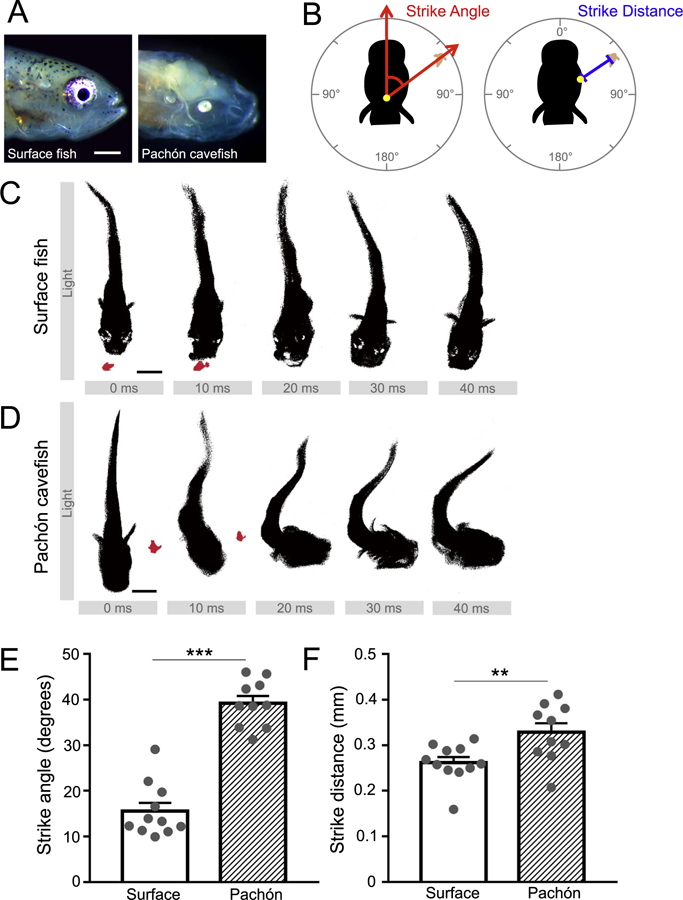
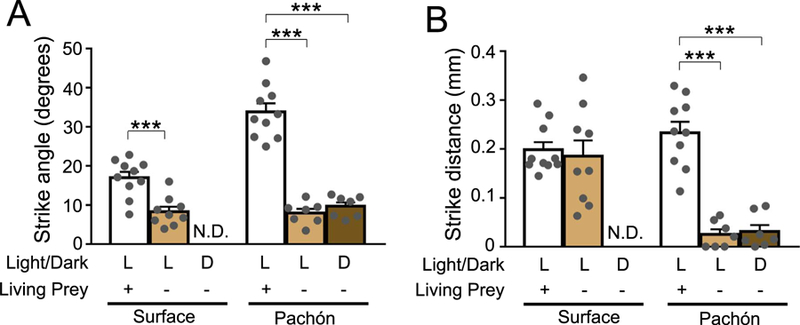
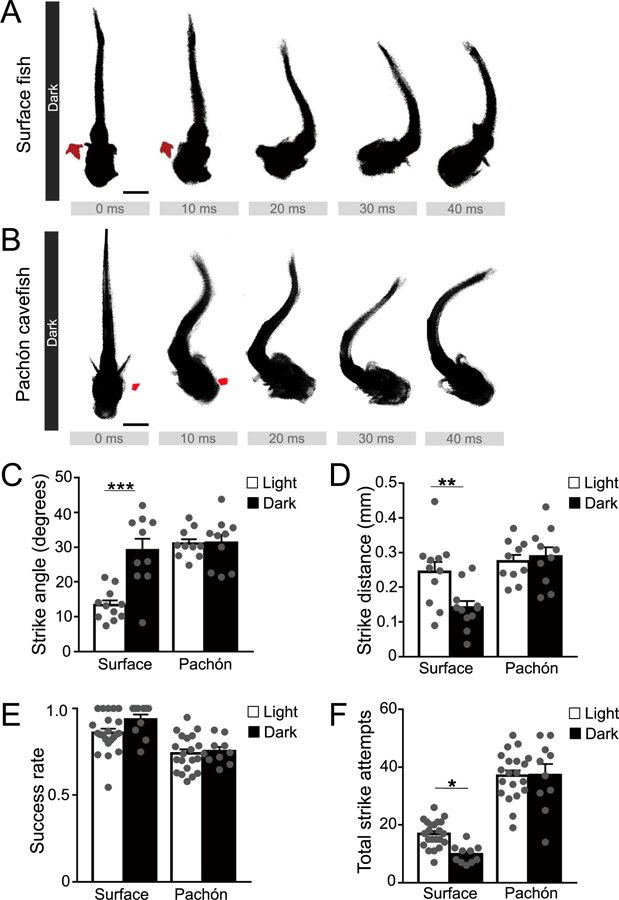
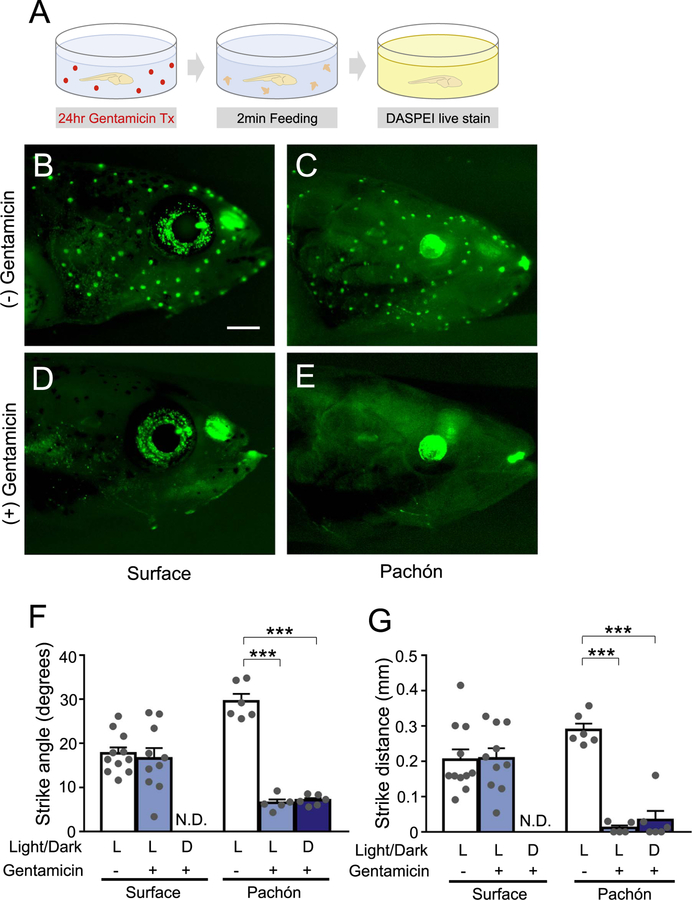
Feeding strategies are dependent on multi-modal sensory processing, that integrates visual, chemosensory, and mechanoreceptive cues. In many fish species, local environments and food availability dramatically influence the evolution of sensory and morphological traits that underlie feeding. The Mexican cavefish, Astyanax mexicanus, have developed robust changes in sensory-dependent behaviors, but the impact on prey detection and feeding behavior is not known. In the absence of eyes, cavefish have evolved enhanced sensitivity of the lateral line, comprised of mechanosensory organs that sense water flow and detect prey. Here, we identify evolved differences in prey capture behavior of larval cavefish that are dependent on lateral line sensitivity. Under lighted conditions, cavefish strike Artemia prey at a wider angle than surface fish; however, this difference is diminished under dark conditions. In addition, the strike distance is greater in cavefish than surface fish, revealing an ability to capture, and likely detect, prey at greater distances. Experimental ablation of the lateral line disrupts prey capture in cavefish under both light and dark conditions, while it only impacts surface fish under dark conditions. Together, these findings identify an evolutionary shift towards a dependence on the lateral line for prey capture in cavefish, providing a model for investigating how loss of visual cues impacts multi-modal sensory behaviors.
摄食策略依赖于多模态感官处理,这种处理整合了视觉、化学感官和机械感受线索。在许多鱼类中,当地环境和食物可获得性极大地影响了作为摄食基础的感官和形态特征的进化。墨西哥丽脂鲤(Astyanax mexicanus)在依赖感官的行为方面发生了显著变化,但对猎物探测和摄食行为的影响尚不清楚。由于没有眼睛,丽脂鲤进化出了增强的侧线敏感性,侧线由感知水流和探测猎物的机械感受器官组成。在这里,我们确定了依赖侧线敏感性的幼体丽脂鲤在猎物捕获行为上的进化差异。在光照条件下,丽脂鲤攻击卤虫猎物的角度比表层鱼更宽;然而,在黑暗条件下这种差异会减小。此外,丽脂鲤的攻击距离比表层鱼更远,这表明它有能力在更远的距离捕获并可能探测到猎物。对侧线进行实验性切除会破坏丽脂鲤在光照和黑暗条件下的猎物捕获,而这只在黑暗条件下影响表层鱼。总之,这些发现确定了丽脂鲤在猎物捕获方面向依赖侧线的进化转变,为研究视觉线索丧失如何影响多模态感官行为提供了一个模型。