Sulica Roxana, Sangli Swathi, Chakravarti Aloke, Steiger David
1 NYU Langone Pulmonary Hypertension Program, New York University School of Medicine, USA.
2 Pulmonary and Critical Care Department, Mayo Clinic, Rochester, USA.
Pulm Circ. 2019 Jan-Mar;9(1):2045894019826944. doi: 10.1177/2045894019826944.
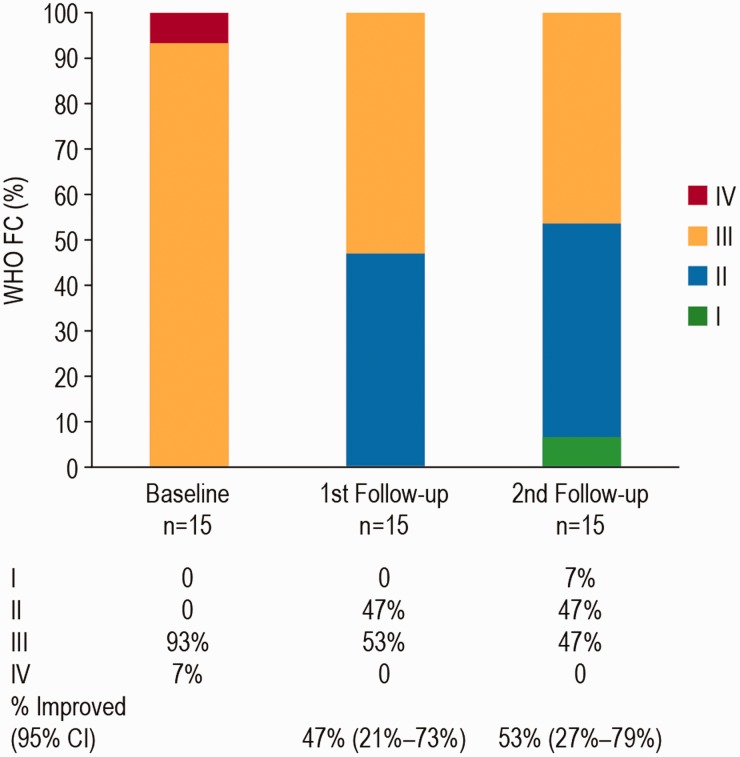
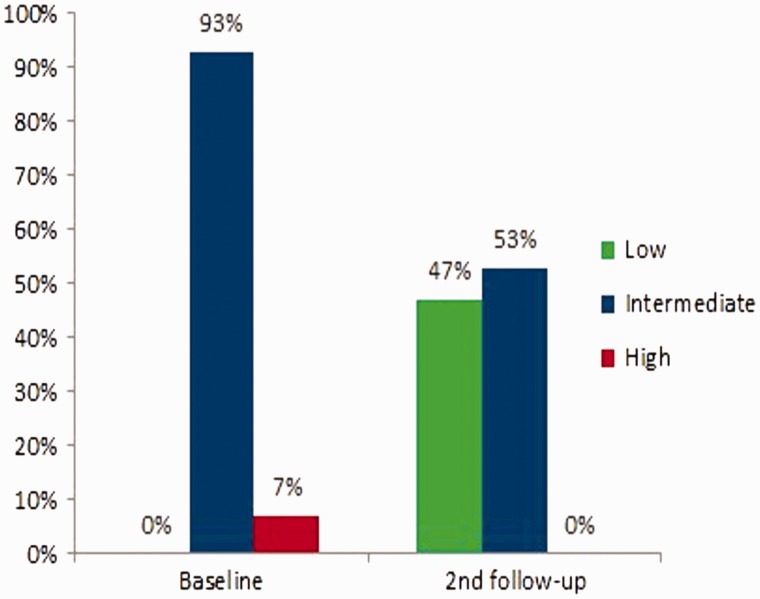
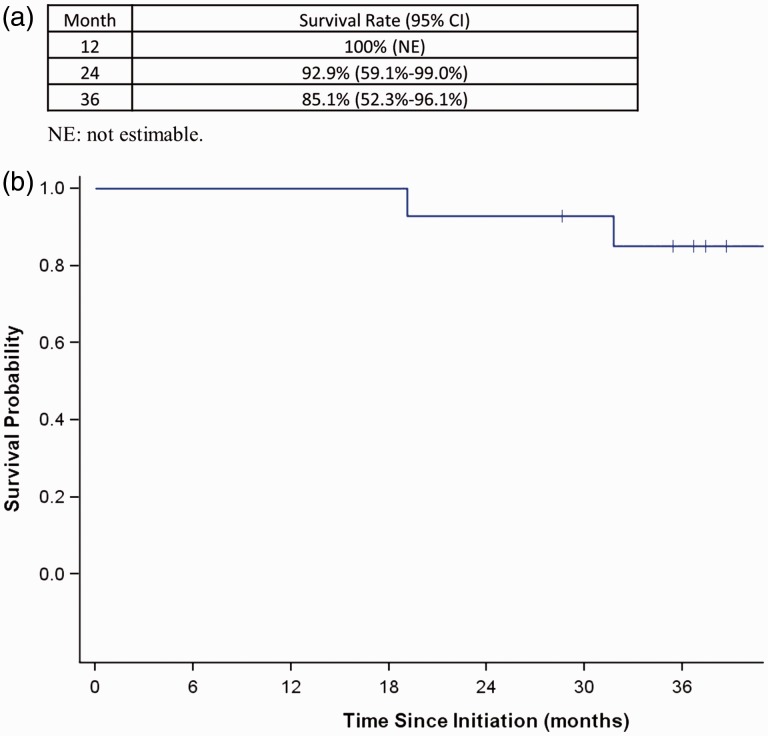
In this open-label study, we evaluated the effect of upfront macitentan and riociguat combination in newly diagnosed pulmonary arterial hypertension (PAH) patients. In 15 consecutive PAH patients, we collected clinical and hemodynamic data at baseline, visit 1 (median 4 months) and visit 2 (median 12 months). Survival and transplantation status were analyzed over 36 months. Statistical analysis included student t-test and 95% confidence interval (CI) ( t-statistic or Clopper-Pearson). Kaplan-Meier was used to estimate survival rate. There were 11/15 women (mean age 56 years), in World Health Organization (WHO) functional class (FC) III ( n = 14) or IV ( n = 1). The 6 min walk distance increased from 281.6 m (baseline) to 315.7 m (visit 1) and visit 2 (313.9 m), representing a 34- and 32-m change ( P < 0.05), respectively, associated with Borg score improvements. Brain natriuretic peptide decreased: 318.2 pg/mL (baseline) to 122.0 pg/mL (visit 1) and 98.6 pg/mL (visit 2) ( P < 0.05). WHO FC improved in eight patients (53%, 95% CI 27%-79%). Pulmonary vascular resistance (9.2 to 5.7 Wood Units) and mean pulmonary artery pressure (47.3 to 38.9 mmHg) decreased; cardiac index increased (2.3 to 3.0 L/min/m) (baseline to visit 2, all P < 0.05). All patients had intermediate and high risk score (baseline); at 1-year follow-up, dual therapy led to reduction to low risk score in 7/15 (47%) patients. There were no unexpected or serious side effects. Three patients died due to unrelated causes; one patient received a lung transplant. Transplant-free survival rate (36 months) was 85%. Preliminary evidence is provided for effectiveness of initial macitentan and riociguat combination therapy in PAH.
在这项开放标签研究中,我们评估了初治时马西替坦与利奥西呱联合用药对新诊断的肺动脉高压(PAH)患者的疗效。在15例连续性PAH患者中,我们在基线、访视1(中位时间4个月)和访视2(中位时间12个月)收集了临床和血流动力学数据。对36个月内的生存和移植状态进行了分析。统计分析包括学生t检验和95%置信区间(CI)(t统计量或克洛普-皮尔逊法)。采用Kaplan-Meier法估计生存率。15例患者中有11例为女性(平均年龄56岁),世界卫生组织(WHO)功能分级为III级(n = 14)或IV级(n = 1)。6分钟步行距离从基线时的281.6米增加至访视1时的315.7米和访视2时的313.9米,分别变化了34米和32米(P < 0.05),同时Borg评分有所改善。脑钠肽水平下降:从基线时的318.2 pg/mL降至访视1时的122.0 pg/mL和访视2时的98.6 pg/mL(P < 0.05)。8例患者(53%,95%CI 27%-79%)的WHO功能分级得到改善。肺血管阻力(从9.2降至5.7伍德单位)和平均肺动脉压(从47.3降至38.9 mmHg)下降;心脏指数增加(从2.3升至3.0 L/min/m²)(从基线到访视2,所有P < 0.05)。所有患者基线时均为中高危评分;在1年随访时,联合治疗使15例患者中的7例(47%)降至低危评分。未出现意外或严重副作用。3例患者因无关原因死亡;1例患者接受了肺移植。无移植生存率(36个月)为85%。本研究为PAH初始马西替坦与利奥西呱联合治疗的有效性提供了初步证据。