Galiè Nazzareno, Jansa Pavel, Pulido Tomás, Channick Richard N, Delcroix Marion, Ghofrani Hossein-Ardeschir, Le Brun Franck-Olivier, Mehta Sanjay, Perchenet Loïc, Rubin Lewis J, Sastry B K S, Simonneau Gérald, Sitbon Olivier, Souza Rogério, Torbicki Adam
Department of Experimental, Diagnostic and Specialty Medicine-DIMES, via Massarenti 9, Bologna 40138, Italy.
Clinical Department of Cardiology and Angiology, 1st Faculty of Medicine, 2nd Medical Department, Charles University, Prague, Czech Republic.
Eur Heart J. 2017 Apr 14;38(15):1147-1155. doi: 10.1093/eurheartj/ehx025.
The effect of macitentan on haemodynamic parameters and NT-proBNP levels was evaluated in pulmonary arterial hypertension (PAH) patients in the SERAPHIN study. Association between these parameters and disease progression, assessed by the primary endpoint (time to first morbidity/mortality event), was explored.
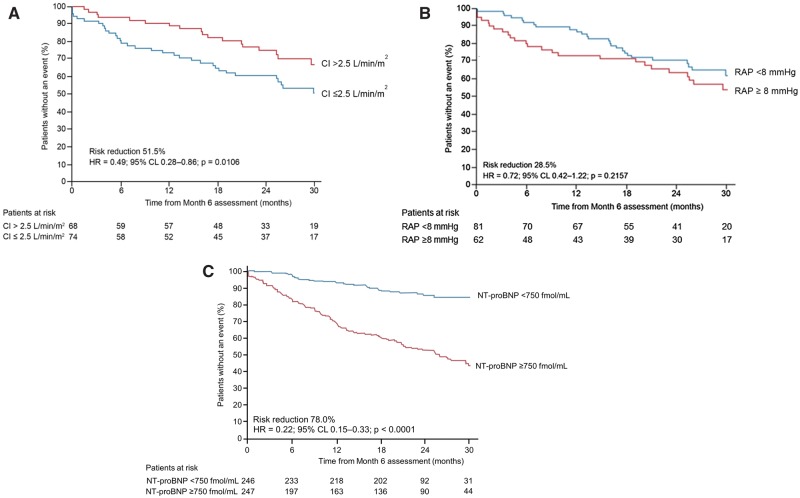
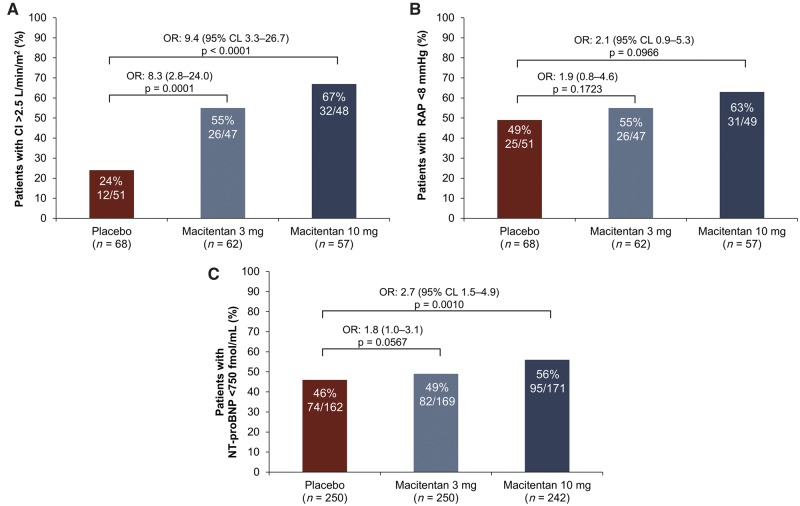
Of the 742 randomized patients, 187 with right heart catheterization at baseline and month 6 participated in a haemodynamic sub-study. Prespecified endpoints included change from baseline to month 6 in cardiac index (CI), right atrial pressure (RAP), mean pulmonary arterial pressure (mPAP), pulmonary vascular resistance (PVR), mixed-venous oxygen saturation, and NT-proBNP. Exploratory analyses examined associations between CI, RAP, and NT-proBNP and disease progression using the Kaplan-Meier method and Cox regression models. Macitentan improved CI, RAP, mPAP, PVR and NT-proBNP vs. placebo at month 6. Absolute levels of CI, RAP and NT-proBNP at baseline and month 6, but not their changes, were associated with morbidity/mortality events. Patients with CI > 2.5 L/min/m2, RAP < 8 mmHg, or NT-proBNP < 750 fmol/ml at month 6 had a lower risk of morbidity/mortality than those not meeting these thresholds (HR 0.49, 95% CL 0.28-0.86; HR 0.72, 95% CL 0.42-1.22; and HR 0.22, 95% CL 0.15-0.33, respectively).
For all treatment groups, baseline and month 6 values of CI, RAP, and NT-proBNP, but not their changes, were associated with morbidity/mortality events, confirming their relevance in predicting disease progression in patients with PAH. By improving those parameters, macitentan increased the likelihood of reaching threshold values associated with lower risk of morbidity/mortality.
在SERAPHIN研究中评估了马昔腾坦对肺动脉高压(PAH)患者血流动力学参数和NT-proBNP水平的影响。探讨了这些参数与通过主要终点(首次发病/死亡事件的时间)评估的疾病进展之间的关联。
在742例随机分组的患者中,187例在基线和第6个月时进行了右心导管检查,参与了一项血流动力学亚研究。预先设定的终点包括从基线到第6个月心脏指数(CI)、右心房压力(RAP)、平均肺动脉压(mPAP)、肺血管阻力(PVR)、混合静脉血氧饱和度和NT-proBNP的变化。探索性分析使用Kaplan-Meier方法和Cox回归模型检查了CI、RAP和NT-proBNP与疾病进展之间的关联。与安慰剂相比,马昔腾坦在第6个月时改善了CI、RAP、mPAP、PVR和NT-proBNP。基线和第6个月时CI、RAP和NT-proBNP的绝对水平而非其变化与发病/死亡事件相关。第6个月时CI>2.5L/min/m²、RAP<8mmHg或NT-proBNP<750fmol/ml的患者发生发病/死亡的风险低于未达到这些阈值的患者(HR分别为0.49,95%CI 0.28-0.86;HR 0.72,95%CI 0.42-1.22;以及HR 0.22,95%CI 0.15-0.33)。
对于所有治疗组,CI、RAP和NT-proBNP的基线和第6个月值而非其变化与发病/死亡事件相关,证实了它们在预测PAH患者疾病进展中的相关性。通过改善这些参数,马昔腾坦增加了达到与较低发病/死亡风险相关阈值的可能性。