Department of Biomolecular Sciences, Graduate School of Life Sciences, Tohoku University, 2-1-1 Katahira, Aoba-ku, Sendai, Miyagi, 980-8577, Japan.
RIKEN Plant Science Center, Tsurumi, Yokohama, Kanagawa, 230-0045, Japan.
Nat Commun. 2019 Jan 14;10(1):191. doi: 10.1038/s41467-018-08124-7.
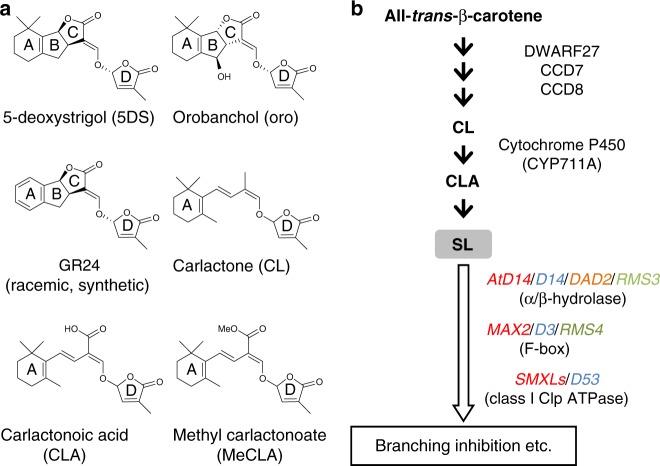
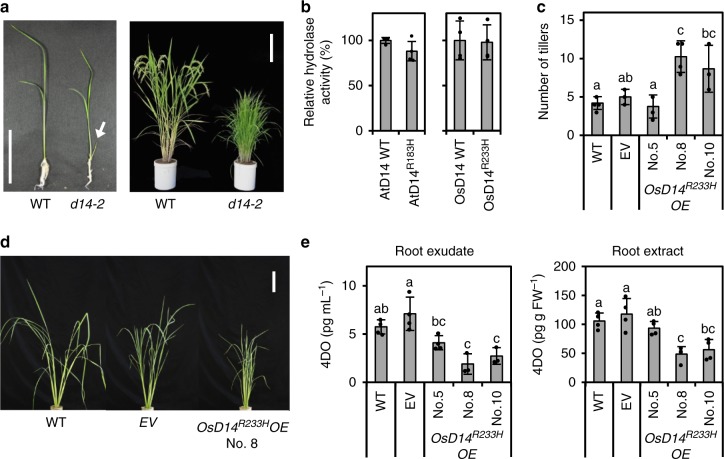
The perception mechanism for the strigolactone (SL) class of plant hormones has been a subject of debate because their receptor, DWARF14 (D14), is an α/β-hydrolase that can cleave SLs. Here we show via time-course analyses of SL binding and hydrolysis by Arabidopsis thaliana D14, that the level of uncleaved SL strongly correlates with the induction of the active signaling state. In addition, we show that an AtD14 catalytic mutant that lacks enzymatic activity is still able to complement the atd14 mutant phenotype in an SL-dependent manner. We conclude that the intact SL molecules trigger the D14 active signaling state, and we also describe that D14 deactivates bioactive SLs by the hydrolytic degradation after signal transmission. Together, these results reveal that D14 is a dual-functional receptor, responsible for both the perception and deactivation of bioactive SLs.
独脚金内酯(SL)类植物激素的感知机制一直存在争议,因为它们的受体 DWARF14(D14)是一种可以切割 SL 的α/β-水解酶。在这里,我们通过对拟南芥 D14 结合和水解 SL 的时程分析表明,未切割 SL 的水平与活性信号状态的诱导强烈相关。此外,我们还表明,缺乏酶活性的 AtD14 催化突变体仍然能够以 SL 依赖的方式互补 atd14 突变体表型。我们得出结论,完整的 SL 分子触发 D14 的活性信号状态,我们还描述了 D14 在信号传递后通过水解降解来使生物活性 SL 失活。总之,这些结果表明 D14 是一种双功能受体,负责生物活性 SL 的感知和失活。