Ghidini Michele, Pizzo Claudio, Botticelli Andrea, Hahne Jens Claus, Passalacqua Rodolfo, Tomasello Gianluca, Petrelli Fausto
Department of Oncology, Azienda Socio Sanitaria Territoriale of Cremona, Cremona, Italy.
Department of Clinical and Molecular Medicine, Sant'Andrea Hospital, Rome, Italy.
Cancer Manag Res. 2018 Dec 28;11:379-388. doi: 10.2147/CMAR.S157156. eCollection 2019.
Incidence and mortality of biliary tract carcinoma (BTC) are increasing, especially in South America and Asia. Such a disease often bears a dismal prognosis because of diagnosis occurring at late stages and for the frequent relapses after surgery. The aims of this review were to summarize the state of the art of the treatment of BTC and give a view at possible future prospects linked with molecular profiling, immunotherapy, and targeted therapies.
We conducted a systematic literature search using MEDLINE and the 2018 ASCO Meeting abstract databases to identify published clinical trials, translational series, and meeting abstracts. All significant papers and abstracts available to date were included.
For resected BTC, thanks to the BILCAP study, adjuvant chemotherapy (CT) with capecitabine should be regarded as the new standard of care. For locally advanced inoperable and metastatic diseases, the use of chemoradiotherapy and radioembolization has not been supported by any randomized Phase III study. The standard of care remains the combination of CT with gemcitabine and cisplatin, as reported by the ABC-02 trial. All targeted therapies have failed to improve the survival outcomes, either in combination with CT or as single agents and are not recommended in the treatment of BTC. Whole-exome sequencing and molecular profiling have helped in identifying genetic signatures typical of different BTC subtypes. With this support, new trials with targeted agents and immunotherapy have been designed, and results are awaited.
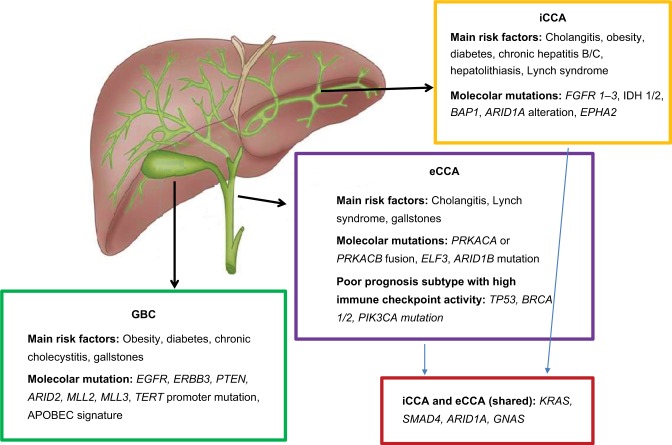
BTC still remains a disease with very few treatment options. Different BTC subtypes own peculiar gene mutations and pathways alterations. Therefore, molecular profiling may be the only key to enable new tailored strategies with targeted agents and immunotherapy.
胆管癌(BTC)的发病率和死亡率正在上升,尤其是在南美洲和亚洲。由于该疾病常在晚期才被诊断出来,且术后频繁复发,其预后往往很差。本综述的目的是总结BTC的治疗现状,并展望与分子谱分析、免疫治疗和靶向治疗相关的未来可能前景。
我们使用MEDLINE和2018年美国临床肿瘤学会(ASCO)会议摘要数据库进行了系统的文献检索,以识别已发表的临床试验、转化研究系列和会议摘要。纳入了所有至今可得的重要论文和摘要。
对于可切除的BTC,得益于BILCAP研究,卡培他滨辅助化疗(CT)应被视为新的标准治疗方法。对于局部晚期不可切除和转移性疾病,任何随机III期研究均未支持使用放化疗和放射性栓塞治疗。如ABC-02试验所报道,标准治疗仍然是CT联合吉西他滨和顺铂。所有靶向治疗,无论是与CT联合还是作为单一药物使用,均未能改善生存结果,因此不推荐用于BTC的治疗。全外显子测序和分子谱分析有助于识别不同BTC亚型的典型基因特征。在此支持下,已设计了针对靶向药物和免疫治疗的新试验,目前正在等待结果。
BTC仍然是一种治疗选择非常有限的疾病。不同的BTC亚型具有独特的基因突变和通路改变。因此,分子谱分析可能是实现使用靶向药物和免疫治疗的新定制策略的唯一关键。