Odintsova Tatyana I, Slezina Marina P, Istomina Ekaterina A, Korostyleva Tatyana V, Kasianov Artem S, Kovtun Alexey S, Makeev Vsevolod J, Shcherbakova Larisa A, Kudryavtsev Alexander M
Vavilov Institute of General Genetics, Russian Academy of Sciences, Moscow, Russia.
Moscow Institute of Physics and Technology, Dolgoprudny, Moscow Region, Russia.
PeerJ. 2019 Jan 8;7:e6125. doi: 10.7717/peerj.6125. eCollection 2019.
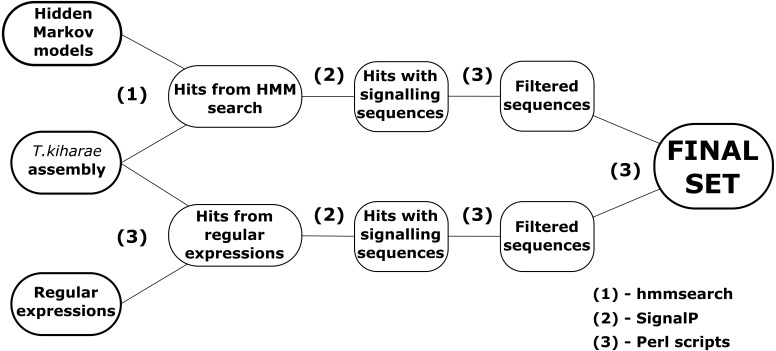
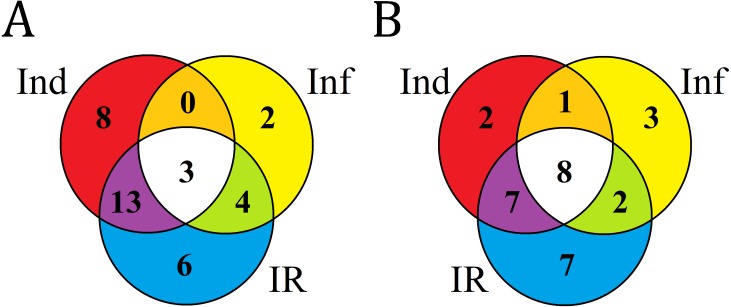
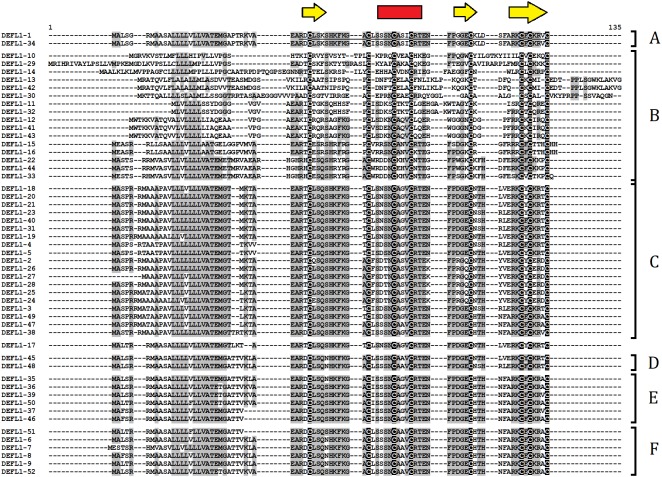
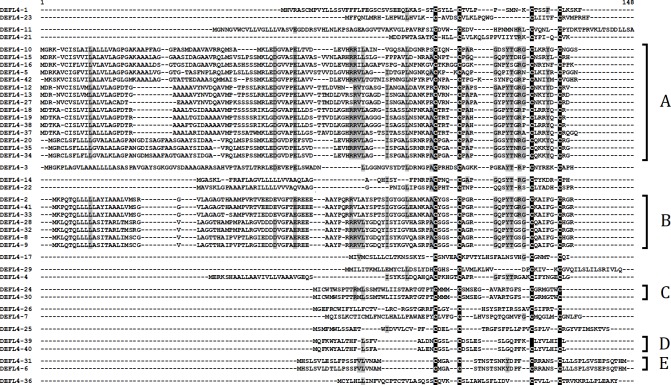
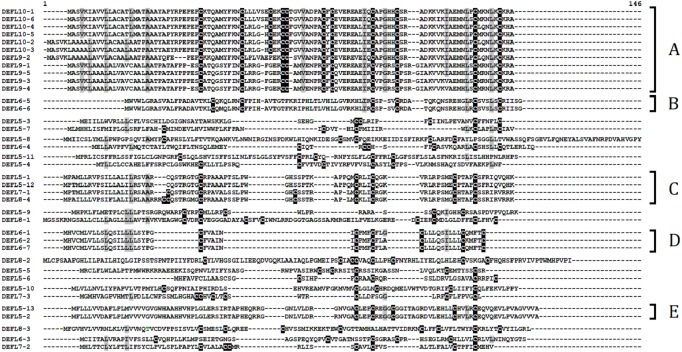
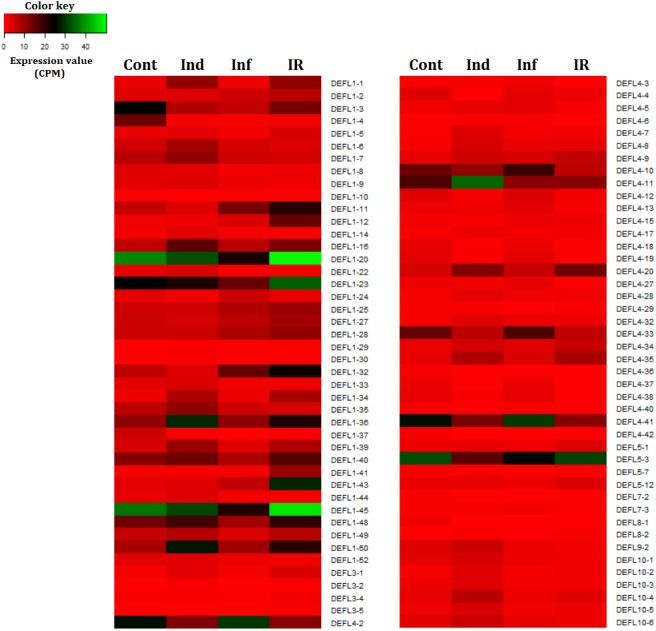
Antimicrobial peptides (AMPs) are the main components of the plant innate immune system. Defensins represent the most important AMP family involved in defense and non-defense functions. In this work, global RNA sequencing and transcriptome assembly were performed to explore the diversity of defensin-like (DEFL) genes in the wheat and to study their role in induced resistance (IR) mediated by the elicitor metabolites of a non-pathogenic strain FS-94 of . Using a combination of two pipelines for DEFL mining in transcriptome data sets, as many as 143 DEFL genes were identified in the vast majority of them represent novel genes. According to the number of cysteine residues and the cysteine motif, wheat DEFLs were classified into ten groups. Classical defensins with a characteristic 8-Cys motif assigned to group 1 DEFLs represent the most abundant group comprising 52 family members. DEFLs with a characteristic 4-Cys motif CX{3,5}CX{8,17}CX{4,6}C named group 4 DEFLs previously found only in legumes were discovered in wheat. Within DEFL groups, subgroups of similar sequences originated by duplication events were isolated. Variation among DEFLs within subgroups is due to amino acid substitutions and insertions/deletions of amino acid sequences. To identify IR-related DEFL genes, transcriptional changes in DEFL gene expression during elicitor-mediated IR were monitored. Transcriptional diversity of DEFL genes in wheat seedlings in response to the fungus , FS-94 elicitors, and the combination of both (elicitors + fungus) was demonstrated, with specific sets of up- and down-regulated DEFL genes. DEFL expression profiling allowed us to gain insight into the mode of action of the elicitors from We discovered that the elicitors up-regulated a set of 24 DEFL genes. After challenge inoculation with , another set of 22 DEFLs showed enhanced expression in IR-displaying seedlings. These DEFLs, in concert with other defense molecules, are suggested to determine enhanced resistance of elicitor-pretreated wheat seedlings. In addition to providing a better understanding of the mode of action of the elicitors from FS-94 in controlling diseases, up-regulated IR-specific DEFL genes represent novel candidates for genetic transformation of plants and development of pathogen-resistant crops.
抗菌肽(AMPs)是植物先天免疫系统的主要组成部分。防御素是参与防御和非防御功能的最重要的抗菌肽家族。在本研究中,通过全基因组RNA测序和转录组组装,探索了小麦中类防御素(DEFL)基因的多样性,并研究了它们在由非致病性菌株FS-94的激发子代谢产物介导的诱导抗性(IR)中的作用。利用两种在转录组数据集中挖掘DEFL的方法,共鉴定出143个DEFL基因,其中绝大多数代表新基因。根据半胱氨酸残基的数量和半胱氨酸基序,小麦DEFL被分为十组。具有特征性8个半胱氨酸基序的经典防御素属于第1组DEFL,是最丰富的一组,包含52个家族成员。在小麦中发现了具有特征性4个半胱氨酸基序CX{3,5}CX{8,17}CX{4,6}C的DEFL,以前仅在豆科植物中发现,被命名为第4组DEFL。在DEFL组内,通过复制事件产生的相似序列亚组被分离出来。亚组内DEFL之间的差异是由于氨基酸替换和氨基酸序列的插入/缺失。为了鉴定与IR相关的DEFL基因,监测了激发子介导的IR过程中DEFL基因表达的转录变化。证明了小麦幼苗中DEFL基因在响应真菌、FS-94激发子以及两者组合(激发子+真菌)时的转录多样性,有特定的上调和下调DEFL基因集。DEFL表达谱分析使我们深入了解了来自FS-94的激发子的作用模式。我们发现激发子上调了一组24个DEFL基因。在用[具体真菌名称未给出]进行挑战接种后,另一组22个DEFL在表现出IR的幼苗中表达增强。这些DEFL与其他防御分子协同作用,被认为决定了激发子预处理的小麦幼苗的增强抗性。除了更好地理解来自FS-94的激发子在控制疾病中的作用模式外,上调的IR特异性DEFL基因代表了植物遗传转化和抗病作物开发的新候选基因。