Department of Biostatistics, Harvard T.H. Chan School of Public Health, Boston, Massachusetts.
Center for Outcomes Research and Evaluation, Yale-New Haven Hospital, New Haven, Connecticut.
JAMA Netw Open. 2018 Aug 3;1(4):e181079. doi: 10.1001/jamanetworkopen.2018.1079.
Patients who survive acute myocardial infarction (AMI) have a high risk of subsequent major cardiovascular events. Efforts to identify risk factors for recurrence have primarily focused on the period immediately following AMI admission.
To identify risk factors and develop and evaluate a risk model that predicts 1-year cardiovascular events after AMI.
DESIGN, SETTING, AND PARTICIPANTS: Prospective cohort study. Patients with AMI (n = 4227), aged 18 years or older, discharged alive from 53 acute-care hospitals across China from January 1, 2013, to July 17, 2014. Patients were randomly divided into samples: training (50% [2113 patients]), test (25% [1057 patients]), and validation (25% [1057 patients]). Risk factors were identified by a Cox model with Markov chain Monte Carlo simulation and further evaluated by latent class analysis. Analyses were conducted from May 1, 2017, to January 21, 2018.
Major cardiovascular events, including recurrent AMI, stroke, heart failure, and death, within 1 year after discharge for the index AMI hospitalization.
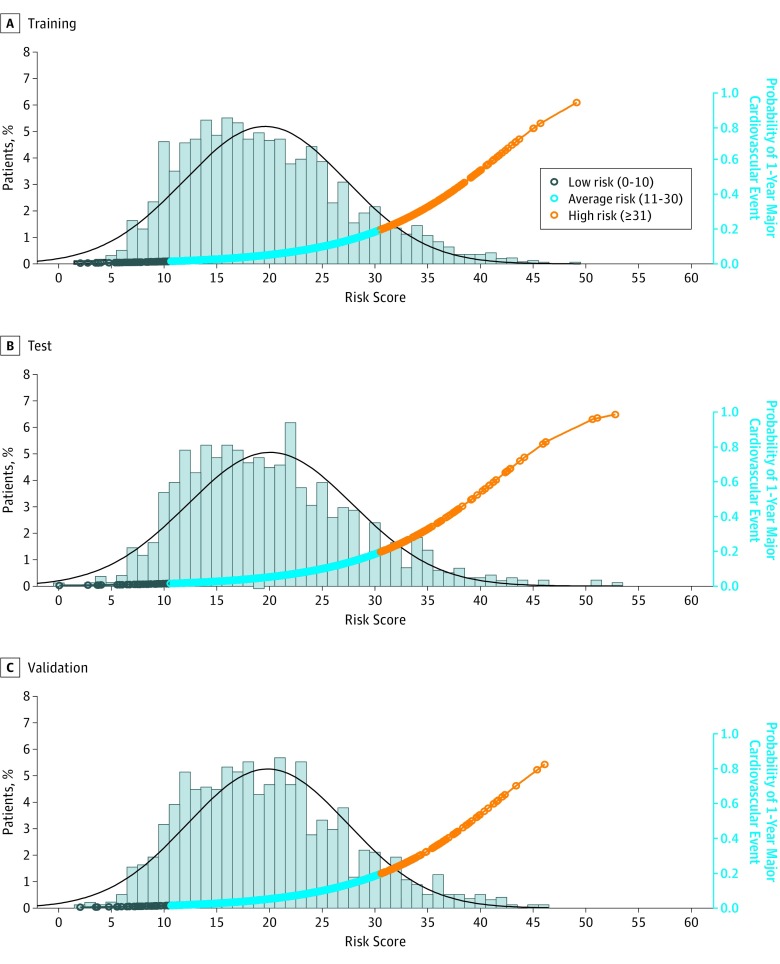
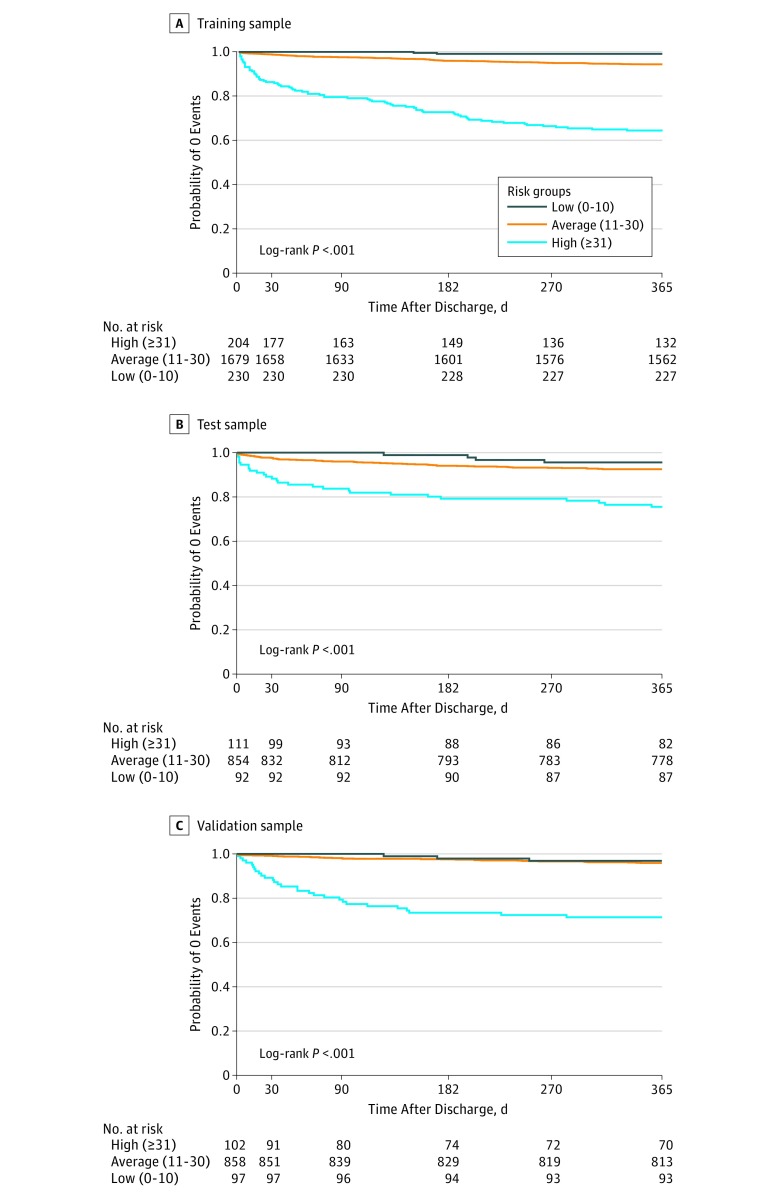
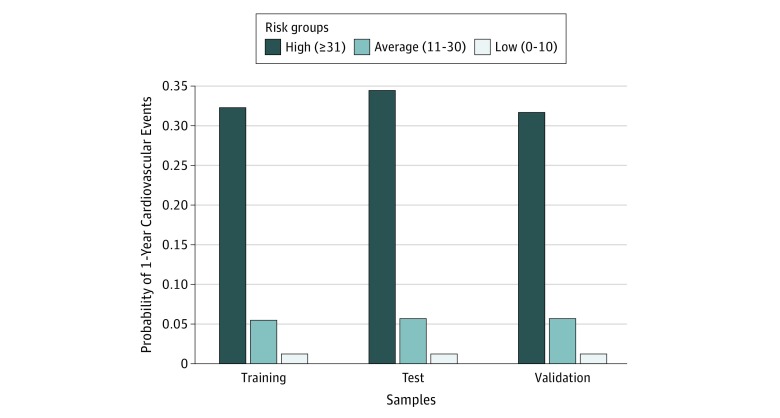
The mean (SD) age of the cohort was 60.8 (11.8) years and 994 of 4227 patients (23.5%) were female. Common comorbidities included hypertension (2358 patients [55.8%]), coronary heart disease (1798 patients [42.5%]), and dyslipidemia (1290 patients [30.5%]). One-year event rates were 8.1% (95% CI, 6.91%-9.24%), 9.0% (95% CI, 7.22%-10.70%), and 6.4% (95% CI, 4.89%-7.85%) for the training, test, and validation samples, respectively. Nineteen risk factors comprising 15 unique variables (age, education, prior AMI, prior ventricular tachycardia or fibrillation, hypertension, angina, prearrival medical assistance, >4 hours from onset of symptoms to admission, ejection fraction, renal dysfunction, heart rate, systolic blood pressure, white blood cell count, blood glucose, and in-hospital complications) were identified. In the training, test, and validation samples, respectively, the risk model had C statistics of 0.79 (95% CI, 0.75-0.83), 0.73 (95% CI, 0.68-0.78), and 0.77 (95% CI, 0.70-0.83) and a predictive range of 1.2% to 33.9%, 1.2% to 37.9%, and 1.3% to 34.3%. The C statistic was 0.69 (95% CI, 0.65-0.74) for the latent class model in the training data. The risk model stratified 11.3%, 81.0%, and 7.7% of patients to high-, average-, and low-risk groups, with respective probabilities of 0.32, 0.06, and 0.01 for 1-year events.
Nineteen risk factors were identified, and a model was developed and evaluated to predict risk of 1-year cardiovascular events after AMI. This may aid clinicians in identifying high-risk patients who would benefit most from intensive follow-up and aggressive risk factor reduction.
急性心肌梗死(AMI)存活的患者有很高的发生后续重大心血管事件的风险。努力识别复发的风险因素主要集中在 AMI 入院后立即发生的时期。
确定风险因素,并开发和评估预测 AMI 后 1 年心血管事件的风险模型。
设计、地点和参与者:前瞻性队列研究。患者为 AMI(n=4227),年龄 18 岁或以上,从 2013 年 1 月 1 日至 2014 年 7 月 17 日从中国 53 家急性护理医院出院存活。患者被随机分为样本:训练(50%[2113 例])、测试(25%[1057 例])和验证(25%[1057 例])。通过带有马尔可夫链蒙特卡罗模拟的 Cox 模型确定风险因素,并通过潜在类别分析进一步评估。分析于 2017 年 5 月 1 日至 2018 年 1 月 21 日进行。
出院后索引 AMI 住院期间 1 年内发生的主要心血管事件,包括复发性 AMI、中风、心力衰竭和死亡。
队列的平均(标准差)年龄为 60.8(11.8)岁,4227 例患者中有 994 例(23.5%)为女性。常见合并症包括高血压(2358 例[55.8%])、冠心病(1798 例[42.5%])和血脂异常(1290 例[30.5%])。训练、测试和验证样本的 1 年事件发生率分别为 8.1%(95%CI,6.91%-9.24%)、9.0%(95%CI,7.22%-10.70%)和 6.4%(95%CI,4.89%-7.85%)。确定了 19 个风险因素,包括 15 个独特变量(年龄、教育程度、既往 AMI、既往室性心动过速或颤动、高血压、心绞痛、到达前医疗援助、症状发作至入院时间>4 小时、射血分数、肾功能障碍、心率、收缩压、白细胞计数、血糖和院内并发症)。在训练、测试和验证样本中,风险模型的 C 统计分别为 0.79(95%CI,0.75-0.83)、0.73(95%CI,0.68-0.78)和 0.77(95%CI,0.70-0.83),预测范围为 1.2%至 33.9%、1.2%至 37.9%和 1.3%至 34.3%。训练数据中潜在类别模型的 C 统计为 0.69(95%CI,0.65-0.74)。风险模型将 11.3%、81.0%和 7.7%的患者分为高、中、低风险组,相应的 1 年事件概率分别为 0.32、0.06 和 0.01。
确定了 19 个风险因素,并开发和评估了预测 AMI 后 1 年心血管事件风险的模型。这可能有助于临床医生识别高风险患者,这些患者最需要强化随访和积极降低风险因素。