Division of Critical Care, Department of Anesthesiology, Critical Care and Pain Medicine, Boston Children's Hospital, Boston, Massachusetts.
Harvard Medical School, Boston, Massachusetts.
JAMA Netw Open. 2018 Oct 5;1(6):e183249. doi: 10.1001/jamanetworkopen.2018.3249.
Hospital care for children is becoming more concentrated, with interhospital transfer occurring more frequently even for common conditions. Condition-specific analysis is required to determine the value, costs, and consequences of this trend.
To describe the capabilities of transferring and receiving hospitals and to determine how often children transferred after an initial diagnosis of abdominal pain or appendicitis require higher levels of care.
DESIGN, SETTING, AND PARTICIPANTS: Retrospective cohort analysis using the 2 most recent available inpatient and emergency department administrative data sets from all acute care hospitals in California from 2010 to 2011 and Florida, Massachusetts, and New York from 2013 to 2014. Data were analyzed between February and June 2018. All patients younger than 18 years with a primary diagnosis of abdominal pain or appendicitis who underwent an interhospital transfer and whose care could be matched through unique identifiers were included.
Outcomes after hospital transfers, classified into encounters with major surgical procedures, imaging diagnostics, and no major procedures. Pediatric Hospital Capability Index of transferring and receiving hospitals.
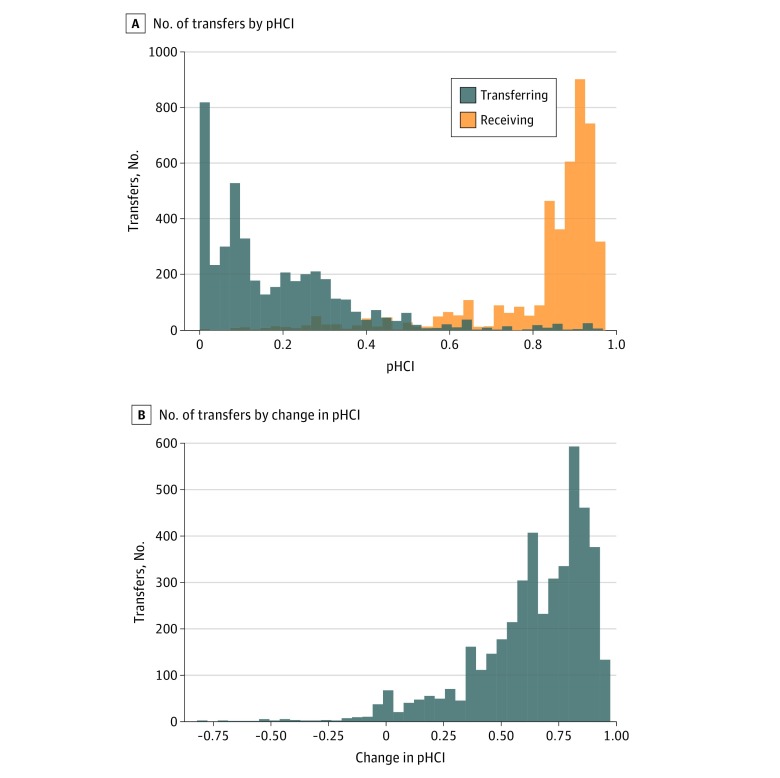
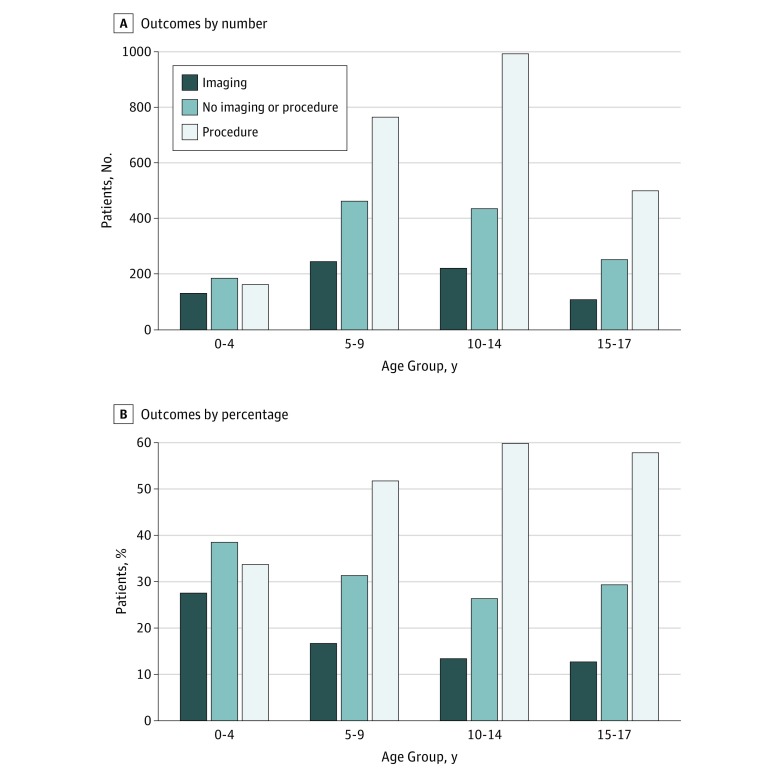
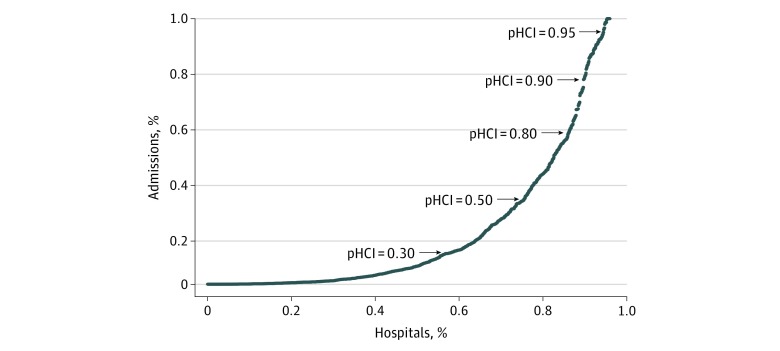
There were 465 143 pediatric hospital encounters for abdominal pain and appendicitis, including 53 517 inpatient admissions and 15 275 transfers. Among them, 4469 could be matched to encounters in receiving hospitals. The median (interquartile range) age of this cohort was 10 (7-14) years, with 54.8% female (2449 patients), 40.9% male (1830 patients), and 4.3% unreported sex (190 patients). The increase in capability at the receiving hospital compared with the transferring hospital was large (median [interquartile range] change in Pediatric Hospital Capability Index score, 0.70 [0.54-0.82]), with 9.2% of hospitals (57) with very high capability (Pediatric Hospital Capability Index score >0.77) receiving 80.8% of the total transfers (3610). Diagnostic imaging was undertaken in the care of 710 transferred patients (15.9%) and invasive procedures were performed in 2421 patients (54.2%), including 2153 appendectomies. No imaging or surgery was required in the care of 1338 transfers (29.9%).
In this study, interfacility transfers of patients with appendicitis and abdominal pain were concentrated toward high-capability hospitals, and about 30% of patients were released without apparent intervention. These findings suggest an opportunity for improving care and decreasing cost through better interfacility coordination, such as standardized management protocols and telemedicine with high-capability hospitals. Further research is needed to identify similar opportunities among other common conditions.
儿童的医院护理越来越集中,即使是常见病症,医院间的转院也越来越频繁。需要对特定病症进行分析,以确定这种趋势的价值、成本和后果。
描述转院和接收医院的能力,并确定在初始诊断为腹痛或阑尾炎后,有多少儿童需要更高水平的治疗。
设计、地点和参与者:使用来自加利福尼亚州和佛罗里达州、马萨诸塞州和纽约州 2010 年至 2011 年以及 2013 年至 2014 年所有急症护理医院的 2 个最近可用的住院和急诊部行政数据集进行回顾性队列分析。数据分析于 2018 年 2 月至 6 月进行。所有年龄在 18 岁以下、初次诊断为腹痛或阑尾炎、进行过医院间转院且可通过唯一标识符进行匹配的患者均被纳入研究。
转院后的治疗结果,分为有重大手术、影像学诊断和无重大手术的治疗。转院和接收医院的儿科医院能力指数。
共有 465143 例儿科腹痛和阑尾炎的医院就诊,包括 53517 例住院和 15275 例转院。其中,4469 例可以与接收医院的就诊进行匹配。该队列的中位(四分位间距)年龄为 10 岁(7-14 岁),其中 54.8%为女性(2449 例),40.9%为男性(1830 例),4.3%为未报告性别(190 例)。与转院医院相比,接收医院的能力显著提高(儿科医院能力指数评分的中位数[四分位间距]变化,0.70[0.54-0.82]),其中 9.2%(57 家)能力非常高(儿科医院能力指数评分>0.77)的医院接收了总转院患者的 80.8%(3610 例)。在 710 例转院患者(15.9%)的治疗中进行了影像学检查,在 2421 例患者(54.2%)中进行了有创性手术,包括 2153 例阑尾切除术。在 1338 例转院患者(29.9%)的治疗中不需要影像学检查或手术。
在这项研究中,阑尾炎和腹痛患者的医院间转院集中在能力较高的医院,约 30%的患者在没有明显干预的情况下出院。这些发现表明,通过更好的医院间协调,如标准化管理方案和与高能力医院的远程医疗,可以为改善护理和降低成本提供机会。还需要进一步研究,以确定其他常见病症中是否存在类似的机会。