Department of Pediatrics, University of Wisconsin-Madison, Madison.
Undergraduate Student, Department of Pediatrics, University of Washington, Seattle.
JAMA Netw Open. 2018 Nov 2;1(7):e182242. doi: 10.1001/jamanetworkopen.2018.2242.
Recreational marijuana use was legalized in the state of Washington in 2012, and the Washington Administrative Code (WAC) 314-55-155 was implemented to limit the exposure of youths to marijuana advertisements.
To evaluate the content of social media posts by marijuana companies and to assess the compliance of these posts with WAC regulations.
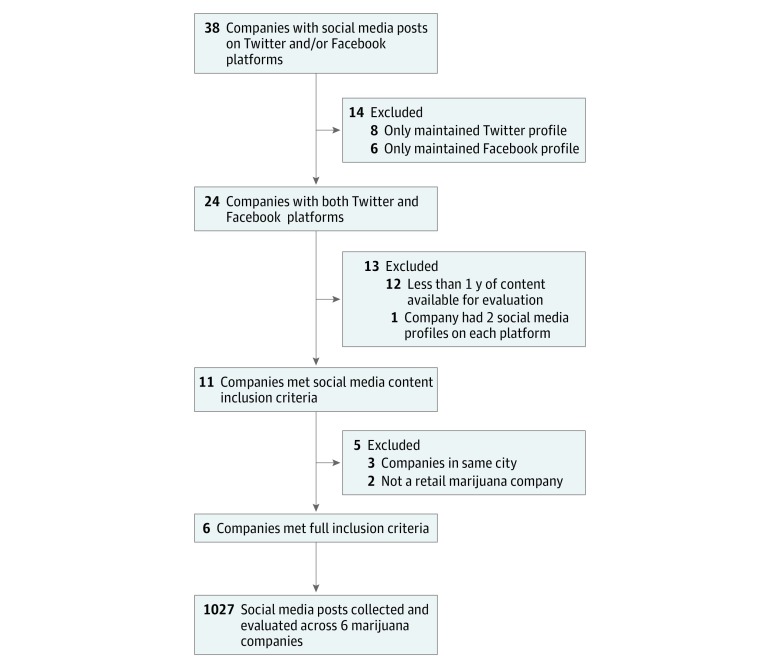
DESIGN, SETTING, AND PARTICIPANTS: In a cross-sectional study, a content analysis of 1027 social media posts was conducted to identify and assess compliance of WAC regulations with the business pages of recreational marijuana companies located on Facebook and Twitter platforms in the state of Washington from December 1, 2015, through November 30, 2016.
Application of coding based on WAC regulations to focus on the prohibition of language that promoted the overconsumption of marijuana, that described its curative or therapeutic benefits, or that was designed to appeal to youths; and the requirements for warnings about intoxication, driving, health risks, and age restrictions for marijuana.
Of the 1027 posts on Facebook and Twitter from business pages of 6 marijuana companies, Facebook followers ranged from 342 to 1592 persons and Twitter followers ranged from 374 to 2915 persons per company. Findings for WAC regulations included 17 posts (1.7%) that encouraged overconsumption; 137 posts (13.3%) that promoted therapeutic benefits; and 9 posts (0.01%) that appealed to youths. Requirements for warnings addressing intoxication, driving, health risks, and age restrictions were present on 110 posts (10.7%). Some businesses repeatedly violated particular regulations; 7 of 17 (41.2%) posts encouraging overconsumption derived from 1 marijuana company.
Most social media posts by marijuana companies were consistent with WAC regulations that prohibit particular messages, but few companies provided required warning messages. Findings can be used toward implementation strategies for marijuana prevention to address these influential media messages.
2012 年,华盛顿州将娱乐用大麻合法化,实施了《华盛顿管理法规》(WAC)314-55-155,以限制青少年接触大麻广告。
评估大麻公司社交媒体帖子的内容,并评估这些帖子是否符合 WAC 法规。
设计、设置和参与者:在一项横断面研究中,对 1027 个社交媒体帖子进行了内容分析,以识别和评估 2015 年 12 月 1 日至 2016 年 11 月 30 日在华盛顿州位于 Facebook 和 Twitter 平台上的娱乐大麻公司的业务页面上的 WAC 法规的遵守情况。
根据 WAC 法规进行编码,重点关注禁止宣传大麻过度消费、描述其治疗或治疗益处或针对青少年的语言;以及关于醉酒、驾驶、健康风险和大麻年龄限制的警告要求。
在 6 家大麻公司业务页面的 Facebook 和 Twitter 上的 1027 个帖子中,每个公司的 Facebook 关注者人数从 342 人到 1592 人不等,Twitter 关注者人数从 374 人到 2915 人不等。WAC 法规的调查结果包括 17 个(1.7%)鼓励过度消费的帖子;137 个(13.3%)促进治疗效益的帖子;以及 9 个(0.01%)针对青少年的帖子。110 个(10.7%)帖子提供了关于醉酒、驾驶、健康风险和年龄限制的警告要求。一些企业反复违反特定规定;来自 1 家大麻公司的 7 个(41.2%)鼓励过度消费的帖子。
大麻公司的大多数社交媒体帖子都符合禁止特定信息的 WAC 法规,但很少有公司提供所需的警告信息。调查结果可用于实施大麻预防战略,以解决这些有影响力的媒体信息。