Department of Biostatistics, Boston University School of Public Health, Boston, Massachusetts.
National Heart, Lung, and Blood Institute and Boston University Framingham Heart Study, Framingham, Massachusetts.
JAMA Netw Open. 2018 Nov 2;1(7):e184587. doi: 10.1001/jamanetworkopen.2018.4587.
Many studies of the association between obesity and mortality rely on weight status at a single point in time, making it difficult to adequately address bias associated with reverse causality.
To investigate the association between maximum body mass index (BMI) and all-cause mortality without the consequences of reverse causality.
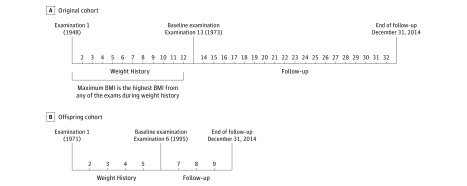
DESIGN, SETTING, AND PARTICIPANTS: Prospective cohort studies for the original and offspring cohorts of the Framingham Heart Study. The follow-up period started from baseline examination 13 for the original cohort and from baseline examination 6 for the offspring cohort and ended December 31, 2014. The analyses were conducted in 2017. Participants were 6197 individuals with 3478 deaths during a mean of 17 years of follow-up.
Maximum BMI over 24 years of weight history before the beginning of follow-up for all-cause mortality and cause-specific mortality. All-cause mortality and cause-specific mortality (deaths due to cardiovascular disease, cancer, or other causes).
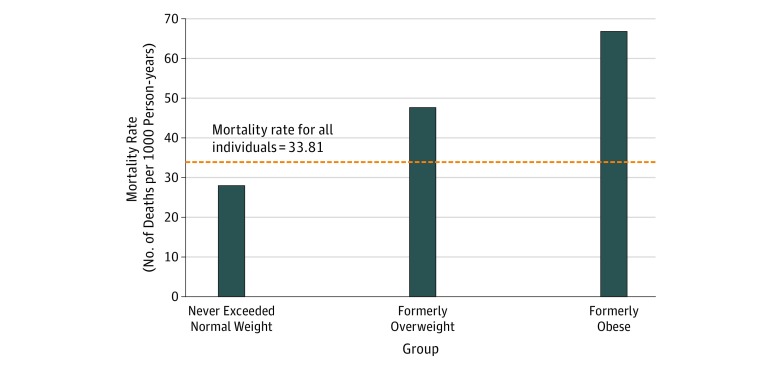
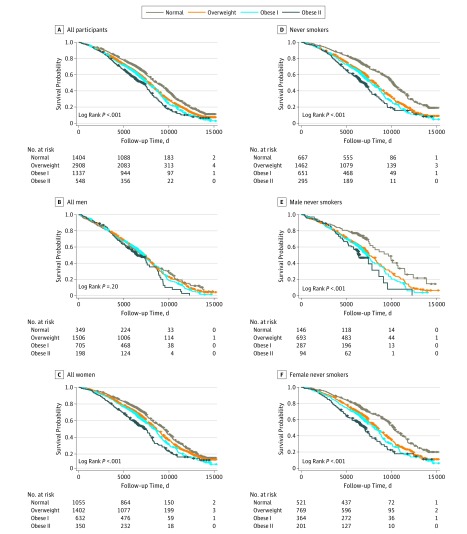
Among 6197 participants (mean [SD] age at baseline, 62.79 [8.98] years; 55.5% female), 3478 (56.1%) died during the follow-up. A monotonic association was observed between maximum BMI and mortality, with increasing risks observed across obese I (BMI of 30 to <35; hazard ratio [HR], 1.27; 95% CI, 1.14-1.41) and obese II (BMI of 35 to <40; HR, 1.93; 95% CI, 1.68-2.20) categories. A significant association was not observed for the overweight category (BMI of 25 to <30; HR, 1.08; 95% CI, 0.99-1.18). Among never smokers, the risks increased, with a significant association emerging for individuals with maximum BMI in the overweight range (HR, 1.31; 95% CI, 1.13-1.51). The mortality rates of normal-weight individuals who were formerly overweight or obese were 47.48 and 66.67 per 1000 person-years, respectively, while individuals who never exceeded normal weight had a mortality rate of 27.93 per 1000 person-years.
A monotonic association was found between maximum BMI over 24 years of weight history and subsequent all-cause mortality. Maximum BMI in the normal-weight range was associated with the lowest risk of mortality in this cohort, highlighting the importance of obesity prevention.
许多关于肥胖与死亡率之间关联的研究都依赖于某一时间点的体重状况,这使得很难充分解决与反向因果关系相关的偏差。
在没有反向因果关系后果的情况下,研究最大体重指数(BMI)与全因死亡率之间的关联。
设计、地点和参与者:弗雷明汉心脏研究的原始队列和后代队列的前瞻性队列研究。原始队列的随访期从基线检查 13 开始,后代队列的随访期从基线检查 6 开始,截止到 2014 年 12 月 31 日。分析于 2017 年进行。参与者为 6197 人,在平均 17 年的随访中有 3478 人死亡。
在开始随访之前 24 年的体重史中最大 BMI 与全因死亡率和特定原因死亡率(心血管疾病、癌症或其他原因导致的死亡)的关系。
在 6197 名参与者(基线时的平均[标准差]年龄为 62.79[8.98]岁;55.5%为女性)中,有 3478 人(56.1%)在随访期间死亡。观察到最大 BMI 与死亡率之间存在单调关联,随着肥胖 I (BMI 为 30 至<35;风险比[HR],1.27;95%置信区间[CI],1.14-1.41)和肥胖 II (BMI 为 35 至<40;HR,1.93;95%CI,1.68-2.20)类别的风险增加而增加。超重类别(BMI 为 25 至<30;HR,1.08;95%CI,0.99-1.18)未观察到显著关联。在从不吸烟者中,风险增加,超重范围内最大 BMI 与个体之间存在显著关联(HR,1.31;95%CI,1.13-1.51)。曾经超重或肥胖的正常体重个体的死亡率分别为每 1000 人年 47.48 和 66.67,而从未超过正常体重的个体的死亡率为每 1000 人年 27.93。
在 24 年的体重史中最大 BMI 与随后的全因死亡率之间发现了单调关联。在本队列中,正常体重范围内的最大 BMI 与最低死亡率相关,突出了预防肥胖的重要性。