Department of Pharmacology, Yong Loo Lin School of Medicine, National University of Singapore, Singapore 117600, Singapore.
Food Science and Technology Program, Department of Chemistry, National University of Singapore, Singapore 117600, Singapore.
Int J Mol Sci. 2019 Jan 14;20(2):313. doi: 10.3390/ijms20020313.
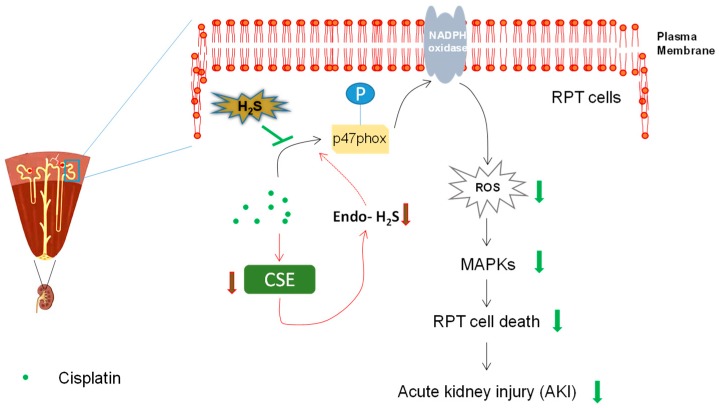
Though historically known as a toxic gas, hydrogen sulfide (H₂S) has displayed a new face as the third endogenous gaseous signaling molecule after nitric oxide (NO) and carbon monoxide (CO). Here in this review, we survey the role and therapeutic potential of H₂S in cisplatin-induced nephrotoxicity. Specifically, reduction of H₂S by cystathionine γ-lyase (CSE) downregulation upon cisplatin treatment may contribute to cisplatin-induced renal cell injury, possibly by augmentation of endogenous reactive oxygen species (ROS) production, while H₂S donation may prevent subsequent renal dysfunction by inhibiting NADPH oxidase activation. Intriguingly, H₂S slow-releasing compound GYY4137 seems to increase the anticancer activity of cisplatin, at least in several cancer cell lines, and this is probably due to its own anticancer effect. However, the efficacy of H₂S donors in tumor-bearing animals remains to be tested in terms of renal protection and cancer inhibition after receiving cisplatin. Furthermore, accumulative evidence regarding usage of polysulfide, a novel H₂S derived molecule, in the therapy of cisplatin-induced nephrotoxicity, was also summarized.
虽然硫化氢 (H₂S) 在历史上一直被认为是一种有毒气体,但它作为继一氧化氮 (NO) 和一氧化碳 (CO) 之后的第三种内源性气体信号分子,已经呈现出了新的面貌。在这篇综述中,我们调查了 H₂S 在顺铂诱导的肾毒性中的作用和治疗潜力。具体来说,顺铂治疗时胱硫醚 γ-裂解酶 (CSE) 下调导致 H₂S 减少,可能通过增加内源性活性氧 (ROS) 产生而导致顺铂诱导的肾细胞损伤,而 H₂S 供体通过抑制 NADPH 氧化酶激活可能预防随后的肾功能障碍。有趣的是,H₂S 缓慢释放化合物 GYY4137 似乎增加了顺铂的抗癌活性,至少在几种癌细胞系中是这样,这可能是由于其自身的抗癌作用。然而,在接受顺铂治疗后,H₂S 供体在肿瘤动物中保护肾脏和抑制癌症的疗效仍有待检验。此外,还总结了关于使用多硫化物(一种新型 H₂S 衍生分子)治疗顺铂诱导的肾毒性的累积证据。