1 Department of Cardiology The Second Affiliated Hospital of Soochow University Suzhou China.
2 Department of Geriatrics The Affiliated Sir Run Run Hospital of Nanjing Medical University Nanjing China.
J Am Heart Assoc. 2019 Jan 22;8(2):e010934. doi: 10.1161/JAHA.118.010934.
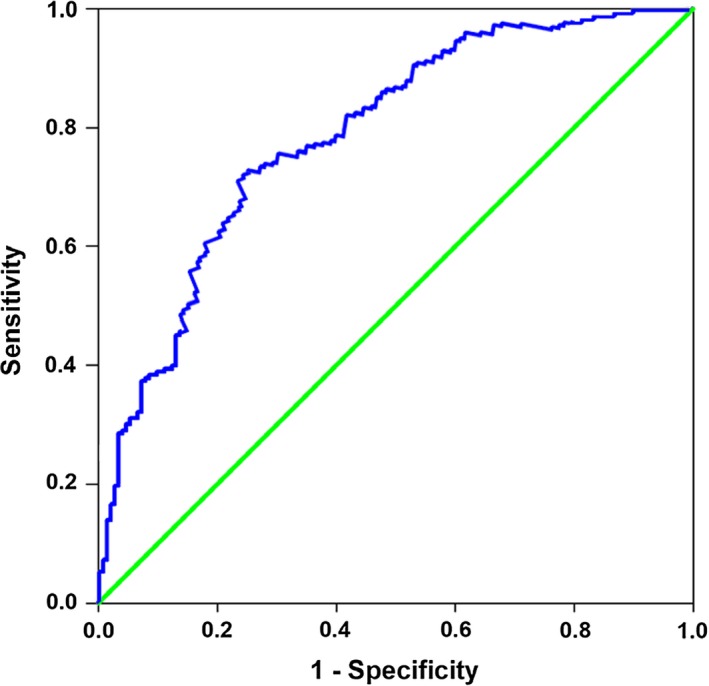
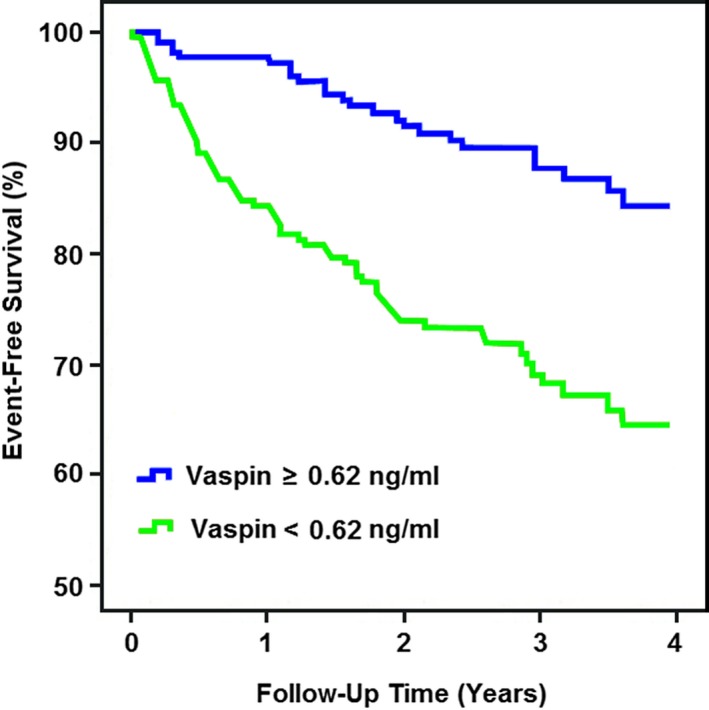
Background The involvement of vaspin (visceral adipose tissue-derived serpin) in the development of atherosclerotic cardiovascular diseases has been documented. This study was designed to explore the prognostic value of serum vaspin in patients with acute myocardial infarction ( AMI ). Methods and Results We included 1036 AMI patients in a cohort study and determined the association between serum vaspin and major adverse cardiac events ( MACE ) using Cox regression analysis. The receiver operating characteristic curve indicated that serum vaspin could significantly differentiate patients with MACE , and the optimal cutoff value was 0.62 ng/mL. The Kaplan-Meier survival curve showed that patients with lower vaspin levels had higher incidence of MACE . Multivariate Cox regression analysis revealed that low vaspin was an independent predictor of MACE (hazard ratio: 0.74; 95% CI , 0.48-0.96; P=0.029), together with age; previous histories of AMI , heart failure, hypertension, and diabetes mellitus; Killip class; revascularization; CRP (C-reactive protein); and NT-proBNP (N-terminal pro-B-type natriuretic peptide). Integrated discrimination and net reclassification improvements for MACE were significantly improved by addition of vaspin to the model of traditional risk factors. Moreover, low vaspin was a valuable predictor of heart failure hospitalization (hazard ratio: 0.58; 95% CI , 0.37-0.89; P=0.005) and recurrent AMI (hazard ratio: 0.72; 95% CI , 0.53-0.95; P=0.036) after adjustment for conventional cardiovascular risk factors. Conclusions Our study suggests that serum vaspin is a significant prognostic marker of MACE in AMI patients.
背景 脂肪细胞因子(内脏脂肪组织衍生丝氨酸蛋白酶抑制剂)在动脉粥样硬化性心血管疾病的发展中的作用已被证实。本研究旨在探讨血清 vaspin 在急性心肌梗死(AMI)患者中的预后价值。
方法和结果 我们进行了一项队列研究,纳入了 1036 例 AMI 患者,采用 Cox 回归分析评估血清 vaspin 与主要不良心脏事件(MACE)之间的关系。受试者工作特征曲线表明,血清 vaspin 能显著区分发生 MACE 的患者,最佳截断值为 0.62ng/ml。Kaplan-Meier 生存曲线显示,血清 vaspin 水平较低的患者发生 MACE 的发生率更高。多因素 Cox 回归分析显示,低 vaspin 是 MACE 的独立预测因子(危险比:0.74;95%置信区间,0.48-0.96;P=0.029),与年龄、既往 AMI、心力衰竭、高血压和糖尿病史、Killip 分级、血运重建、C 反应蛋白(CRP)和 N 末端 pro-B 型利钠肽(NT-proBNP)有关。在传统危险因素模型中加入 vaspin 后,MACE 的综合鉴别和重新分类改善显著提高。此外,在调整传统心血管危险因素后,低 vaspin 是心力衰竭住院(危险比:0.58;95%置信区间,0.37-0.89;P=0.005)和再发 AMI(危险比:0.72;95%置信区间,0.53-0.95;P=0.036)的有价值的预测因子。
结论 本研究表明,血清 vaspin 是 AMI 患者发生 MACE 的重要预后标志物。