An Young-Sil, Park Sunghoon, Jung Ju-Yang, Suh Chang-Hee, Kim Hyoun-Ah
Department of Nuclear Medicine and Molecular Imaging, Ajou University School of Medicine, Suwon, Korea.
Department of Radiology, Ajou University School of Medicine, Suwon, Korea.
BMC Musculoskelet Disord. 2019 Jan 15;20(1):23. doi: 10.1186/s12891-019-2401-y.
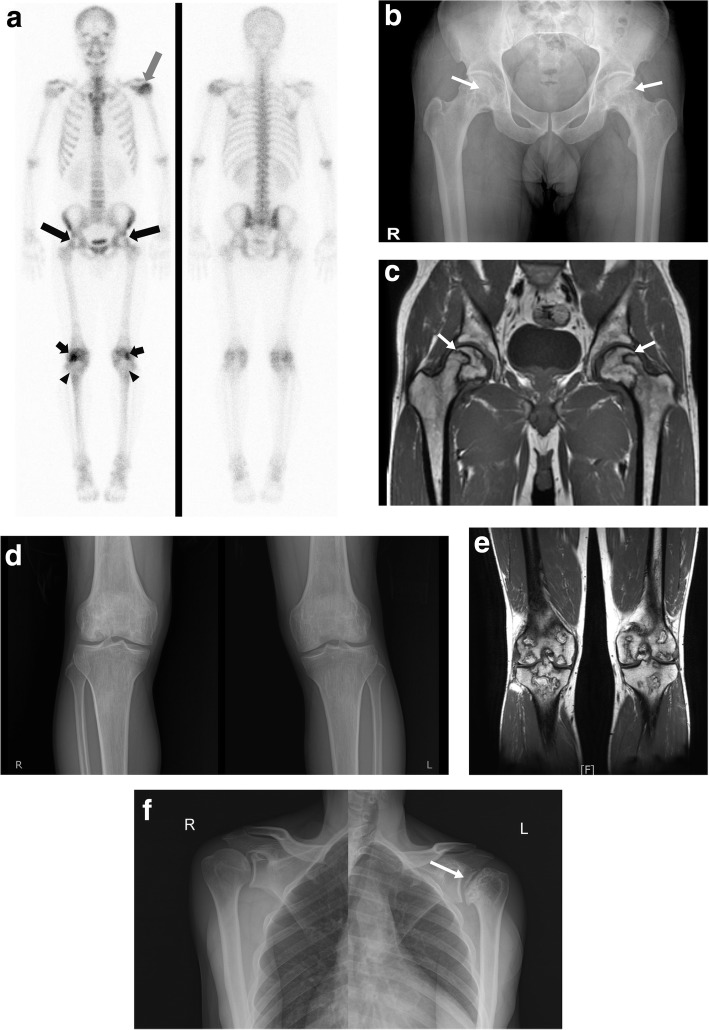
Multifocal osteonecrosis (ON) is defined as ON involving three or more distinct anatomical sites. We investigated the clinical characteristics and utility of whole-body bone scans (WBBS) in patients with multifocal ON.
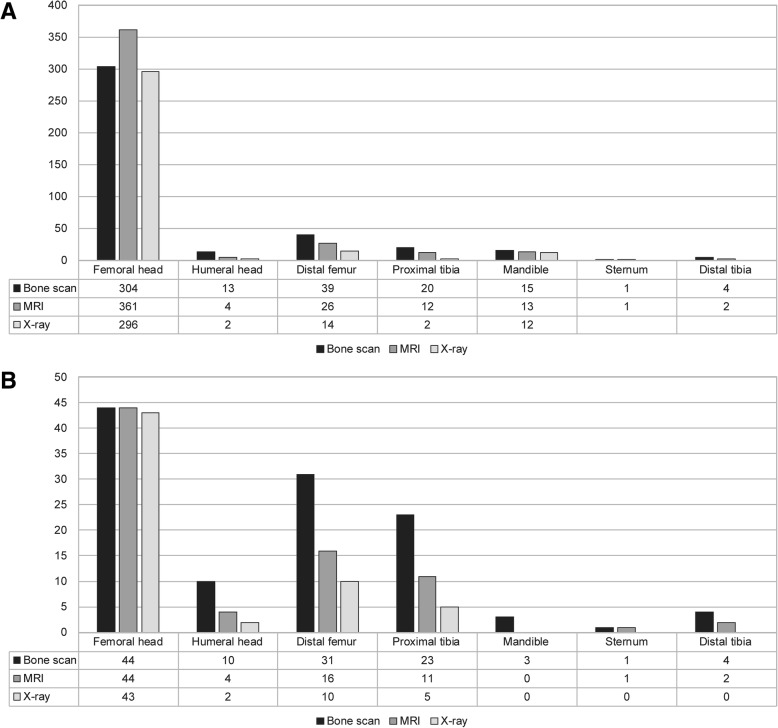
A total of 254 patients with ON confirmed by magnetic resonance imaging (MRI) or X-rays of the hips or other anatomic regions were evaluated using WBBS and divided into those with multifocal disease and those with oligofocal disease; their clinical characteristics were then compared. All data were analyzed retrospectively both visually and quantitatively (via uptake grading and defect scoring). Associations between the MRI Association Research Circulation Osseous (ARCO) classification and bone scan photon defects and uptake grade were assessed. Factors associated with multifocal ON were identified using logistic regression.
Of the 254 ON patients, 26 (10.2%) had multifocal ON. Their mean age (42.8 ± 14.3 years) was less than that of patients with oligofocal ON (50.9 ± 15.4 years; p = 0.011). Comorbidities, corticosteroid use, and treatment with immunosuppressive agents were more frequent in patients with multifocal ON. Age (odds ratio [OR] = 0.964, p = 0.013), the presence of a comorbidity (OR = 3.387, p = 0.006), present corticosteroid use (OR = 5.696, p < 0.001), and treatment with immunosuppressive agents (OR = 3.447, p = 0.004) were significantly associated with multifocal ON. The MRI ARCO classification was not associated with photon defects in the bone scans of those with femoral ON. However, the ARCO classification was significantly associated with uptake grade.
WBBS may be an additional tool for evaluating ON patients with risk factors for multiple ON, such as younger age, corticosteroid use, and comorbidities.
多灶性骨坏死(ON)定义为累及三个或更多不同解剖部位的骨坏死。我们研究了多灶性ON患者的临床特征及全身骨扫描(WBBS)的应用价值。
对254例经磁共振成像(MRI)或髋部及其他解剖区域X线检查确诊为ON的患者进行WBBS评估,并分为多灶性疾病组和少灶性疾病组;然后比较两组的临床特征。所有数据均进行回顾性分析,包括视觉分析和定量分析(通过摄取分级和缺损评分)。评估磁共振成像骨循环研究协会(ARCO)分类与骨扫描光子缺损及摄取分级之间的相关性。采用逻辑回归确定与多灶性ON相关的因素。
254例ON患者中,26例(10.2%)为多灶性ON。他们的平均年龄(42.8±14.3岁)低于少灶性ON患者(50.9±15.4岁;p = 0.011)。多灶性ON患者合并症、使用皮质类固醇及免疫抑制剂治疗更为常见。年龄(比值比[OR]=0.964,p = 0.013)、合并症的存在(OR = 3.387,p = 0.006)、当前使用皮质类固醇(OR = 5.696,p < 0.001)及免疫抑制剂治疗(OR = 3.447,p = 0.004)与多灶性ON显著相关。股骨ON患者的MRI ARCO分类与骨扫描中的光子缺损无关。然而,ARCO分类与摄取分级显著相关。
WBBS可能是评估具有多灶性ON危险因素(如年轻、使用皮质类固醇和合并症)的ON患者的辅助工具。