Yunnan Key Laboratory of Primate Biomedicine Research; Institute of Primate Translational Medicine, Kunming University of Science and Technology, Kunming, 650500, China.
The Cardiology Division, Department of Medicine, Li Ka Shing Faculty of Medicine, University of Hong Kong, Hong Kong, SAR, China.
BMC Biotechnol. 2019 Jan 15;19(1):7. doi: 10.1186/s12896-018-0494-2.
Non-human primate (NHP) models can closely mimic human physiological functions and are therefore highly valuable in biomedical research. Genome editing is now developing rapidly due to the precision and efficiency offered by engineered site-specific endonuclease-based systems, such as transcription activator-like effector nucleases (TALENs) and the clustered regularly interspaced short palindromic repeats (CRISPR)/CRISPR-associated protein-9 nuclease (Cas9) system. It has been demonstrated that these programmable nucleases can introduce genetic changes in embryos from many species including NHPs. In 2014, we reported the first genetic editing of macaques using TALENs and CRISPR/Cas9. Subsequently, we characterized the phenotype of a methyl CpG binding protein 2 (MECP2)-mutant cynomolgus monkey model of Rett syndrome generated using the TALEN approach. These efforts not only accelerated the advance of modeling genetic diseases in NHPs, but also encouraged us to develop specific gene knock-in monkeys. In this study, we assess the possibility of homologous recombination (HR)-mediated gene replacement using TALENs in monkeys, and generate preimplantation embryos carrying an EmGFP fluorescent reporter constructed in the OCT4 gene.
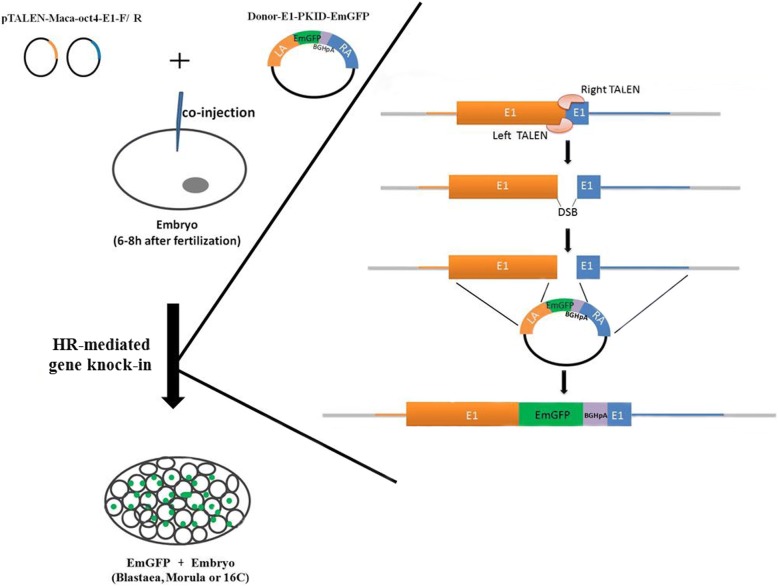
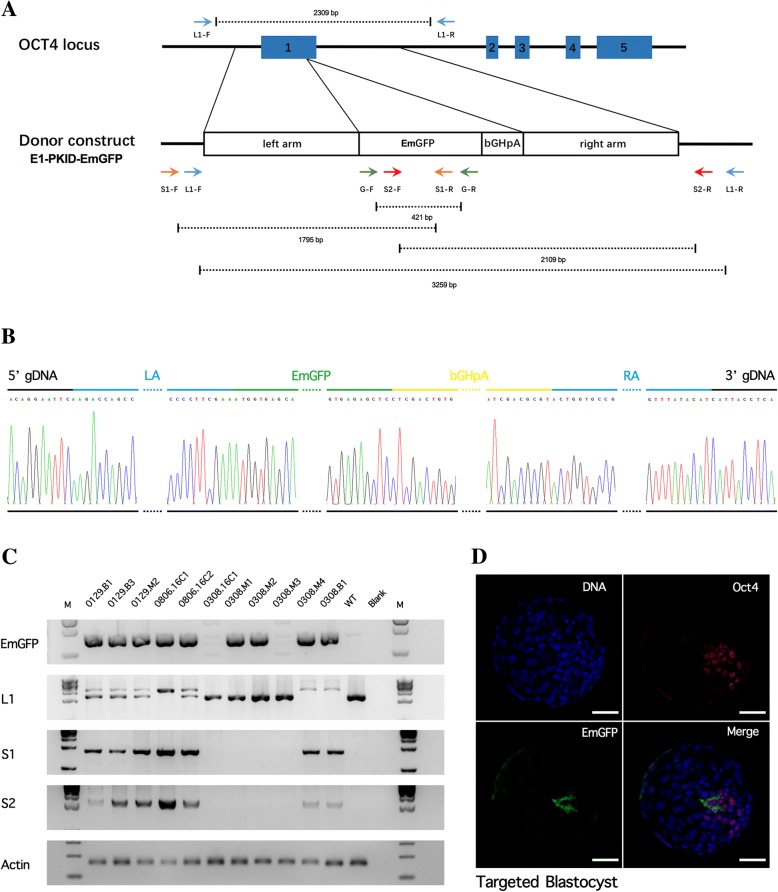
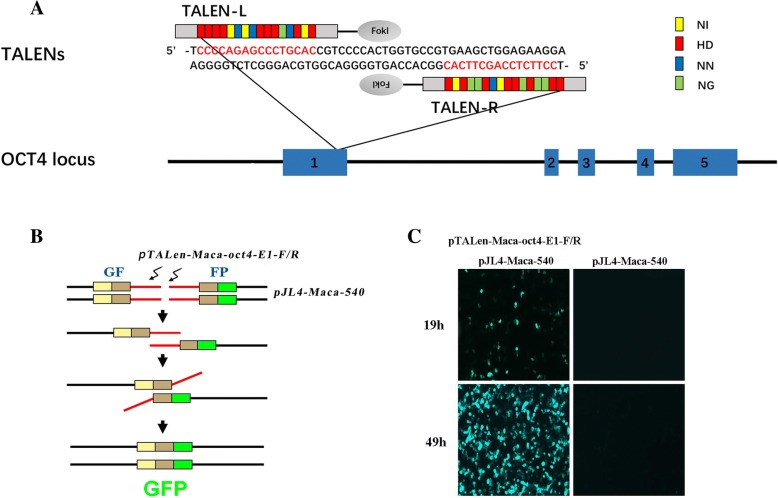
We assembled a pair of TALENs specific to the first exon of the OCT4 gene and constructed a donor vector consisting of the homology arms cloned from the monkey genome DNA, flanking an EmGFP cassette. Next, we co-injected the TALENs-coding plasmid and donor plasmid into the cytoplasm of 122 zygotes 6-8 h after fertilization. Sequencing and immunofluorescence revealed that the OCT4-EmGFP knock-in allele had been successfully generated by TALENs-mediated HR at an efficiency of 11.3% (7 out of 62) or 11.1% (1 out of 9), respectively, in monkey embryos.
We have successfully, for the first time, obtained OCT4-EmGFP knock-in monkey embryos via HR mediated by TALENs. Our results suggest that gene targeting through TALEN-assisted HR is a useful approach to introduce precise genetic modification in NHPs.
非人类灵长类动物(NHP)模型可以很好地模拟人类生理功能,因此在生物医学研究中具有很高的价值。基因组编辑技术由于工程化的定点内切酶系统(如转录激活样效应物核酸酶(TALENs)和簇状规律间隔短回文重复(CRISPR)/CRISPR 相关蛋白-9 核酸酶(Cas9)系统)提供的精确性和效率而得到快速发展。已经证明,这些可编程核酸酶可以在包括 NHPs 在内的许多物种的胚胎中引入遗传变化。2014 年,我们报道了使用 TALENs 和 CRISPR/Cas9 对猕猴进行的首次基因编辑。随后,我们对使用 TALEN 方法产生的 Rett 综合征甲基化 CpG 结合蛋白 2(MECP2)突变恒河猴模型的表型进行了表征。这些努力不仅加速了 NHPs 中遗传疾病模型的发展,还鼓励我们开发特定的基因敲入猴。在这项研究中,我们评估了 TALENs 在猴子中进行同源重组(HR)介导的基因替换的可能性,并生成了携带 OCT4 基因中构建的 EmGFP 荧光报告器的植入前胚胎。
我们组装了一对特异性针对 OCT4 基因第一外显子的 TALEN,并构建了一个由从猴基因组 DNA 中克隆的同源臂组成的供体载体,侧翼是一个 EmGFP 盒。接下来,我们在受精后 6-8 小时将 TALEN 编码质粒和供体质粒共注射到 122 个卵母细胞的细胞质中。测序和免疫荧光显示,TALENs 介导的 HR 成功地在 11.3%(7/62)或 11.1%(1/9)的猴胚胎中生成了 OCT4-EmGFP 敲入等位基因。
我们首次通过 TALEN 介导的 HR 成功获得了 OCT4-EmGFP 敲入猴胚胎。我们的结果表明,通过 TALEN 辅助 HR 进行基因靶向是在 NHPs 中引入精确遗传修饰的一种有用方法。