Institute of Neurobiology, Center of Brain, Behavior and Metabolism, University of Lübeck, Marie-Curie-Straße, 23562 Lübeck, Germany.
Int J Mol Sci. 2019 Jan 15;20(2):343. doi: 10.3390/ijms20020343.
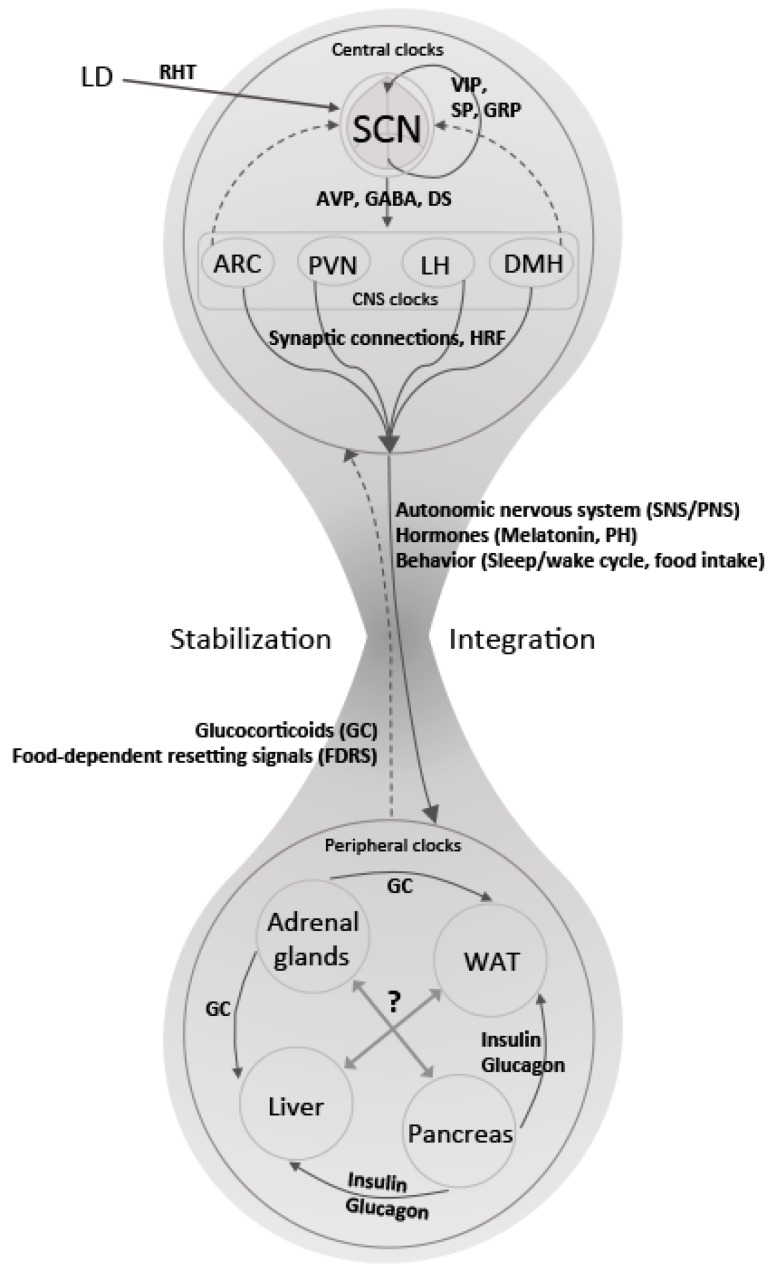
24-hour rhythms in physiology and behaviour are organized by a body-wide network of endogenous circadian clocks. In mammals, a central pacemaker in the hypothalamic suprachiasmatic nucleus (SCN) integrates external light information to adapt cellular clocks in all tissues and organs to the external light-dark cycle. Together, central and peripheral clocks co-regulate physiological rhythms and functions. In this review, we outline the current knowledge about the routes of communication between the environment, the main pacemakers and the downstream clocks in the body, focusing on what we currently know and what we still need to understand about the communication mechanisms by which centrally and peripherally controlled timing signals coordinate physiological functions and behaviour. We highlight recent findings that shed new light on the internal organization and function of the SCN and neuroendocrine mechanisms mediating clock-to-clock coupling. These findings have implications for our understanding of circadian network entrainment and for potential manipulations of the circadian clock system in therapeutic settings.
24 小时的生理和行为节律是由全身内源性生物钟网络组织的。在哺乳动物中,下丘脑视交叉上核(SCN)中的中央起搏器整合外部光信息,使所有组织和器官中的细胞时钟适应外部明暗周期。中央和外周时钟共同调节生理节律和功能。在这篇综述中,我们概述了目前关于环境、主要起搏器和体内下游时钟之间的通讯途径的知识,重点介绍了我们目前了解的情况以及我们仍需要了解的有关中枢和外周控制的定时信号协调生理功能和行为的通讯机制的情况。我们强调了最近的发现,这些发现揭示了 SCN 的内部组织和功能以及神经内分泌机制介导时钟到时钟耦合的新情况。这些发现对于我们理解生物钟网络的驯化以及在治疗环境中对生物钟系统进行潜在操作具有重要意义。