Miyatake Hidemitsu, Fujino Kazunori, Tanaka Sachiko, Tsujita Yasuyuki, Horie Minoru, Eguchi Yutaka
Department of Critical and Intensive Care Medicine Shiga University of Medical Science Otsu Japan.
Department of Medical Statistics Shiga University of Medical Science Otsu Japan.
Acute Med Surg. 2018 Oct 4;6(1):30-39. doi: 10.1002/ams2.374. eCollection 2019 Jan.
To examine lymphocyte counts as a predictive prognostic marker in patients with coma after cardiac arrest.
We retrospectively evaluated patients with coma after cardiac arrest admitted to the intensive care unit of Shiga University of Medical Science (Otsu, Japan). Lymphocyte counts were measured for 6 days from admission. Neurological outcome was assessed as favorable or unfavorable using cerebral performance categories. Associations between lymphocyte count and prognosis were investigated using multivariate logistic regression analysis and receiver operating characteristic curves.
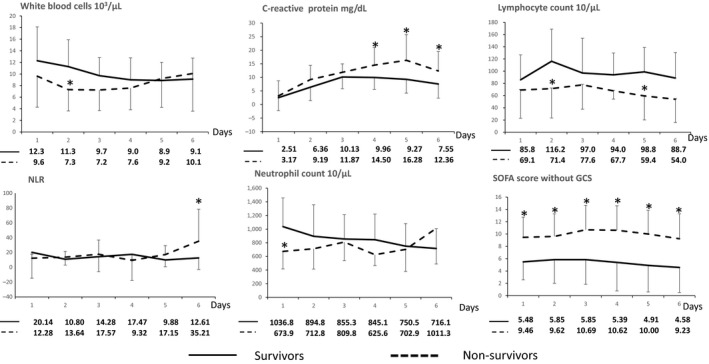
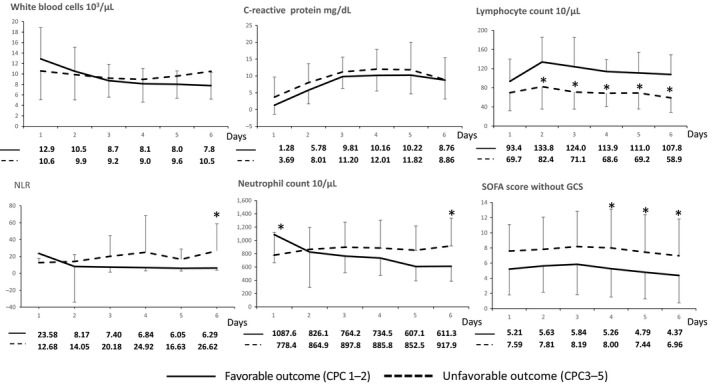
Forty-six patients were assessed from February 2012 to December 2016. Survivors had significantly higher lymphocyte counts than non-survivors on days 2 and 5. Multivariate analysis showed that lymphocyte count was not associated with 90-day mortality. Patients with favorable neurological outcome at discharge had significantly higher lymphocyte counts on days 2-6 than patients with unfavorable outcomes. Multivariate logistic regression analysis, including possible confounders, showed that lymphocyte counts on days 2-4 and 6 were associated with neurological outcome (day 2: odds ratio [OR] = 0.75, 95% confidence interval [CI] = 0.58-0.97, = 0.029; day 3: OR = 0.68, 95% CI = 0.47-0.98, = 0.04; day 4: OR = 0.4, 95% CI = 0.16-1.00, = 0.05; day 6: OR = 0.69, 95% CI = 0.48-0.99, = 0.046). Receiver operating characteristic curve analysis indicated high accuracy for predicting neurological outcome for each lymphocyte count on days 2-6 using the area under the curve, day 4 values being most accurate (day 2: 0.776, day 3: 0.787, day 4: 0.909, day 5: 0.774, day 6: 0.839).
Lymphocyte counts on days 2-4 and 6 after cardiac arrest are associated with neurological outcome; counts on day 4 most accurately predict neurological outcome.
研究淋巴细胞计数作为心脏骤停后昏迷患者的预测性预后标志物。
我们回顾性评估了入住滋贺医科大学重症监护病房(日本大津)的心脏骤停后昏迷患者。从入院起6天内测量淋巴细胞计数。使用脑功能分类将神经学预后评估为良好或不良。使用多因素逻辑回归分析和受试者工作特征曲线研究淋巴细胞计数与预后之间的关联。
2012年2月至2016年12月期间评估了46例患者。幸存者在第2天和第5天的淋巴细胞计数显著高于非幸存者。多因素分析表明淋巴细胞计数与90天死亡率无关。出院时神经学预后良好的患者在第2 - 6天的淋巴细胞计数显著高于预后不良者。包括可能混杂因素的多因素逻辑回归分析表明,第2 - 4天和第6天的淋巴细胞计数与神经学预后相关(第2天:比值比[OR]=0.75,95%置信区间[CI]=[0.58 - 0.97],P = 0.029;第3天:OR = 0.68,95% CI = 0.47 - 0.98,P = 0.04;第4天:OR = 0.4,95% CI = 0.16 - 1.00,P = 0.05;第6天:OR = 0.69,95% CI = 0.48 - 0.99,P = 0.046)。受试者工作特征曲线分析表明,使用曲线下面积,第2 - 6天的每个淋巴细胞计数预测神经学预后的准确性较高,第4天的值最准确(第2天:0.776,第3天:0.787,第4天:0.909,第5天:0.774,第6天:0.839)。
心脏骤停后第2 - 4天和第6天的淋巴细胞计数与神经学预后相关;第4天的计数最准确地预测神经学预后。