Centre for Small Molecule Energy Kyushu University Fukuoka Japan.
Department of Chemistry and Biochemistry Graduate School of Engineering Kyushu University Fukuoka Japan.
FEBS Open Bio. 2018 Nov 28;9(1):53-73. doi: 10.1002/2211-5463.12542. eCollection 2019 Jan.
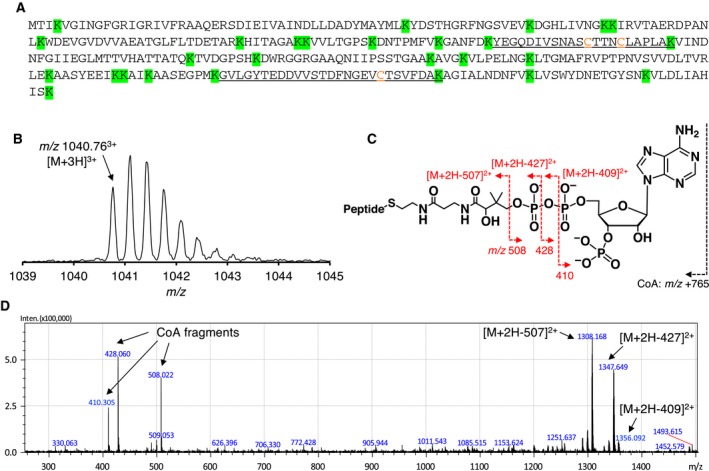
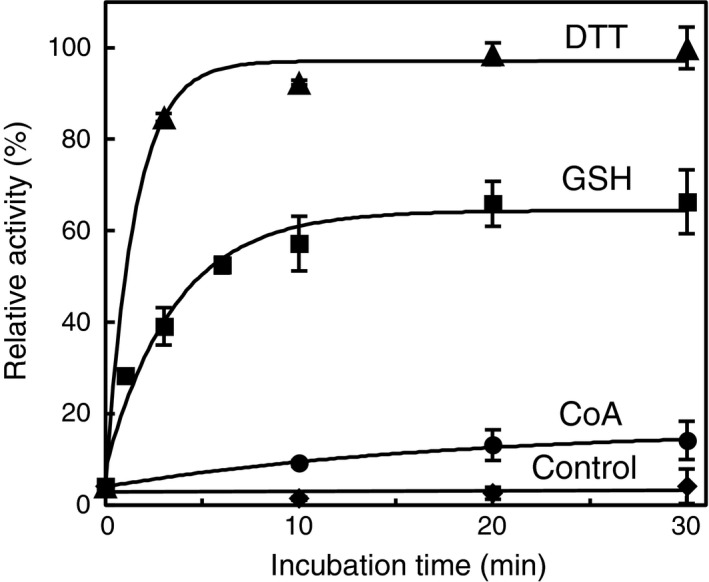
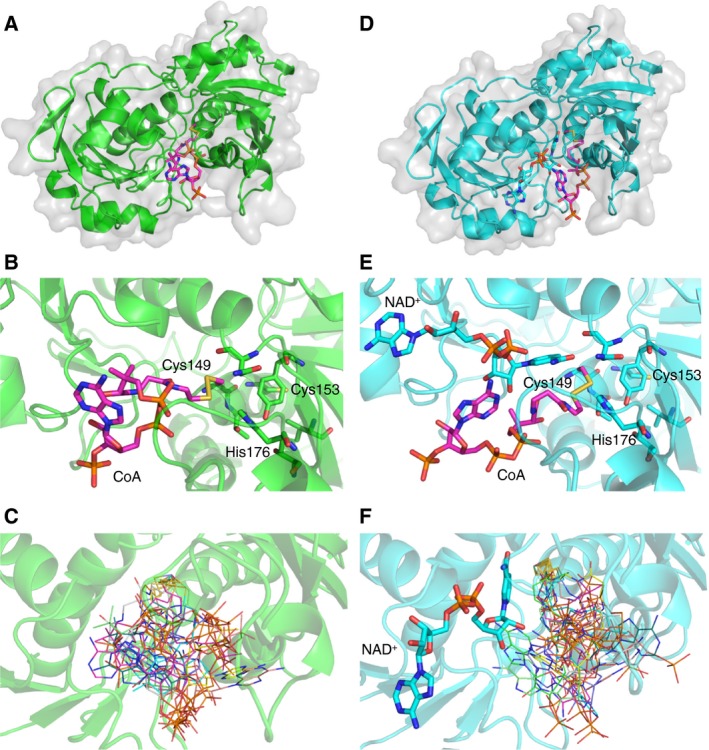
Protein CoAlation (S-thiolation by coenzyme A) has recently emerged as an alternative redox-regulated post-translational modification by which protein thiols are covalently modified with coenzyme A (CoA). However, little is known about the role and mechanism of this post-translational modification. In the present study, we investigated CoAlation of glyceraldehyde-3-phosphate dehydrogenase (GAPDH) from a facultative anaerobic Gram-negative bacterium sp. S-77 ( GAPDH). GAPDH is a key glycolytic enzyme whose activity relies on the thiol-based redox-regulated post-translational modifications of active-site cysteine. LC-MS/MS analysis revealed that CoAlation of GAPDH occurred under sodium hypochlorite (NaOCl) stress. The purified GAPDH was highly sensitive to overoxidation by HO and NaOCl, which resulted in irreversible enzyme inactivation. By contrast, treatment with coenzyme A disulphide (CoASSCoA) or HO/NaOCl in the presence of CoA led to CoAlation and inactivation of the enzyme; activity could be recovered after incubation with dithiothreitol, glutathione and CoA. CoAlation of the enzyme was confirmed by mass spectrometry. The presence of a substrate, glyceraldehyde-3-phosphate, fully protected GAPDH from inactivation by CoAlation, suggesting that the inactivation is due to the formation of mixed disulphides between CoA and the active-site cysteine Cys149. A molecular docking study also supported the formation of mixed disulphide without steric constraints. These observations suggest that CoAlation is an alternative mechanism to protect the redox-sensitive thiol (Cys149) of GAPDH against irreversible oxidation, thereby regulating enzyme activity under oxidative stress.
蛋白 CoA 化(辅酶 A 介导的 S-巯基化)作为一种替代的氧化还原调控的翻译后修饰方式,最近被发现,其可使蛋白巯基与辅酶 A(CoA)共价结合。然而,这种翻译后修饰的作用和机制仍知之甚少。在本研究中,我们研究了兼性厌氧革兰氏阴性菌 sp. S-77 中的甘油醛-3-磷酸脱氢酶(GAPDH)的 CoA 化。GAPDH 是一种关键的糖酵解酶,其活性依赖于活性位点半胱氨酸的基于巯基的氧化还原调控的翻译后修饰。LC-MS/MS 分析表明,GAPDH 的 CoA 化发生在次氯酸钠(NaOCl)应激下。纯化的 GAPDH 对 HO 和 NaOCl 的过度氧化非常敏感,这导致酶不可逆失活。相比之下,用辅酶 A 二硫化物(CoASSCoA)或 HO/NaOCl 在辅酶 A 的存在下处理导致酶的 CoA 化和失活;在用二硫苏糖醇、谷胱甘肽和辅酶 A 孵育后,酶活性可以恢复。通过质谱法证实了该酶的 CoA 化。底物甘油醛-3-磷酸的存在完全保护 GAPDH 免受 CoA 化引起的失活,表明失活是由于 CoA 与活性位点半胱氨酸 Cys149 之间形成混合二硫键所致。分子对接研究也支持在没有空间位阻的情况下形成混合二硫键。这些观察结果表明,CoA 化是一种替代机制,可以保护 GAPDH 的氧化还原敏感的巯基(Cys149)免受不可逆氧化,从而在氧化应激下调节酶活性。