Department of Structural and Molecular Biology, University College London, London WC1E 6BT, UK.
Departmento de Química Inorgánica Analítica y Química Física, Instituto de Química Física de los Materiales, Medioambiente y Energía (INQUIMAE) and Consejo Nacional de Investigaciones Científicas y Técnicas (CONICET), Ciudad Universitaria, Pab. 2 C1428EHA, Buenos Aires 1865, Argentina.
Int J Mol Sci. 2023 May 27;24(11):9359. doi: 10.3390/ijms24119359.
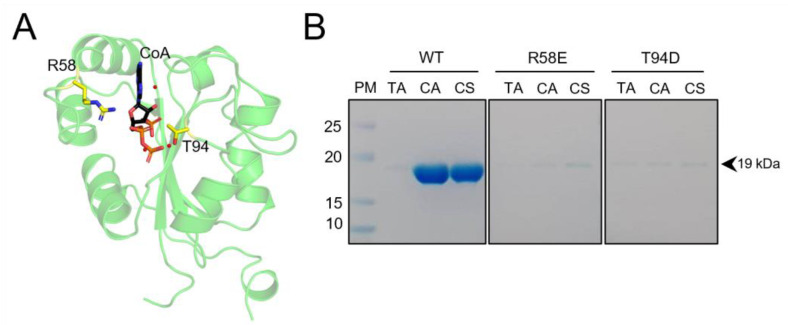
Coenzyme A (CoA) is a key cellular metabolite which participates in diverse metabolic pathways, regulation of gene expression and the antioxidant defense mechanism. Human NME1 (hNME1), which is a moonlighting protein, was identified as a major CoA-binding protein. Biochemical studies showed that hNME1 is regulated by CoA through both covalent and non-covalent binding, which leads to a decrease in the hNME1 nucleoside diphosphate kinase (NDPK) activity. In this study, we expanded the knowledge on previous findings by focusing on the non-covalent mode of CoA binding to the hNME1. With X-ray crystallography, we solved the CoA bound structure of hNME1 (hNME1-CoA) and determined the stabilization interactions CoA forms within the nucleotide-binding site of hNME1. A hydrophobic patch stabilizing the CoA adenine ring, while salt bridges and hydrogen bonds stabilizing the phosphate groups of CoA were observed. With molecular dynamics studies, we extended our structural analysis by characterizing the hNME1-CoA structure and elucidating possible orientations of the pantetheine tail, which is absent in the X-ray structure due to its flexibility. Crystallographic studies suggested the involvement of arginine 58 and threonine 94 in mediating specific interactions with CoA. Site-directed mutagenesis and CoA-based affinity purifications showed that arginine 58 mutation to glutamate (R58E) and threonine 94 mutation to aspartate (T94D) prevent hNME1 from binding to CoA. Overall, our results reveal a unique mode by which hNME1 binds CoA, which differs significantly from that of ADP binding: the α- and β-phosphates of CoA are oriented away from the nucleotide-binding site, while 3'-phosphate faces catalytic histidine 118 (H118). The interactions formed by the CoA adenine ring and phosphate groups contribute to the specific mode of CoA binding to hNME1.
辅酶 A(CoA)是一种关键的细胞代谢物,参与多种代谢途径、基因表达调控和抗氧化防御机制。人类 NME1(hNME1)是一种多功能蛋白,被鉴定为主要的 CoA 结合蛋白。生化研究表明,hNME1 通过共价和非共价结合受 CoA 调节,导致 hNME1 的核苷二磷酸激酶(NDPK)活性降低。在这项研究中,我们通过关注 CoA 与 hNME1 的非共价结合模式,扩展了先前研究结果的知识。通过 X 射线晶体学,我们解决了 hNME1 与 CoA 结合的结构(hNME1-CoA),并确定了 CoA 在 hNME1 的核苷酸结合位点形成的稳定相互作用。观察到一个疏水斑稳定 CoA 的腺嘌呤环,而盐桥和氢键稳定 CoA 的磷酸基团。通过分子动力学研究,我们通过对 hNME1-CoA 结构进行特征描述,并阐明了由于其灵活性而在 X 射线结构中缺失的泛酰巯基乙胺尾的可能取向,从而扩展了我们的结构分析。晶体学研究表明,精氨酸 58 和苏氨酸 94 参与介导与 CoA 的特定相互作用。定点突变和基于 CoA 的亲和纯化表明,精氨酸 58 突变为谷氨酸(R58E)和苏氨酸 94 突变为天冬氨酸(T94D)可阻止 hNME1 与 CoA 结合。总的来说,我们的结果揭示了 hNME1 与 CoA 结合的独特模式,与 ADP 结合模式有很大不同:CoA 的α-和β-磷酸基团朝向远离核苷酸结合位点的方向,而 3'-磷酸基团朝向催化组氨酸 118(H118)。CoA 腺嘌呤环和磷酸基团形成的相互作用有助于 CoA 与 hNME1 的特异性结合模式。