Department of Public Health and Primary Care, Leiden University Medical Center, Hippocratespad 21, 2333 ZD, Leiden, The Netherlands.
Institute of Primary Health Care (BIHAM), University of Bern, Bern, Switzerland.
J Gen Intern Med. 2019 Sep;34(9):1751-1757. doi: 10.1007/s11606-018-4795-x. Epub 2019 Jan 16.
Statins are widely used to prevent cardiovascular disease (CVD). With advancing age, the risks of statins might outweigh the potential benefits. It is unclear which factors influence general practitioners' (GPs) advice to stop statins in oldest-old patients.
To investigate the influence of a history of CVD, statin-related side effects, frailty and short life expectancy, on GPs' advice to stop statins in oldest-old patients.
We invited GPs to participate in this case-based survey. GPs were presented with 8 case vignettes describing patients > 80 years using a statin, and asked whether they would advise stopping statin treatment.
Cases varied in history of CVD, statin-related side effects and frailty, with and without shortened life expectancy (< 1 year) in the context of metastatic, non-curable cancer. Odds ratios adjusted for GP characteristics (OR) were calculated for GPs' advice to stop.
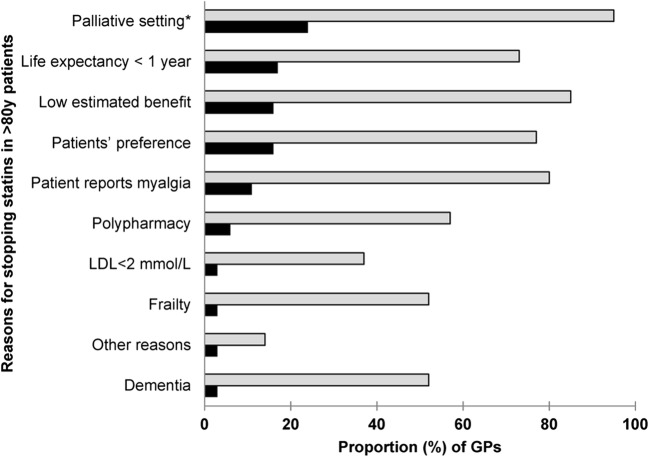
Two thousand two hundred fifty GPs from 30 countries participated (median response rate 36%). Overall, GPs advised stopping statin treatment in 46% (95%CI 45-47) of the case vignettes; with shortened life expectancy, this proportion increased to 90% (95CI% 89-90). Advice to stop was more frequent in case vignettes without CVD compared to those with CVD (OR 13.8, 95%CI 12.6-15.1), with side effects compared to without OR 1.62 (95%CI 1.5-1.7) and with frailty (OR 4.1, 95%CI 3.8-4.4) compared to without. Shortened life expectancy increased advice to stop (OR 50.7, 95%CI 45.5-56.4) and was the strongest predictor for GP advice to stop, ranging across countries from 30% (95%CI 19-42) to 98% (95% CI 96-99).
The absence of CVD, the presence of statin-related side effects, and frailty were all independently associated with GPs' advice to stop statins in patients aged > 80 years. Overall, and within all countries, cancer-related short life expectancy was the strongest independent predictor of GPs' advice to stop statins.
他汀类药物被广泛用于预防心血管疾病(CVD)。随着年龄的增长,他汀类药物的风险可能超过潜在益处。目前尚不清楚哪些因素会影响全科医生建议老年患者停止使用他汀类药物。
调查 CVD 病史、他汀类药物相关副作用、虚弱和预期寿命缩短对全科医生建议老年患者停止使用他汀类药物的影响。
我们邀请全科医生参与这项基于案例的调查。向全科医生提供了 8 个描述使用他汀类药物的>80 岁患者的病例简述,并询问他们是否会建议停止他汀类药物治疗。
病例在 CVD 病史、他汀类药物相关副作用和虚弱方面存在差异,并在患有转移性、不可治愈癌症的情况下考虑了预期寿命缩短(<1 年)。为了调整全科医生的特征,计算了建议停止治疗的可能性比(OR)。
来自 30 个国家的 2250 名全科医生参与了此次调查(中位数应答率为 36%)。总体而言,全科医生建议停止治疗的比例为 46%(95%CI 45-47);在预期寿命缩短的情况下,这一比例增加到 90%(95%CI% 89-90)。与有 CVD 的病例相比,无 CVD 的病例更倾向于建议停止治疗(OR 13.8,95%CI 12.6-15.1),与有副作用的病例相比,无副作用的病例建议停止治疗的可能性更高(OR 1.62,95%CI 1.5-1.7),与虚弱的病例相比,无虚弱的病例建议停止治疗的可能性更高(OR 4.1,95%CI 3.8-4.4)。预期寿命缩短增加了建议停止治疗的可能性(OR 50.7,95%CI 45.5-56.4),是全科医生建议停止治疗的最强预测因素,在各国的范围从 30%(95%CI 19-42)到 98%(95%CI 96-99)。
无 CVD、他汀类药物相关副作用和虚弱均与全科医生建议>80 岁患者停止使用他汀类药物独立相关。总体而言,在所有国家中,癌症相关的预期寿命缩短是全科医生建议停止使用他汀类药物的最强独立预测因素。