Soares Janaina, Vargas Divane de
Escola de Enfermagem da Universidade Federal de Minas Gerais. Departamento de Enfermagem Aplicada. Belo Horizonte, MG, Brasil.
Escola de Enfermagem da Universidade de São Paulo. Departamento de Enfermagem Materno-Infantil e Psiquiátrica. São Paulo, SP, Brasil.
Rev Saude Publica. 2018 Dec 20;53:04. doi: 10.11606/S1518-8787.2019053000498.
To verify the effectiveness of brief group intervention, performed by nurses, in reducing the hazardous or harmful alcohol use in users of a primary health care service.
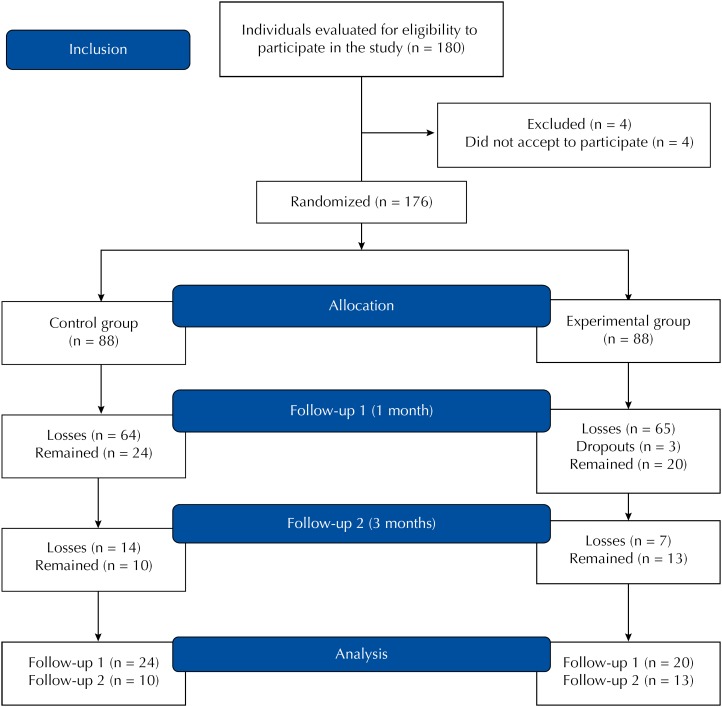
Clinical and randomized trial with follow-up of three months. The sample had 180 individuals with a pattern of hazardous or harmful alcohol use, recruited in a Basic Health Unit in the city of São Paulo. A sociodemographic questionnaire and the Alcohol Use Disorders Identification Test (Audit) were applied. The experimental group underwent the Brief Group Intervention, which had four group sessions, with weekly meetings. The control group received an information leaflet about issues related to alcohol consumption. Both groups participated in the follow-up of three months. The linear mixed model was used for data analysis, in which a 5% significance level was adopted.
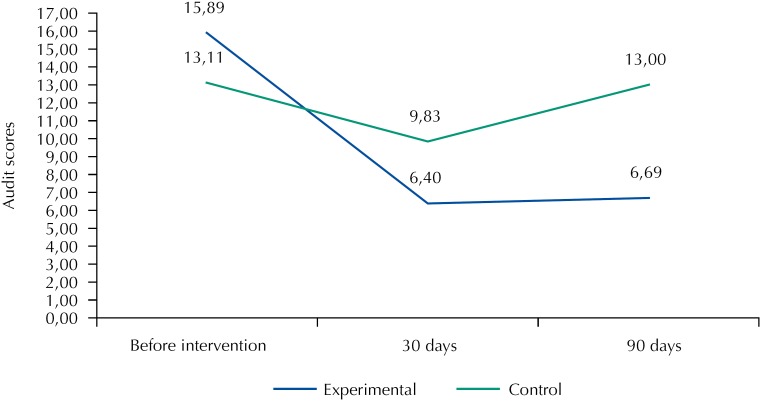
Forty-four individuals under hazardous or harmful alcohol use completed all phases of the research. The experimental group had a statistically significant reduction (p < 0.01) of about 10 points in Audit score after the brief group intervention [before BGI = 15.89 (SD = 6.62) - hazardous use; after BGI = 6.40 (SD = 5.05) - low hazardous use] maintaining the low hazardous use in follow-up [6.69 (SD = 6.38) - low hazardous use]. The control group had a statistically significant reduction (p ≤ 0.01) of about three points in Audit score [before BGI = 13.11 (SD = 4.54) - hazardous use; after BGI = 9.83 (SD = 5.54) - hazardous use] and in follow-up presented the mean score of 13.00 (SD = 5.70), indicative of hazardous use. Differences between the two groups (experimental group versus control group) in reduction of consumption were statistically significant (p ≤ 0.01).
Our evidence showed that the brief group intervention performed by the nurse in the primary health care context was effective to reduce alcohol consumption in individuals with patterns of hazardous or harmful use.
验证护士实施的简短小组干预对减少初级卫生保健服务使用者危险或有害饮酒行为的有效性。
进行为期三个月随访的临床随机试验。样本包括180名有危险或有害饮酒模式的个体,在圣保罗市的一个基本卫生单位招募。应用了社会人口学问卷和酒精使用障碍识别测试(Audit)。实验组接受简短小组干预,共进行四次小组会议,每周一次。对照组收到一份关于酒精消费相关问题的信息传单。两组均参与为期三个月的随访。采用线性混合模型进行数据分析,采用5%的显著性水平。
44名有危险或有害饮酒行为的个体完成了研究的所有阶段。实验组在简短小组干预后Audit评分有统计学意义的显著降低(p < 0.01),降低了约10分[干预前=15.89(标准差=6.62)-危险使用;干预后=6.40(标准差=5.05)-低危险使用],随访期间维持低危险使用水平[6.69(标准差=6.38)-低危险使用]。对照组Audit评分有统计学意义的显著降低(p≤0.01),降低了约3分[干预前=13.11(标准差=4.54)-危险使用;干预后=9.83(标准差=5.54)-危险使用],随访时平均评分为13.00(标准差=5.70),表明为危险使用。两组(实验组与对照组)在饮酒量减少方面的差异有统计学意义(p≤0.01)。
我们的证据表明,护士在初级卫生保健环境中实施的简短小组干预对于减少有危险或有害使用模式个体的酒精消费是有效的。