Rice Somchai, Tursumbayeva Madina, Clark Matthew, Greenlee David, Dharmadhikari Murlidhar, Fennell Anne, Koziel Jacek A
Midwest Grape and Wine Industry Institute, Iowa State University, Ames, IA 50011, USA.
Interdepartmental Toxicology Graduate Program, Iowa State University, Ames, IA 50011, USA.
Foods. 2019 Jan 16;8(1):29. doi: 10.3390/foods8010029.
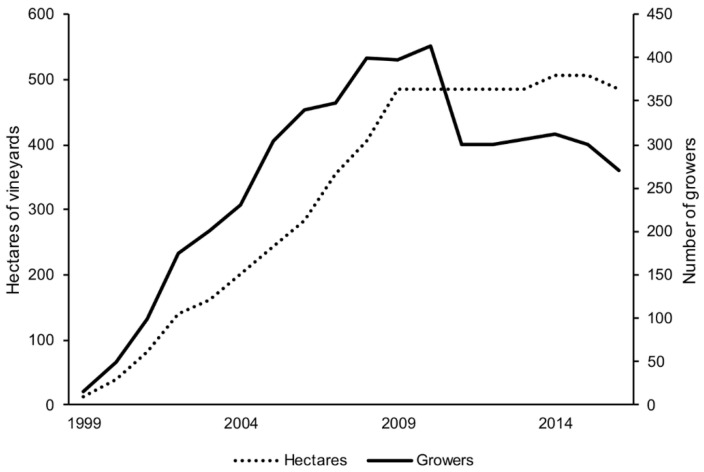
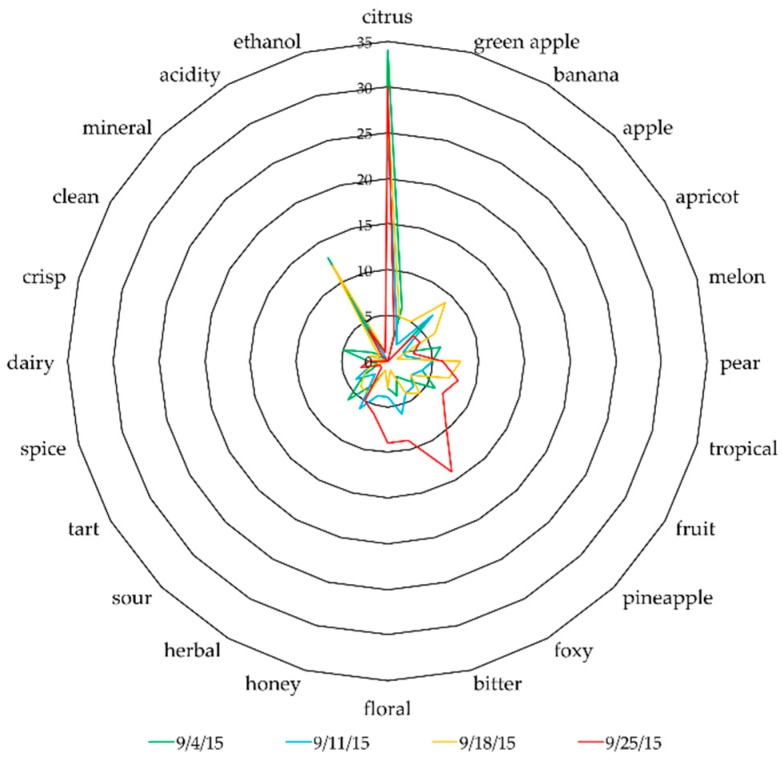
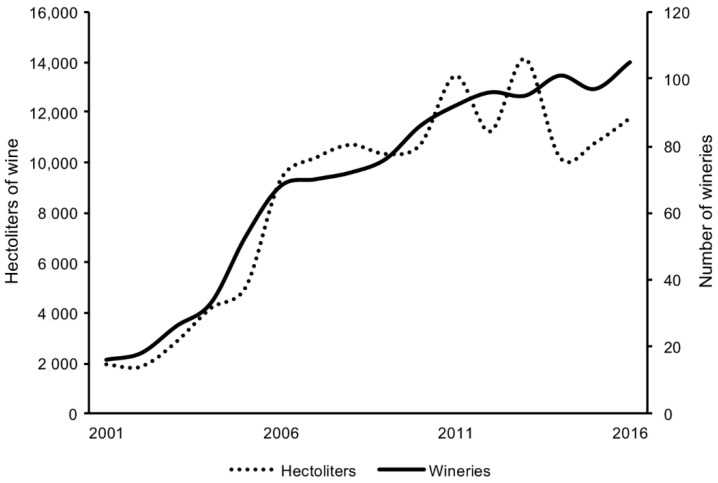
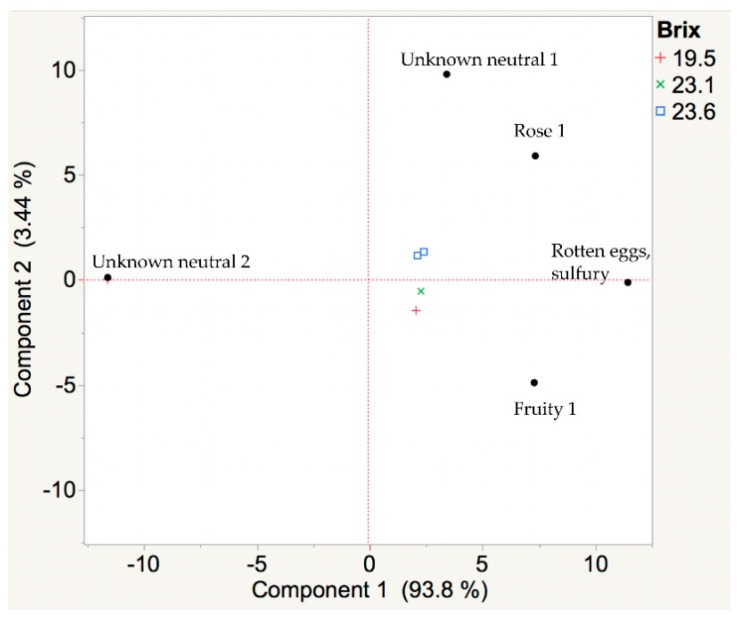
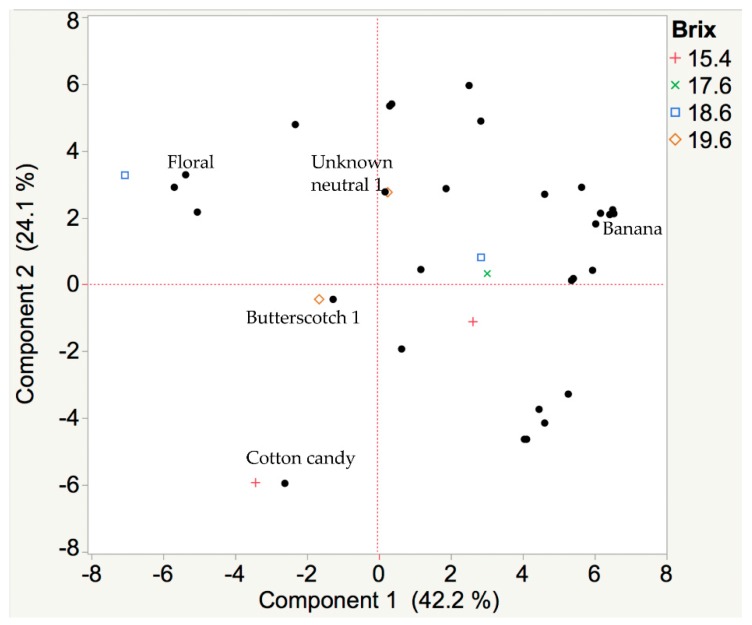
The Midwest wine industry has shown a marked increase in growers, hectares planted, wineries, and wine production. This growth coincides with the release of cold-hardy cultivars such as Brianna and Frontenac gris, in 2001 and 2003, respectively. These white grape varieties account for one-third of the total area grown in the state of Iowa. It is generally accepted that the wine aroma profile plays a crucial role in developing a local, sustainable brand. However, the identity of Brianna/Frontenac Gris-based wine aromas and their link to the grape berry chemistry at harvest is unknown. This study aims to preliminarily characterize key odor-active compounds that can influence the aroma profile in wines made from Brianna and Frontenac gris grapes harvested at different stages of ripening. Brianna and Frontenac gris grapes were harvested approximately 7 days apart, starting at 15.4 °Brix (3.09 pH) and 19.5 °Brix (3.00 pH), respectively. Small batch fermentations were made for each time point with all juices adjusted to the same °Brix prior to fermentation. Odor-active compounds were extracted from wine headspace using solid-phase microextraction (SPME) and analyzed by gas chromatography-mass spectrometry (GC-MS) and simultaneous olfactometry (O). Over 30 odor-active compounds were detected. Aromas in Brianna wines developed from "cotton candy" and "floral", to "banana" and "butterscotch", then finally to "honey", "caramel" and an unknown neutral aroma. Frontenac gris wines changed from an unknown neutral aroma to "fruity" and "rose". Results from the lay audiences' flavor and aroma descriptors also indicate a shift with harvest date and associated °Brix. To date, this is the first report of wine aromas from Brianna and Frontenac gris by GC-MS-O. Findings from this research support the hypothesis that aroma profiles of Brianna and Frontenac gris wines can be influenced by harvesting the grapes at different stages of ripening.
美国中西部葡萄酒产业在种植者数量、种植公顷数、酿酒厂数量以及葡萄酒产量方面均呈现出显著增长。这一增长与2001年和2003年分别推出的耐寒品种布丽安娜(Brianna)和灰比诺(Frontenac gris)相契合。这些白葡萄品种占爱荷华州种植总面积的三分之一。人们普遍认为,葡萄酒的香气特征对于打造一个具有地方特色且可持续发展的品牌起着至关重要的作用。然而,基于布丽安娜/灰比诺的葡萄酒香气特征及其与收获时葡萄浆果化学成分的联系尚不清楚。本研究旨在初步鉴定出关键的气味活性化合物,这些化合物能够影响由不同成熟阶段收获的布丽安娜和灰比诺葡萄酿造的葡萄酒的香气特征。布丽安娜和灰比诺葡萄分别在起始糖度为15.4°Brix(pH值3.09)和19.5°Brix(pH值3.00)时,每隔约7天进行一次采收。在每次发酵前,将所有果汁的糖度调整至相同水平,针对每个时间点进行小批量发酵。使用固相微萃取(SPME)从葡萄酒顶空中提取气味活性化合物,并通过气相色谱 - 质谱联用仪(GC - MS)和同时嗅觉测定法(O)进行分析。检测到3以上种气味活性化合物。布丽安娜葡萄酒的香气从“棉花糖”和“花香”发展为“香蕉”和“奶油糖果”,最终变为“蜂蜜”、“焦糖”以及一种未知的中性香气。灰比诺葡萄酒的香气则从一种未知的中性香气转变为“果香”和“玫瑰香”。普通受众对风味和香气的描述结果也表明,香气会随着采收日期和相应的糖度而发生变化。迄今为止,这是通过气相色谱 - 质谱联用嗅觉测定法(GC - MS - O)对布丽安娜和灰比诺葡萄酒香气进行的首次报道。本研究结果支持了这样的假设,即布丽安娜和灰比诺葡萄酒的香气特征会受到在不同成熟阶段采收葡萄的影响。