Ruiz-Rodríguez Ana, Durán-Guerrero Enrique, Natera Ramón, Palma Miguel, Barroso Carmelo G
Department of Analytical Chemistry, Center for Agri-Food and Wine Research (IVAGRO), Faculty of Sciences, University of Cadiz, 11510 Puerto Real, Spain.
Foods. 2020 Oct 24;9(11):1529. doi: 10.3390/foods9111529.
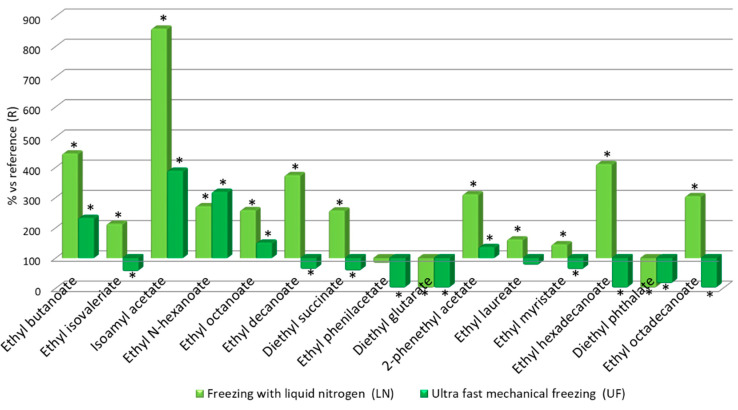
Freezing grapes is a winemaking technique known as cryoextraction that intends to modify the composition of the final wines. The changes that take place in the frozen grapes facilitate the transfer of certain compounds from the grape skins into the musts because of the grape's unstructured tissues. For this study, the white grape variety Muscat of Alexandria was selected. Two different cryoextraction procedures have been analyzed as follows: (i) Ultrafast freezing, and (ii) liquid nitrogen freezing. The wines obtained using liquid nitrogen freezing exhibited higher levels of terpenoids, as well as higher levels of hydroxylic compounds and fatty acids than both the wines obtained through traditional methods and ultrafast freezing wines. In any case, both freezing techniques produced wines of a more intense aroma compared with those wines obtained by traditional methods. In fact, liquid nitrogen freezing produced the wines with the most intense aroma and were the best valued by the tasting panel.
冷冻葡萄是一种被称为低温萃取的酿酒技术,旨在改变最终葡萄酒的成分。由于葡萄组织结构松散,冷冻葡萄中发生的变化有助于某些化合物从葡萄皮转移到葡萄汁中。在本研究中,选用了白葡萄品种亚历山大麝香葡萄。分析了两种不同的低温萃取程序如下:(i)超快冷冻,以及(ii)液氮冷冻。与通过传统方法获得的葡萄酒和超快冷冻葡萄酒相比,使用液氮冷冻获得的葡萄酒表现出更高水平的萜类化合物,以及更高水平的羟基化合物和脂肪酸。无论如何,与通过传统方法获得的葡萄酒相比,这两种冷冻技术生产的葡萄酒香气都更浓郁。事实上,液氮冷冻生产的葡萄酒香气最浓郁,也是品尝小组评价最高的。