Yu Lingling, Wang Wei, Li Liang, Qin Qingguang, Yu Yutian, Liu Kun, Zhao Yufeng, Rong Peijing, Zhu Bing
Department of Neurology, Tongji Hospital, Tongji Medical College, Huazhong University of Science and Technology, Wuhan, Hubei, China.
Institute of Acupuncture and Moxibustion, China Academy of Chinese Medical Sciences, Beijing, China,
J Pain Res. 2019 Jan 3;12:231-242. doi: 10.2147/JPR.S182876. eCollection 2019.
The transmission of visceral nociception can be inhibited by electroacupuncture (EA) at the spinal level. However, relationships between current intensity and EA-induced analgesia are still lacking. This study compares the effects of different intensities of EA at local acupoints and heterotopic acupoints on nociceptive responses of spinal wide dynamic range (WDR) neurons induced by noxious colorectal distension (CRD).
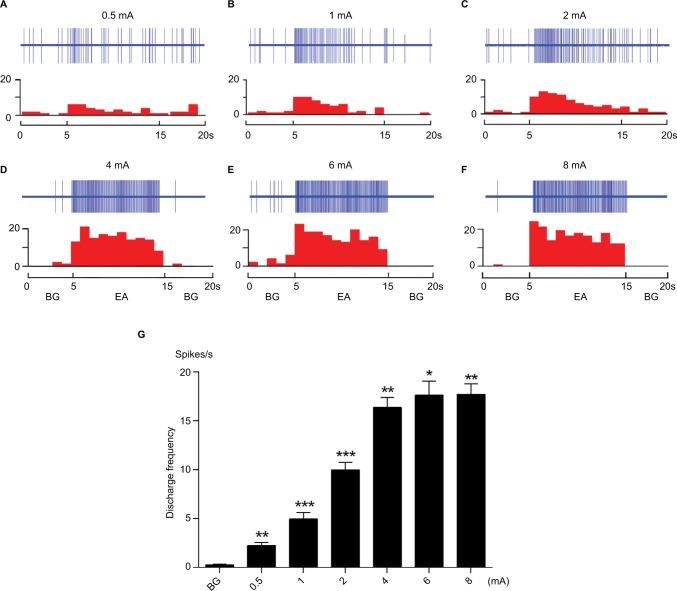
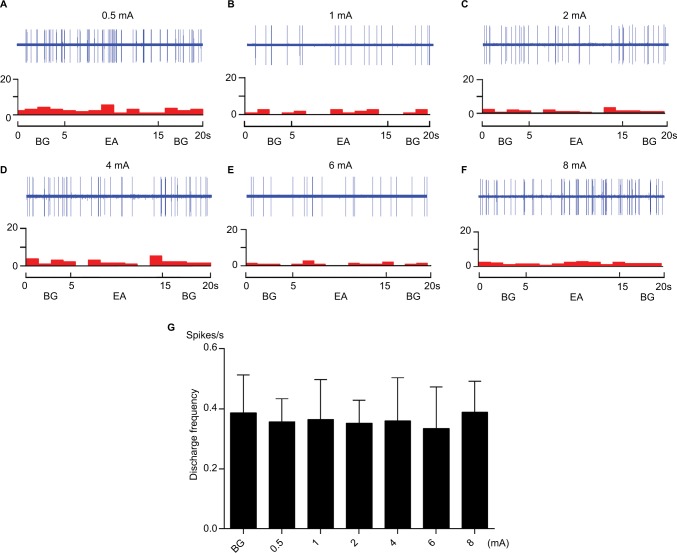
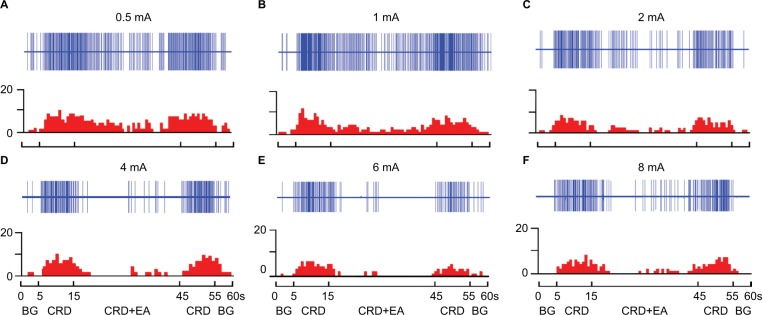
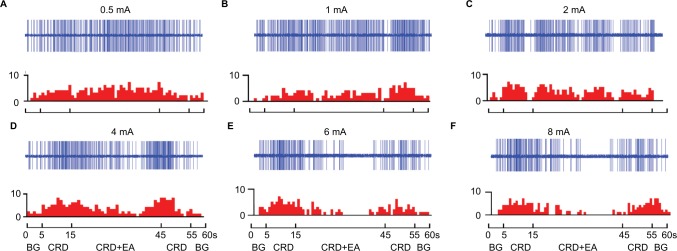
Experiments were conducted on 40 Sprague Dawley rats anesthetized with 10% urethane. Discharges of WDR neurons in the L1-L3 segments of the dorsal horn of the spinal cord were recorded extracellularly by glass micropipettes. Different intensities of EA (0.5, 1, 2, 4, 6, and 8 mA, 0.5 ms, 2 Hz) were applied to contralateral "Zusanli" (ST 36) or "Neiguan" (PC 6), with either the same or different segmental innervation of the colon.
In local acupoints, the increased discharges of WDR neurons evoked by CRD were significantly inhibited by EA at 0.5-8 mA. A positive relationship between current intensity and the inhibiting rate was observed within 0.5-4 mA, but the inhibiting rate reached a plateau when EA exceeded 4 mA. In heterotopic acupoints, the increased discharges of WDR neurons evoked by CRD were significantly inhibited by EA at 2-8 mA. A positive relationship between current intensity and the inhibiting rate was observed within 2-6 mA. Further increase in the current beyond 6 mA also resulted in a plateau effect.
Within a certain range, the nociceptive responses of dorsal horn neurons induced by CRD could be inhibited by EA in an intensity-dependent manner.
内脏痛觉的传导在脊髓水平可被电针(EA)抑制。然而,电流强度与电针诱导镇痛之间的关系仍不明确。本研究比较了不同强度的电针刺激局部穴位和非穴位对有害性结直肠扩张(CRD)诱导的脊髓广动力范围(WDR)神经元伤害性反应的影响。
对40只10%乌拉坦麻醉的Sprague Dawley大鼠进行实验。用玻璃微电极细胞外记录脊髓背角L1-L3节段WDR神经元的放电。将不同强度的电针(0.5、1、2、4、6和8 mA,0.5 ms,2 Hz)施加于对侧“足三里”(ST 36)或“内关”(PC 6),这些穴位对结肠的节段性神经支配相同或不同。
在局部穴位,0.5-8 mA的电针显著抑制了CRD诱发的WDR神经元放电增加。在0.5-4 mA范围内,观察到电流强度与抑制率呈正相关,但当电针超过4 mA时,抑制率达到平台期。在非穴位,2-8 mA的电针显著抑制了CRD诱发的WDR神经元放电增加。在2-6 mA范围内,观察到电流强度与抑制率呈正相关。电流进一步增加超过6 mA也会产生平台效应。
在一定范围内,电针可呈强度依赖性抑制CRD诱导的背角神经元伤害性反应。