Hradilová Iveta, Duchoslav Martin, Brus Jan, Pechanec Vilém, Hýbl Miroslav, Kopecký Pavel, Smržová Lucie, Štefelová Nikola, Vaclávek Tadeáš, Bariotakis Michael, Machalová Jitka, Hron Karel, Pirintsos Stergios, Smýkal Petr
Department of Botany, Palacký University Olomouc, Olomouc, Czech Republic.
Department of Geoinformatics, Palacký University Olomouc, Olomouc, Czech Republic.
PeerJ. 2019 Jan 14;7:e6263. doi: 10.7717/peerj.6263. eCollection 2019.
Seed germination is one of the earliest key events in the plant life cycle. The timing of transition from seed to seedling is an important developmental stage determining the survival of individuals that influences the status of populations and species. Because of wide geographical distribution and occurrence in diverse habitats, wild pea ( subsp. ) offers an excellent model to study physical type of seed dormancy in an ecological context. This study addresses the gap in knowledge of association between the seed dormancy, seed properties and environmental factors, experimentally testing oscillating temperature as dormancy release clue.
Seeds of 97 pea accessions were subjected to two germination treatments (oscillating temperatures of 25/15 °C and 35/15 °C) over 28 days. Germination pattern was described using B-spline coefficients that aggregate both final germination and germination speed. Relationships between germination pattern and environmental conditions at the site of origin (soil and bioclimatic variables extracted from WorldClim 2.0 and SoilGrids databases) were studied using principal component analysis, redundancy analysis and ecological niche modelling. Seeds were analyzed for the seed coat thickness, seed morphology, weight and content of proanthocyanidins (PA).
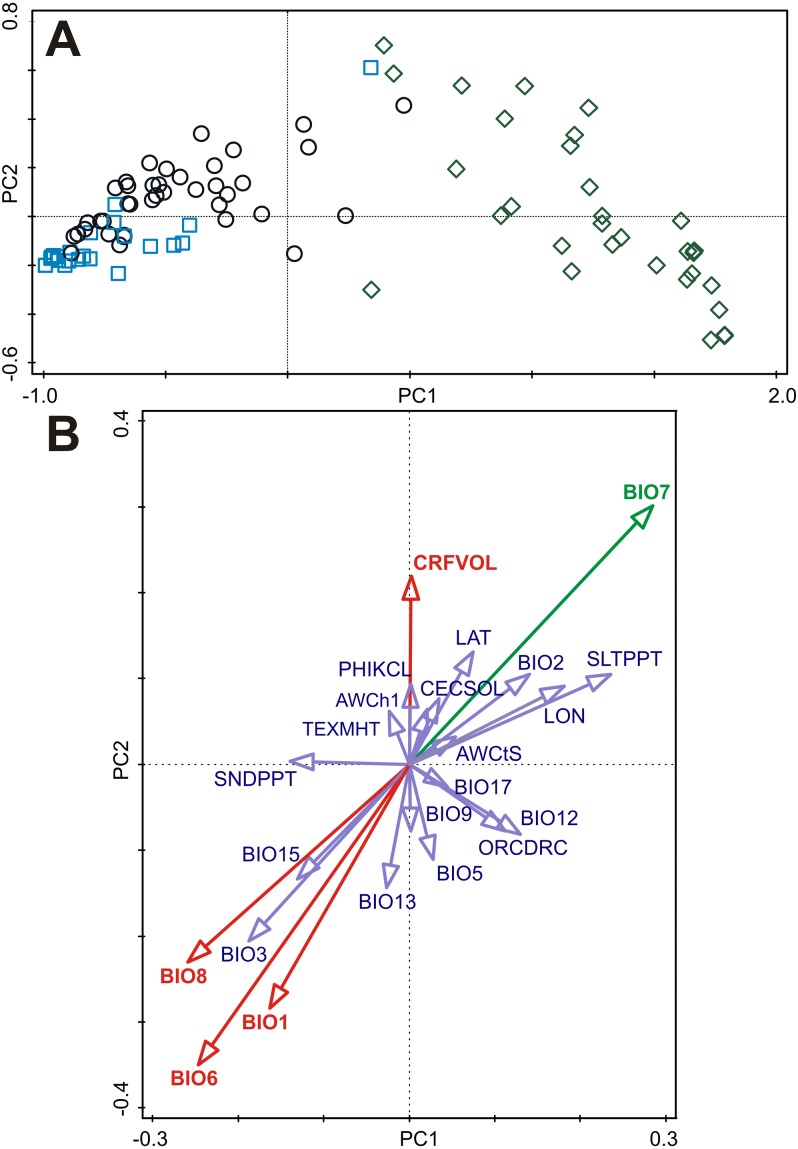
Seed total germination ranged from 0% to 100%. Cluster analysis of germination patterns of seeds under two temperature treatments differentiated the accessions into three groups: (1) non-dormant (28 accessions, mean germination of 92%), (2) dormant at both treatments (29 acc., 15%) and (3) responsive to increasing temperature range (41 acc., with germination change from 15 to 80%). Seed coat thickness differed between groups with dormant and responsive accessions having thicker testa (median 138 and 140 µm) than non-dormant ones (median 84 mm). The total PA content showed to be higher in the seed coat of dormant (mean 2.18 mg g) than those of non-dormant (mean 1.77 mg g) and responsive accessions (mean 1.87 mg g). Each soil and bioclimatic variable and also germination responsivity (representing synthetic variable characterizing germination pattern of seeds) was spatially clustered. However, only one environmental variable (BIO7, i.e., annual temperature range) was significantly related to germination responsivity. Non-dormant and responsive accessions covered almost whole range of BIO7 while dormant accessions are found in the environment with higher annual temperature, smaller temperature variation, seasonality and milder winter. Ecological niche modelling showed a more localized potential distribution of dormant group. Seed dormancy in the wild pea might be part of a bet-hedging mechanism for areas of the Mediterranean basin with more unpredictable water availability in an otherwise seasonal environment. This study provides the framework for analysis of environmental aspects of physical seed dormancy.
种子萌发是植物生命周期中最早的关键事件之一。从种子到幼苗的转变时间是一个重要的发育阶段,它决定了个体的存活,进而影响种群和物种的状况。由于野生豌豆(亚种)广泛的地理分布和在多样栖息地中的出现,它为在生态背景下研究种子休眠的物理类型提供了一个极好的模型。本研究填补了种子休眠、种子特性和环境因素之间关联的知识空白,通过实验测试振荡温度作为休眠解除的线索。
对97份豌豆种质的种子进行了为期28天的两种萌发处理(25/15°C和35/15°C的振荡温度)。使用B样条系数描述萌发模式,该系数综合了最终萌发率和萌发速度。利用主成分分析、冗余分析和生态位建模研究了萌发模式与原产地环境条件(从WorldClim 2.0和SoilGrids数据库中提取的土壤和生物气候变量)之间的关系。对种子的种皮厚度、种子形态、重量和原花青素(PA)含量进行了分析。
种子总萌发率在0%至100%之间。对两种温度处理下种子萌发模式的聚类分析将种质分为三组:(1)非休眠(28份种质,平均萌发率92%),(2)在两种处理下均休眠(29份种质,15%),(3)对温度范围增加有响应(41份种质,萌发率从15%变化到80%)。休眠和有响应的种质组的种皮厚度与非休眠种质组不同,前者种皮较厚(中位数分别为138和140 µm),后者种皮较薄(中位数为84 µm)。休眠种子的种皮中总PA含量(平均2.18 mg/g)高于非休眠种子(平均1.77 mg/g)和有响应的种子(平均1.87 mg/g)。每个土壤和生物气候变量以及萌发响应性(代表表征种子萌发模式的综合变量)在空间上呈聚类分布。然而,只有一个环境变量(BIO7,即年温度范围)与萌发响应性显著相关。非休眠和有响应的种质几乎覆盖了BIO7的整个范围,而休眠种质则出现在年温度较高、温度变化较小、季节性较强且冬季较温和的环境中。生态位建模显示休眠组的潜在分布更具局部性。野生豌豆中的种子休眠可能是地中海盆地某些地区在季节性环境中水分供应更不可预测情况下的一种风险分摊机制的一部分。本研究为分析种子物理休眠的环境方面提供了框架。