Williams Owen R, Vander Schoor Jacqueline K, Butler Jakob B, Hecht Valérie F G, Weller James L
School of Natural Sciences, University of Tasmania, Hobart, TAS, Australia.
ARC Centre of Excellence for Plant Success in Nature and Agriculture, University of Tasmania, Hobart, TAS, Australia.
Front Plant Sci. 2024 Feb 27;15:1359226. doi: 10.3389/fpls.2024.1359226. eCollection 2024.
The seeds of wild pea () exhibit marked physical dormancy due to impermeability of the seed coat to water, and the loss of this dormancy is thought to have been critical for domestication. Wild pea seed coats are also notably thick and rough, traits that have also reduced during domestication and are anecdotally linked to increased permeability. However, how these traits specifically interact with permeability is unclear.
To investigate this, we examined the genetic control of differences in seed coat characteristics between wild ssp. and a non-dormant domesticated accession in a recombinant inbred population. QTL effects were confirmed and their locations refined in segregating F populations.
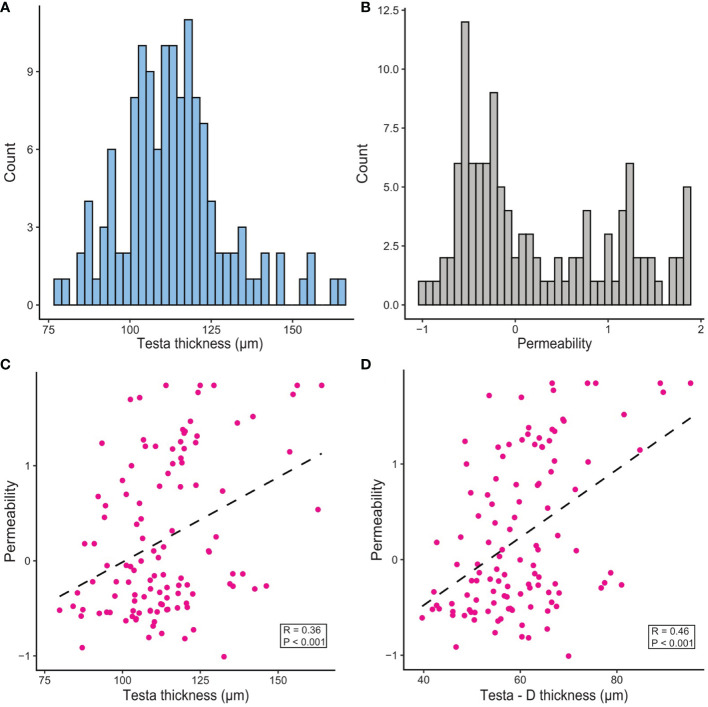
In this population we found a moderate correlation between testa thickness and permeability, and identified loci that affect them independently, suggesting no close functional association. However, the major loci affecting both testa thickness and permeability collocated closely with Mendel's pigmentation locus A, suggesting flavonoid compounds under its control might contribute significantly to both traits. We also show that seed coat roughness is oligogenic in this population, with the major locus independent of both testa thickness and permeability, suggesting selection for smooth seed was unlikely to be due to effects on either of these traits.
Results indicate loss of seed coat dormancy during domestication was not primarily driven by reduced testa thickness or smooth seededness. The close association between major permeability and thickness QTL and Mendel's 'A' warrant further study, particularly regarding the role of flavonoids.
野生豌豆()种子由于种皮不透水而表现出明显的物理休眠,这种休眠的丧失被认为对驯化至关重要。野生豌豆种皮也明显厚实且粗糙,这些性状在驯化过程中也有所减少,并且据推测与通透性增加有关。然而,这些性状如何具体与通透性相互作用尚不清楚。
为了研究这一点,我们在一个重组自交群体中研究了野生豌豆亚种和一个非休眠驯化豌豆品种之间种皮特征差异的遗传控制。在分离的F群体中证实了数量性状基因座(QTL)效应并细化了它们的位置。
在这个群体中,我们发现种皮厚度与通透性之间存在适度的相关性,并鉴定出独立影响它们的基因座,这表明它们之间没有紧密的功能关联。然而,影响种皮厚度和通透性的主要基因座与孟德尔色素沉着基因座A紧密共定位,表明其控制下的类黄酮化合物可能对这两个性状都有显著贡献。我们还表明,在这个群体中种皮粗糙度是寡基因的,主要基因座独立于种皮厚度和通透性,这表明对光滑种子的选择不太可能是由于对这两个性状中任何一个的影响。
结果表明,驯化过程中种皮休眠的丧失并非主要由种皮厚度降低或种子光滑度引起。主要通透性和厚度QTL与孟德尔“A”之间的紧密关联值得进一步研究,特别是关于类黄酮的作用。