Kim Nan-Soo
Department of Physical Therapy, College of Health Sciences, Catholic University of Pusan, Busan, Korea.
J Exerc Rehabil. 2018 Dec 27;14(6):1017-1023. doi: 10.12965/jer.1836444.222. eCollection 2018 Dec.
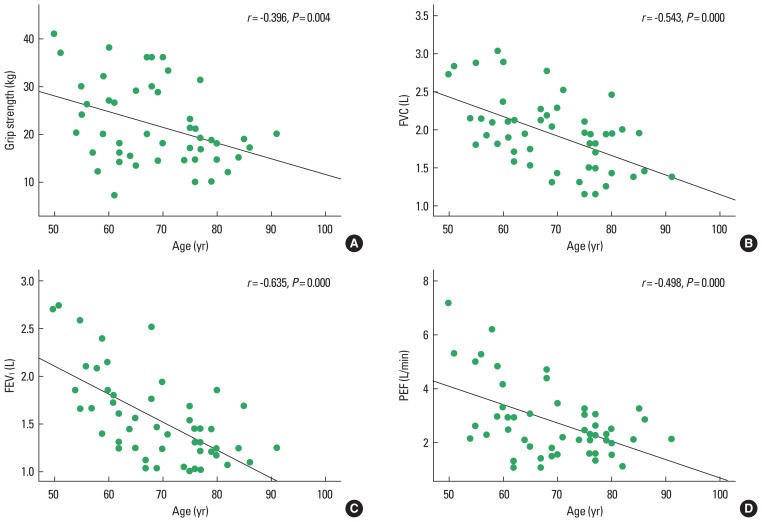
Age-related skeletal muscle changes may impact respiratory muscle function, and low muscle mass is associated with low pulmonary function in older adults. Stroke not only causes weakness in the muscles of the upper and lower limbs, but it can also affect the respiratory system. This study aimed to investigate the relationships between grip strength and pulmonary function and respiratory muscle strength in stroke patients over 50 years of age. Fifty-one patients (68.69±10.40 years) who had been clinically diagnosed with ischemic or hemorrhagic stroke were included in this study. We measured these patients' forced vital capacity (FVC), forced expiratory volume in 1 sec (FEV), peak expiratory flow (PEF), maximal inspiratory pressure (MIP), maximal expiratory pressure (MEP), and hand grip strength. The data were analyzed using descriptive statistics and Pearson correlation analysis. Grip strength showed significant correlations with FVC (=0.686, =0.000), FEV (=0.607, =0.000), PEF (=0.494, =0.000), MIP (=0.239, =0.091), and MEP (=0.348, =0.012). This study demonstrated that grip strength is associated with pulmonary function and MEP in stroke patients over 50 years of age.
与年龄相关的骨骼肌变化可能会影响呼吸肌功能,而肌肉量低与老年人的肺功能低下有关。中风不仅会导致上肢和下肢肌肉无力,还会影响呼吸系统。本研究旨在调查50岁以上中风患者握力与肺功能及呼吸肌力量之间的关系。本研究纳入了51例临床诊断为缺血性或出血性中风的患者(年龄68.69±10.40岁)。我们测量了这些患者的用力肺活量(FVC)、第1秒用力呼气量(FEV)、呼气峰值流速(PEF)、最大吸气压力(MIP)、最大呼气压力(MEP)和握力。使用描述性统计和Pearson相关分析对数据进行分析。握力与FVC(=0.686,=0.000)、FEV(=0.607,=0.000)、PEF(=0.494,=0.000)、MIP(=0.239,=0.091)和MEP(=0.348,=0.012)显示出显著相关性。本研究表明,50岁以上中风患者的握力与肺功能和MEP相关。