Jeong Moa, Kang Hyung Koo, Song Pamela, Park Hye Kyeong, Jung Hoon, Lee Sung-Soon, Koo Hyeon-Kyoung
Division of Pulmonary and Critical Care Medicine, Department of Internal Medicine.
Department of Neurology, Ilsan Paik Hospital, Inje University College of Medicine, Goyang, Republic of Korea.
Int J Chron Obstruct Pulmon Dis. 2017 Aug 9;12:2385-2390. doi: 10.2147/COPD.S140915. eCollection 2017.
Hand grip strength (HGS) is a simple way of predicting the risk of cardiovascular disease and all-cause mortality in the general population. However, the practical significance of grip strength in patients with COPD is uncertain. The aim of this study was to compare HGS between subjects with and without COPD and to evaluate its clinical relevance in patients with COPD by using a national survey.
Data were collected from the Korean National Health and Nutrition Examination Survey. The study included 421 adults with COPD and 2,542 controls who completed questionnaires, spirometry, and a HGS test. HGS was compared between subjects with and without COPD, and the association between grip strength, lung function, and quality of life (QoL) was evaluated.
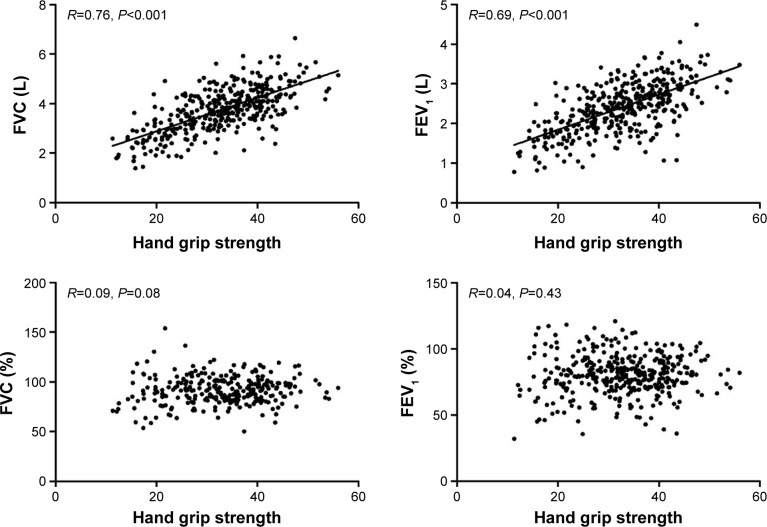
The mean HGS was 33.3±9.1 kg in the COPD group and 29.9±9.5 kg in the non-COPD group; adjusted HGS was 30.9±0.33 kg and 30.9±0.11 kg, respectively (=0.99). HGS was not related to forced vital capacity (β=0.04, =0.70) or forced expiratory volume in 1 second (β=0.11, =0.24) in multivariable analysis. HGS was independently associated with the EQ-5D index, but the relationship was stronger in the COPD group (β=0.30, <0.001) than in the non-COPD group (β=0.21, <0.001). The results were similar for each component of the EQ-5D, including mobility (β=-0.25, <0.001), daily activity (β=-0.19, =0.01), pain/discomfort (β=-0.32, <0.001), and anxiety/depression (β=-0.16, =0.01).
HGS was not different between subjects with and without COPD, but was associated with QoL - including mobility, daily activity, pain/discomfort, and anxiety/depression - in patients with COPD. The HGS test could be used as a marker of QoL in patients with COPD and could assist risk stratification in clinical practice.
握力(HGS)是预测普通人群心血管疾病风险和全因死亡率的一种简单方法。然而,握力在慢性阻塞性肺疾病(COPD)患者中的实际意义尚不确定。本研究的目的是比较有和没有COPD的受试者之间的握力,并通过一项全国性调查评估其在COPD患者中的临床相关性。
数据来自韩国国家健康与营养检查调查。该研究纳入了421名患有COPD的成年人和2542名对照者,他们完成了问卷调查、肺功能测定和握力测试。比较了有和没有COPD的受试者之间的握力,并评估了握力、肺功能和生活质量(QoL)之间的关联。
COPD组的平均握力为33.3±9.1kg,非COPD组为29.9±9.5kg;调整后的握力分别为30.9±0.33kg和30.9±0.11kg(P=0.99)。在多变量分析中,握力与用力肺活量(β=0.04,P=0.70)或1秒用力呼气量(β=0.11,P=0.24)无关。握力与EQ-5D指数独立相关,但在COPD组(β=0.30,P<0.001)中的关系比在非COPD组(β=0.21,P<0.001)中更强。EQ-5D的各个组成部分结果相似,包括活动能力(β=-0.25,P<0.001)、日常活动(β=-0.19,P=0.01)、疼痛/不适(β=-0.32,P<0.001)和焦虑/抑郁(β=-0.16,P=0.01)。
有和没有COPD的受试者之间握力没有差异,但与COPD患者的生活质量相关,包括活动能力、日常活动、疼痛/不适和焦虑/抑郁。握力测试可作为COPD患者生活质量的一个指标,并可在临床实践中协助进行风险分层。