Department of Clinical Genetics Leiden University Medical Center Leiden the Netherlands.
Neurochemistry lab and Biobank Department of Clinical Chemistry Amsterdam Neuroscience VU University Medical Center Amsterdam the Netherlands.
Ann Clin Transl Neurol. 2018 Nov 20;6(1):46-56. doi: 10.1002/acn3.678. eCollection 2019 Jan.
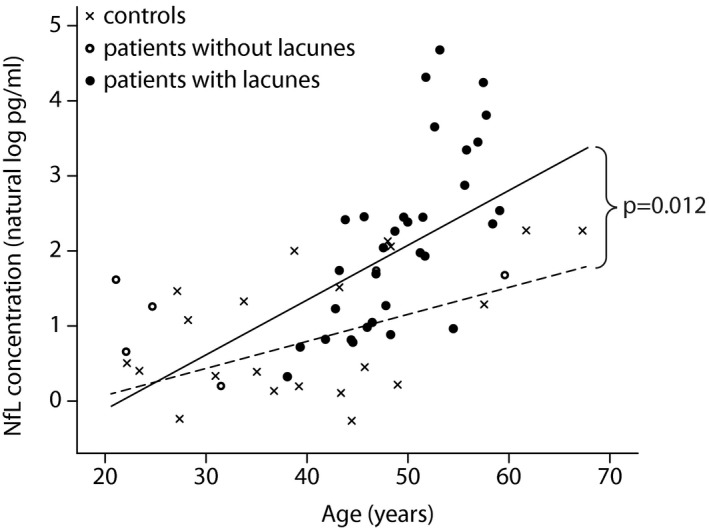
To validate whether serum Neurofilament Light-chain (NfL) levels correlate with disease severity in CADASIL, and to determine whether serum NfL predicts disease progression and survival.
Fourty-one (pre-) manifest individuals with CADASIL causing mutations and 22 healthy controls were recruited from CADASIL families. At baseline, MRI-lesion load and clinical severity was determined and serum was stored. Disease progression was measured in 30/41 patients at 7-year follow-up, and survival of all individuals was determined at 17-year follow-up. Serum NfL levels were quantified using an ultra-sensitive molecule array. Generalized estimated equation regression (GEE) was used to analyze association between serum NfL, MRI-lesion load, disease severity, and disease progression. With GEE-based Cox regression, survival was analyzed.
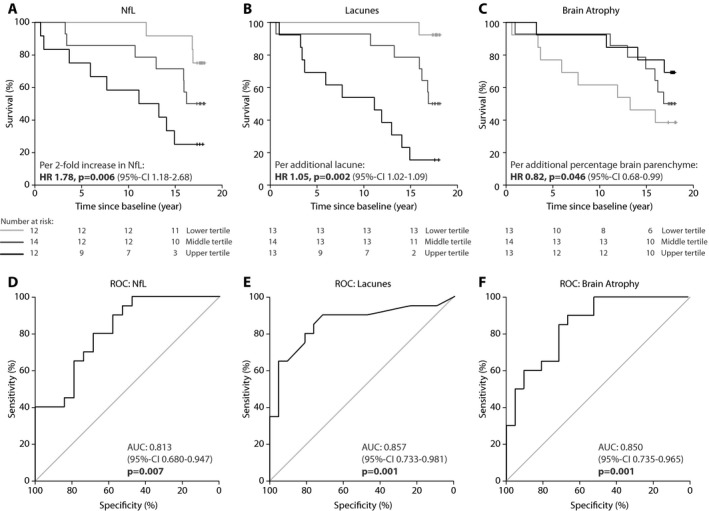
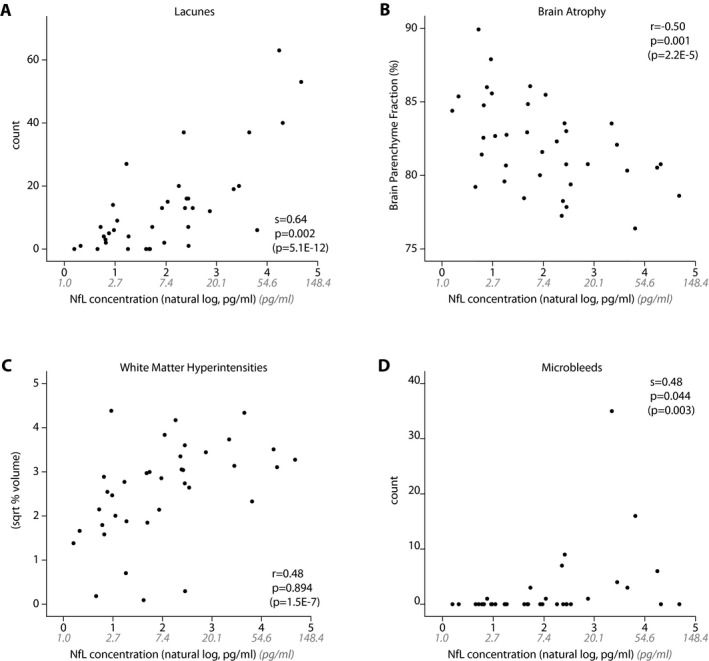
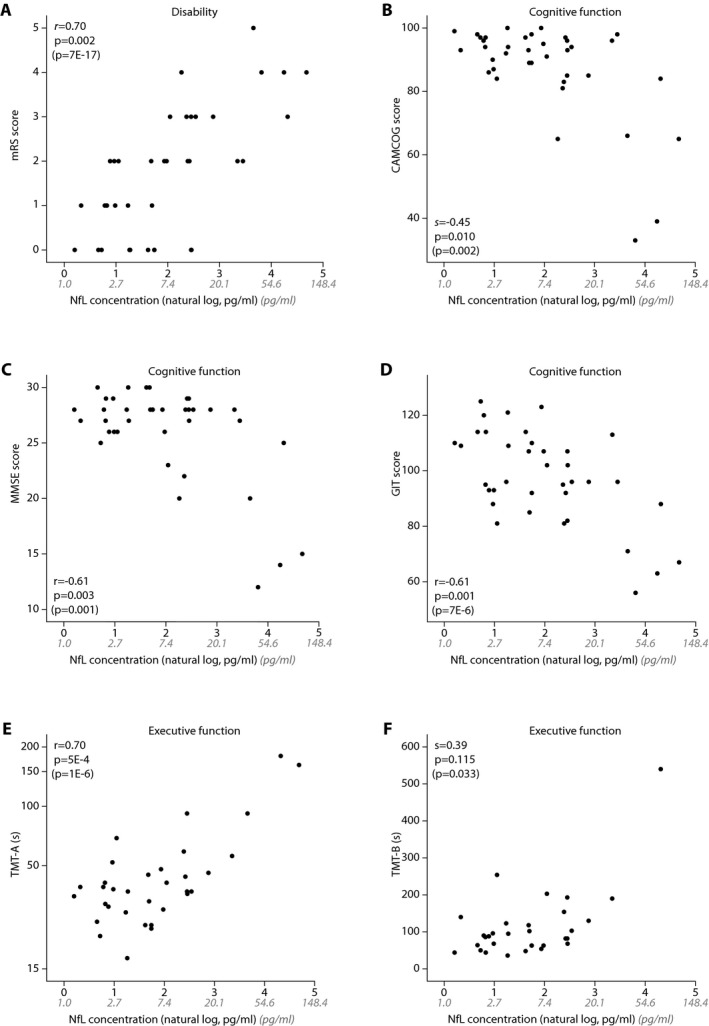
At baseline, serum NfL levels correlated with MRI-lesion load [lacune count (=0.64, = 0.002), brain atrophy (=-0.50, = 0.001), and microbleed count (=0.48, = 0.044)], cognition [CAMCOG (=-0.45, = 0.010), MMSE (=-0.61, = 0.003), GIT (=-0.61, < 0.001), TMT-A (=0.70, < 0.001)) and disability (mRS (=0.70, = 0.002)]. Baseline serum NfL predicted 7-year changes in disability ( = 0.34, < 0.001) and cognition (CAMCOG = -4.94, = 0.032), as well as 17-year survival. Higher NfL levels were associated with increased mortality (HR=1.8 per twofold increase in NfL levels, = 0.006).
Serum NfL levels correlate with disease severity, disease progression and 17-year survival in CADASIL patients. Serum NfL is a promising biomarker to monitor and predict disease course in CADASIL, as well as potentially assessing therapeutic response in future clinical trials.
验证血清神经丝轻链(NfL)水平是否与 CADASIL 疾病严重程度相关,并确定血清 NfL 是否可预测疾病进展和存活。
本研究纳入了 41 名携带 CADASIL 基因突变的(前)显性个体和 22 名健康对照者,他们均来自 CADASIL 家族。在基线时,评估 MRI 病变负荷和临床严重程度,并储存血清。在 7 年随访时,对 30/41 名患者进行疾病进展测量,在 17 年随访时,对所有患者进行生存分析。使用超敏分子阵列定量血清 NfL 水平。采用广义估计方程(GEE)分析血清 NfL 与 MRI 病变负荷、疾病严重程度和疾病进展之间的关系。基于 GEE 的 Cox 回归分析了生存情况。
基线时,血清 NfL 水平与 MRI 病变负荷相关[腔隙数(=0.64, =0.002)、脑萎缩(=-0.50, =0.001)和微出血数(=0.48, =0.044)]、认知功能[CAMCOG (=-0.45, =0.010)、MMSE (=-0.61, =0.003)、GIT (=-0.61, <0.001)、TMT-A (=0.70, <0.001)]和残疾程度(mRS (=0.70, =0.002)]。基线血清 NfL 预测了 7 年的残疾程度变化( =0.34, <0.001)和认知功能变化(CAMCOG =4.94, =0.032)以及 17 年的存活情况。较高的 NfL 水平与死亡率增加相关(HR=1.8,每两倍增加 NfL 水平, =0.006)。
血清 NfL 水平与 CADASIL 患者的疾病严重程度、疾病进展和 17 年生存率相关。血清 NfL 是监测和预测 CADASIL 疾病进程的有前途的生物标志物,也可能在未来的临床试验中评估治疗反应。