Division of General Pediatrics, Department of Pediatrics, Boston University School of Medicine, Boston, Massachusetts.
Department of Pediatrics, Boston Medical Center, Boston, Massachusetts.
JAMA Netw Open. 2019 Jan 4;2(1):e186007. doi: 10.1001/jamanetworkopen.2018.6007.
Prescription opioids are involved in 40% of all deaths from opioid overdose in the United States and are commonly the first opioids encountered by individuals with opioid use disorder. It is unclear whether the pharmaceutical industry marketing of opioids to physicians is associated with mortality from overdoses.
To identify the association between direct-to-physician marketing of opioid products by pharmaceutical companies and mortality from prescription opioid overdoses across US counties.
DESIGN, SETTING, AND PARTICIPANTS: This population-based, county-level analysis of industry marketing information used data from the Centers for Medicare & Medicaid Services Open Payments database linked with data from the Centers for Disease Control and Prevention on opioid prescribing and mortality from overdoses. All US counties were included, with data on overdoses from August 1, 2014, to December 31, 2016, linked to marketing data from August 1, 2013, to December 31, 2015, using a 1-year lag. Statistical analyses were conducted between February 1 and June 1, 2018.
County-level mortality from prescription opioid overdoses, total cost of marketing of opioid products to physicians, number of marketing interactions, opioid prescribing rates, and sociodemographic factors.
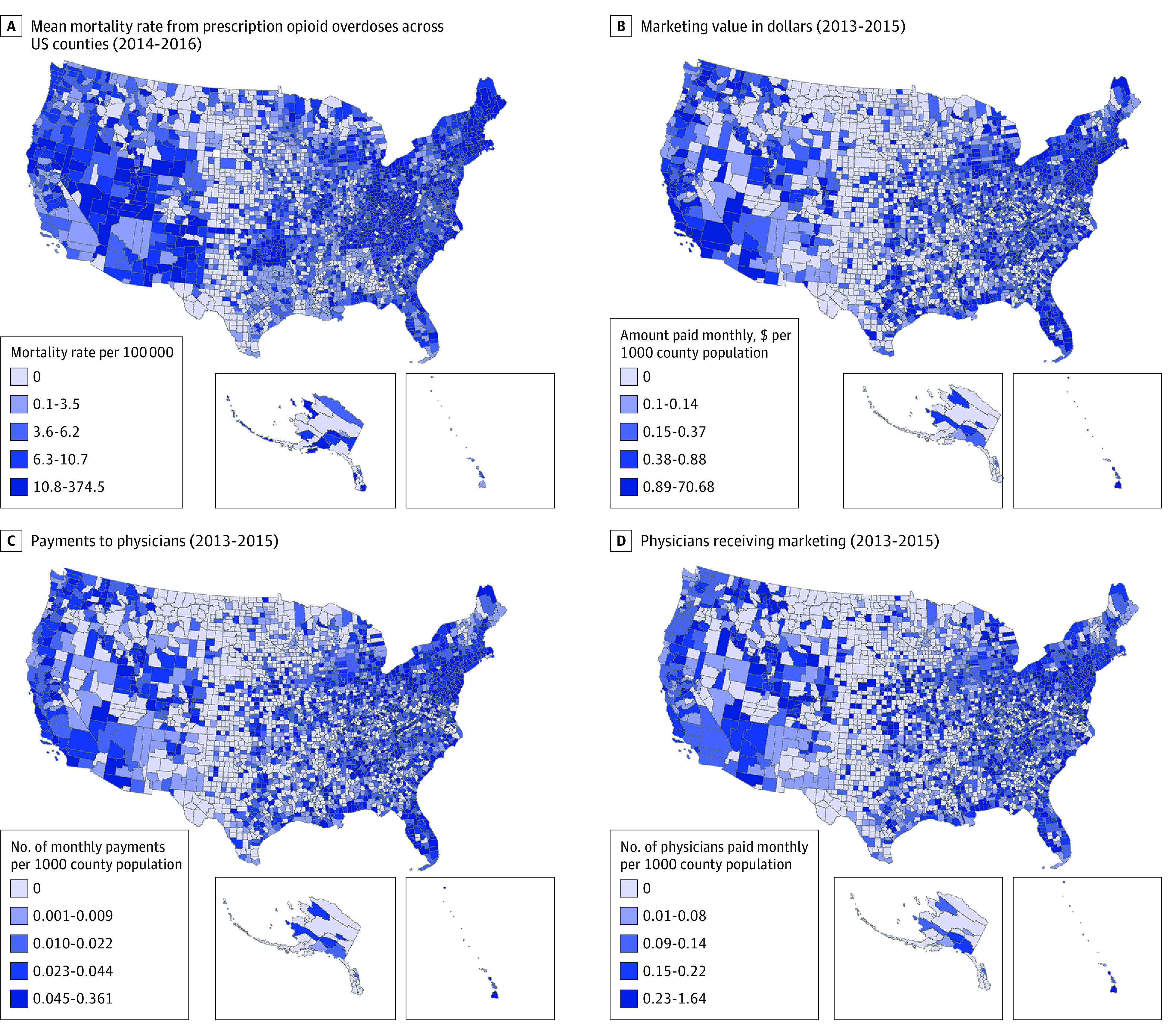
Between August 1, 2013, and December 31, 2015, there were 434 754 payments totaling $39.7 million in nonresearch-based opioid marketing distributed to 67 507 physicians across 2208 US counties. After adjustment for county-level sociodemographic factors, mortality from opioid overdoses increased with each 1-SD increase in marketing value in dollars per capita (adjusted relative risk, 1.09; 95% CI, 1.05-1.12), number of payments to physicians per capita (adjusted relative risk, 1.18; 95% CI, 1.14-1.21, and number of physicians receiving marketing per capita (adjusted relative risk, 1.12; 95% CI, 1.08-1.16). Opioid prescribing rates also increased with marketing and partially mediated the association between marketing and mortality.
In this study, across US counties, marketing of opioid products to physicians was associated with increased opioid prescribing and, subsequently, with elevated mortality from overdoses. Amid a national opioid overdose crisis, reexamining the influence of the pharmaceutical industry may be warranted.
在美国,所有阿片类药物过量死亡中,有 40%涉及处方类阿片类药物,而且阿片类药物使用障碍患者通常首先接触到的就是处方类阿片类药物。目前尚不清楚制药公司向医生直接推销阿片类药物是否与过量用药死亡有关。
确定制药公司向医生直接推销阿片类药物产品与美国各县因处方类阿片类药物过量导致的死亡率之间的关联。
设计、地点和参与者:这是一项基于人群的、县级别的分析,对行业营销信息进行研究,利用医疗保险和医疗补助服务中心(Centers for Medicare & Medicaid Services)开放支付数据库中的数据,该数据库与疾病控制与预防中心(Centers for Disease Control and Prevention)关于阿片类药物处方和过量死亡的数据相关联。所有美国县均包含在内,其 2014 年 8 月 1 日至 2016 年 12 月 31 日期间的过量用药死亡数据与 2013 年 8 月 1 日至 2015 年 12 月 31 日期间的营销数据相关联,使用了 1 年的滞后时间。统计分析于 2018 年 2 月 1 日至 6 月 1 日进行。
县一级因处方类阿片类药物过量导致的死亡率、向医生推销阿片类药物产品的总费用、营销互动次数、阿片类药物处方率和社会人口因素。
在 2013 年 8 月 1 日至 2015 年 12 月 31 日期间,共有 434754 笔款项向 2208 个美国县的 67507 名医生发放,总额为 3970 万美元,用于非研究性阿片类药物营销。在调整了县一级的社会人口因素后,阿片类药物过量死亡率随着每增加 1 美元/人均营销价值(调整后的相对风险,1.09;95%CI,1.05-1.12)、每增加 1 美元/人均支付给医生的款项(调整后的相对风险,1.18;95%CI,1.14-1.21)和每增加 1 名接受营销的医生(调整后的相对风险,1.12;95%CI,1.08-1.16)而增加。阿片类药物处方率也随着营销而增加,并部分中介了营销与死亡率之间的关系。
在这项研究中,在美国各县,向医生推销阿片类药物产品与阿片类药物处方的增加有关,继而与过量用药死亡率的升高有关。在全国阿片类药物过量危机期间,重新审视制药行业的影响可能是有必要的。