College of Life Science, Xinyang Normal University, Xinyang 464000, China.
Cells. 2019 Jan 17;8(1):62. doi: 10.3390/cells8010062.
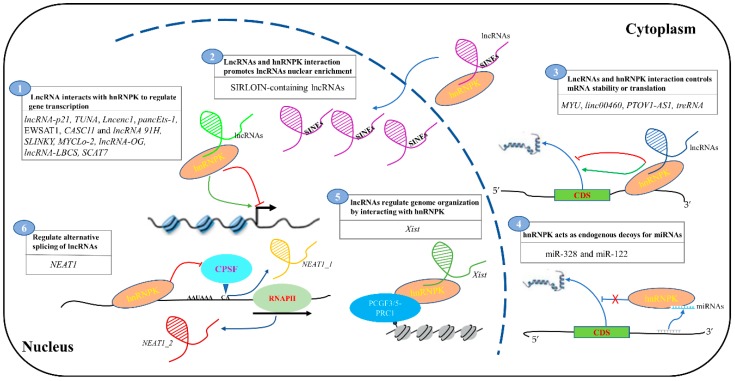
The emerging data indicates that non-coding RNAs (ncRNAs) epresent more than the "junk sequences" of the genome. Both miRNAs and long non-coding RNAs (lncRNAs) are involved in fundamental biological processes, and their deregulation may lead to oncogenesis and other diseases. As an important RNA-binding protein (RBP), heterogeneous nuclear ribonucleoprotein K (hnRNPK) is known to regulate gene expression through the RNA-binding domain involved in various pathways, such as transcription, splicing, and translation. HnRNPK is a highly conserved gene that is abundantly expressed in mammalian cells. The interaction of hnRNPK and ncRNAs defines the novel way through which ncRNAs affect the expression of protein-coding genes and form autoregulatory feedback loops. This review summarizes the interactions of hnRNPK and ncRNAs in regulating gene expression at transcriptional and post-transcriptional levels or by changing the genomic structure, highlighting their involvement in carcinogenesis, glucose metabolism, stem cell differentiation, virus infection and other cellular functions. Drawing connections between such discoveries might provide novel targets to control the biological outputs of cells in response to different stimuli.
新兴数据表明,非编码 RNA(ncRNAs)不仅仅代表基因组的“垃圾序列”。miRNA 和长非编码 RNA(lncRNA)都参与了基本的生物学过程,它们的失调可能导致癌变和其他疾病。作为一种重要的 RNA 结合蛋白(RBP),异质核核糖核蛋白 K(hnRNPK)通过参与转录、剪接和翻译等多种途径的 RNA 结合域来调节基因表达。hnRNPK 是一种高度保守的基因,在哺乳动物细胞中大量表达。hnRNPK 和 ncRNAs 的相互作用定义了 ncRNAs 通过影响蛋白质编码基因的表达并形成自调节反馈环的新方式。本综述总结了 hnRNPK 和 ncRNAs 在转录和转录后水平调节基因表达或通过改变基因组结构的相互作用,强调了它们在致癌作用、葡萄糖代谢、干细胞分化、病毒感染和其他细胞功能中的参与。这些发现之间的联系可能为控制细胞对不同刺激的生物学反应提供新的靶点。