Department of Clinical Medicine, University of Copenhagen and Psychiatry Slagelse, Region Zealand, Fælledvej 6, 4200, Slagelse, Denmark.
Department of Public Health, University of Southern Denmark, Copenhagen, Denmark.
BMC Med Educ. 2019 Jan 18;19(1):27. doi: 10.1186/s12909-019-1465-6.
Over the past decades, the health sector in general has increasingly acknowledged the effectiveness of interprofessional clinical training in enhancing teamwork. In psychiatry, however, knowledge of the benefits of collaborative clinical training is sparse. This study aimed to investigate the impact of interprofessional training on students' readiness for interprofessional collaboration in a psychiatric ward.
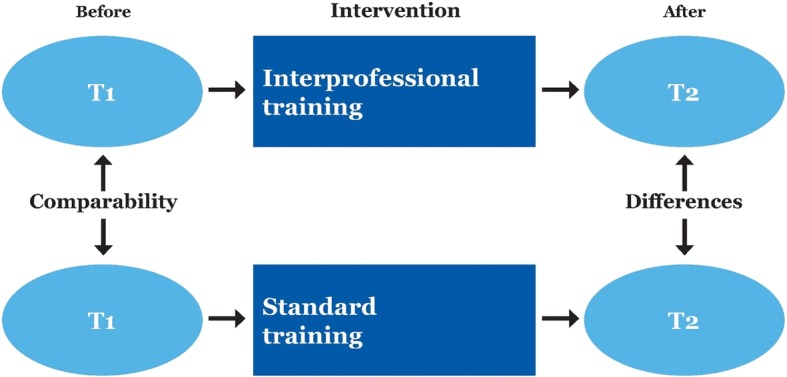
An intervention study assessed interprofessional clinical training in a training ward. Undergraduate students from the disciplines of medicine, nursing, psychotherapy, pedagogy, and social work were allocated either to an intervention group receiving interprofessional training or to a comparison group receiving conventional clinical training. Outcomes were assessed using the Readiness for Interprofessional Learning Scale (RIPLS) and the Assessment of Interprofessional Team Collaboration Scale (AITCS). Linear mixed regression was used to compare differences in mean scores postintervention, adjusted for baseline score, gender, and profession.
Mean postintervention scores were higher in the intervention group (n = 87) than in the comparison group (n = 108) for both scales (overall sum score). For the RIPLS, the mean difference was 2.99 (95% CI 0.82 to 5.16; p = 0.007); for the AITCS it was 8.11 (95% CI 2.92-13.30; p = 0.002). Improvement in readiness for interprofessional learning and team collaboration in the intervention group remained statistically significant after adjustment for baseline differences between the two groups.
Students' self-reported readiness for interprofessional learning and their team collaboration were improved after interprofessional clinical training. Still, further studies of both the processes and the long-term effects of undergraduate IPE in mental healthcare are needed. The study was registered March 62,017 on ClinicalTrials.gov: NCT03070977 (Retrospectively registrered).
在过去几十年中,一般卫生部门越来越认识到跨专业临床培训在增强团队合作方面的有效性。然而,在精神病学领域,关于协作临床培训的益处的知识却很少。本研究旨在调查跨专业培训对精神科病房学生跨专业合作准备情况的影响。
一项干预研究评估了培训病房中的跨专业临床培训。来自医学、护理、心理治疗、教育学和社会工作等学科的本科生被分配到干预组(接受跨专业培训)或对照组(接受常规临床培训)。使用跨专业学习准备量表(RIPLS)和跨专业团队协作评估量表(AITCS)评估结果。线性混合回归用于比较干预后平均得分的差异,调整了基线得分、性别和专业。
干预组(n=87)的干预后平均得分高于对照组(n=108),两个量表(总分)均如此。对于 RIPLS,平均差异为 2.99(95%置信区间为 0.82 至 5.16;p=0.007);对于 AITCS,平均差异为 8.11(95%置信区间为 2.92 至 13.30;p=0.002)。在调整两组间基线差异后,干预组的跨专业学习和团队协作准备的改善仍然具有统计学意义。
学生的跨专业学习和团队协作准备情况在接受跨专业临床培训后得到了改善。尽管如此,仍需要进一步研究本科 IPE 在精神卫生保健中的过程和长期效果。该研究于 2017 年 3 月 6 日在 ClinicalTrials.gov 注册:NCT03070977(回顾性注册)。