Computational, Cognitive and Clinical Neuroimaging Laboratory, Division of Brain Sciences, Imperial College London, Hammersmith Hospital, London, UK.
Cambridge Intellectual and Developmental Disabilities Research Group, Academic Department of Psychiatry, University of Cambridge, Cambridge, UK; National Institute for Health Research (NIHR) Collaborations for Leadership in Applied Health Care Research and Care (CLAHRC), East of England, UK.
Neuroimage Clin. 2019;21:101664. doi: 10.1016/j.nicl.2019.101664. Epub 2019 Jan 10.
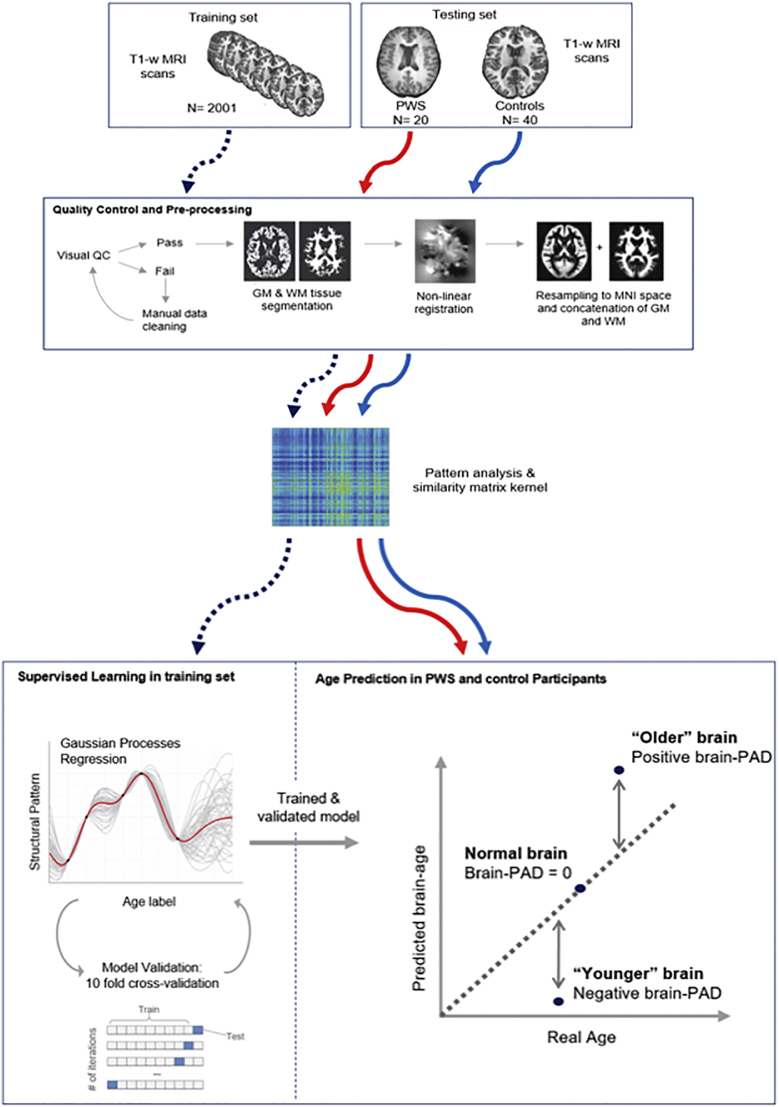
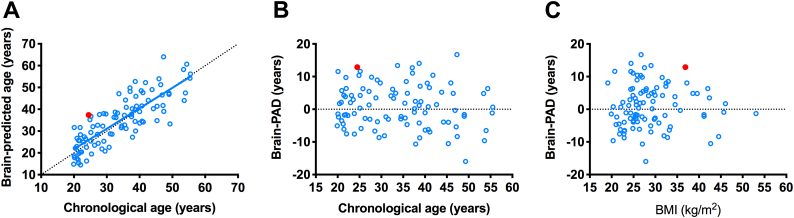
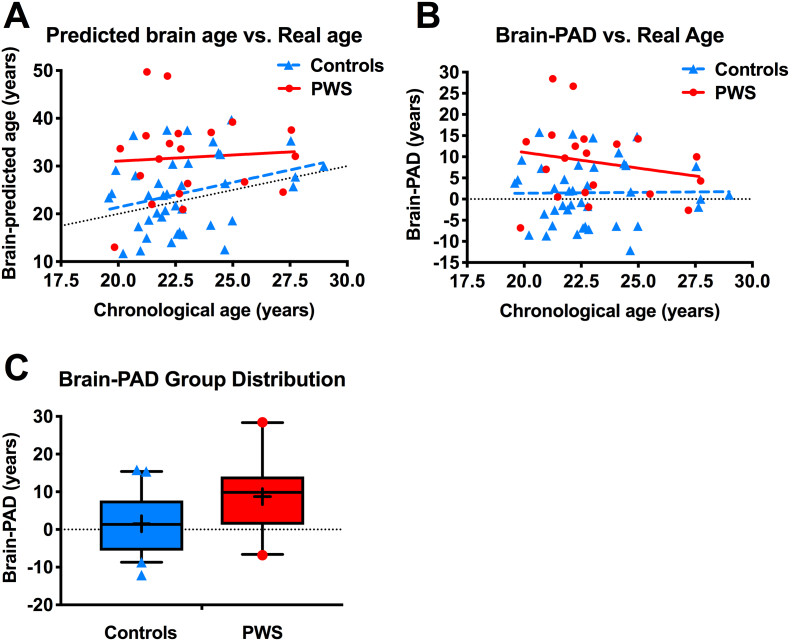
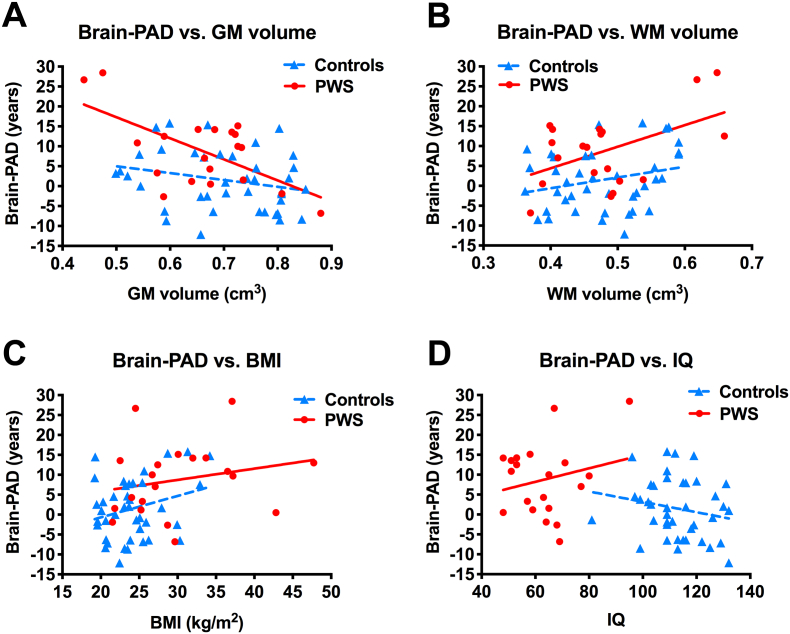
Prader-Willi syndrome (PWS) is the most common genetic obesity syndrome, with associated learning difficulties, neuroendocrine deficits, and behavioural and psychiatric problems. As the life expectancy of individuals with PWS increases, there is concern that alterations in brain structure associated with the syndrome, as a direct result of absent expression of PWS genes, and its metabolic complications and hormonal deficits, might cause early onset of physiological and brain aging. In this study, a machine learning approach was used to predict brain age based on grey matter (GM) and white matter (WM) maps derived from structural neuroimaging data using T1-weighted magnetic resonance imaging (MRI) scans. Brain-predicted age difference (brain-PAD) scores, calculated as the difference between chronological age and brain-predicted age, are designed to reflect deviations from healthy brain aging, with higher brain-PAD scores indicating premature aging. Two separate adult cohorts underwent brain-predicted age calculation. The main cohort consisted of adults with PWS (n = 20; age mean 23.1 years, range 19.8-27.7; 70.0% male; body mass index (BMI) mean 30.1 kg/m, 21.5-47.7; n = 19 paternal chromosome 15q11-13 deletion) and age- and sex-matched controls (n = 40; age 22.9 years, 19.6-29.0; 65.0% male; BMI 24.1 kg/m, 19.2-34.2) adults (BMI PWS vs. control P = .002). Brain-PAD was significantly greater in PWS than controls (effect size mean ± SEM +7.24 ± 2.20 years [95% CI 2.83, 11.63], P = .002). Brain-PAD remained significantly greater in PWS than controls when restricting analysis to a sub-cohort matched for BMI consisting of n = 15 with PWS with BMI range 21.5-33.7 kg/m, and n = 29 controls with BMI 21.7-34.2 kg/m (effect size +5.51 ± 2.56 years [95% CI 3.44, 10.38], P = .037). In the PWS group, brain-PAD scores were not associated with intelligence quotient (IQ), use of hormonal and psychotropic medications, nor severity of repetitive or disruptive behaviours. A 24.5 year old man (BMI 36.9 kg/m) with PWS from a SNORD116 microdeletion also had increased brain PAD of 12.87 years, compared to 0.84 ± 6.52 years in a second control adult cohort (n = 95; age mean 34.0 years, range 19.9-55.5; 38.9% male; BMI 28.7 kg/m, 19.1-43.1). This increase in brain-PAD in adults with PWS indicates abnormal brain structure that may reflect premature brain aging or abnormal brain development. The similar finding in a rare patient with a SNORD116 microdeletion implicates a potential causative role for this PWS region gene cluster in the structural brain abnormalities associated primarily with the syndrome and/or its complications. Further longitudinal neuroimaging studies are needed to clarify the natural history of this increase in brain age in PWS, its relationship with obesity, and whether similar findings are seen in those with PWS from maternal uniparental disomy.
普拉德-威利综合征(PWS)是最常见的遗传性肥胖综合征,伴有学习困难、神经内分泌缺陷以及行为和精神问题。随着 PWS 患者的预期寿命延长,人们担心与该综合征直接相关的大脑结构改变,由于 PWS 基因表达缺失以及其代谢并发症和激素缺乏,可能导致生理和大脑衰老的早期发生。在这项研究中,使用机器学习方法基于 T1 加权磁共振成像(MRI)扫描的结构神经影像学数据来预测脑龄。脑预测年龄差异(brain-PAD)评分是根据实际年龄和脑预测年龄之间的差异计算得出的,旨在反映与健康大脑衰老的偏差,较高的 brain-PAD 评分表示过早衰老。两个单独的成年队列进行了脑预测年龄计算。主要队列由患有 PWS 的成年人(n=20;年龄平均 23.1 岁,范围 19.8-27.7;70.0%为男性;体重指数(BMI)平均 30.1kg/m,范围 21.5-47.7;n=19 为父系 15q11-13 缺失)和年龄及性别匹配的对照组(n=40;年龄 22.9 岁,范围 19.6-29.0;65.0%为男性;BMI 24.1kg/m,范围 19.2-34.2)成年人(BMI PWS 与对照组 P=0.002)组成。PWS 组的 brain-PAD 明显大于对照组(效应量平均值±SEM +7.24±2.20 岁[95%CI 2.83,11.63],P=0.002)。当将分析限制在一个由 n=15 名 BMI 范围为 21.5-33.7kg/m 的 PWS 患者和 n=29 名 BMI 为 21.7-34.2kg/m 的对照组组成的 BMI 匹配子队列时,PWS 组的 brain-PAD 仍明显大于对照组(效应量+5.51±2.56 岁[95%CI 3.44,10.38],P=0.037)。在 PWS 组中,brain-PAD 评分与智商(IQ)、激素和精神药物的使用以及重复性或破坏性行为的严重程度无关。一名来自 SNORD116 微缺失的 24.5 岁男性(BMI 36.9kg/m)也有 12.87 岁的脑 PAD 增加,而第二个对照组的成年队列(n=95;年龄平均 34.0 岁,范围 19.9-55.5;38.9%为男性;BMI 28.7kg/m,范围 19.1-43.1)的平均脑 PAD 为 0.84±6.52 岁。PWS 成人的这种脑-PAD 增加表明大脑结构异常,可能反映出过早的大脑衰老或异常的大脑发育。在一个罕见的 SNORD116 微缺失患者中也有类似的发现,这暗示了该 PWS 区域基因簇在与该综合征及其并发症主要相关的结构大脑异常中可能具有潜在的因果作用。需要进一步的纵向神经影像学研究来阐明 PWS 中脑龄增加的自然史,以及它与肥胖的关系,以及是否在来自母体单亲二体性的 PWS 患者中也有类似的发现。