INSERM U1163/CNRS ERL8254 - Laboratory of cellular and molecular mechanisms of hematological disorders and therapeutic implications, IMAGINE Institute, Paris, France.
Front Immunol. 2019 Jan 4;9:3060. doi: 10.3389/fimmu.2018.03060. eCollection 2018.
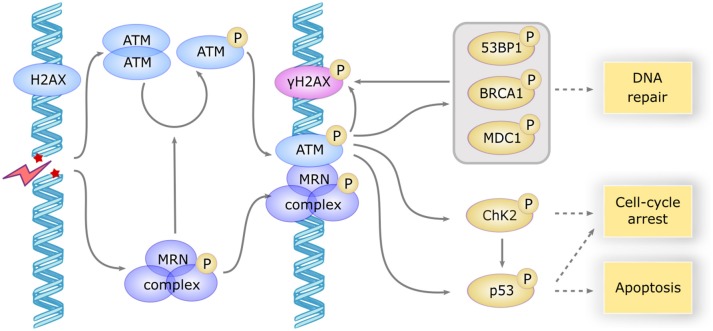
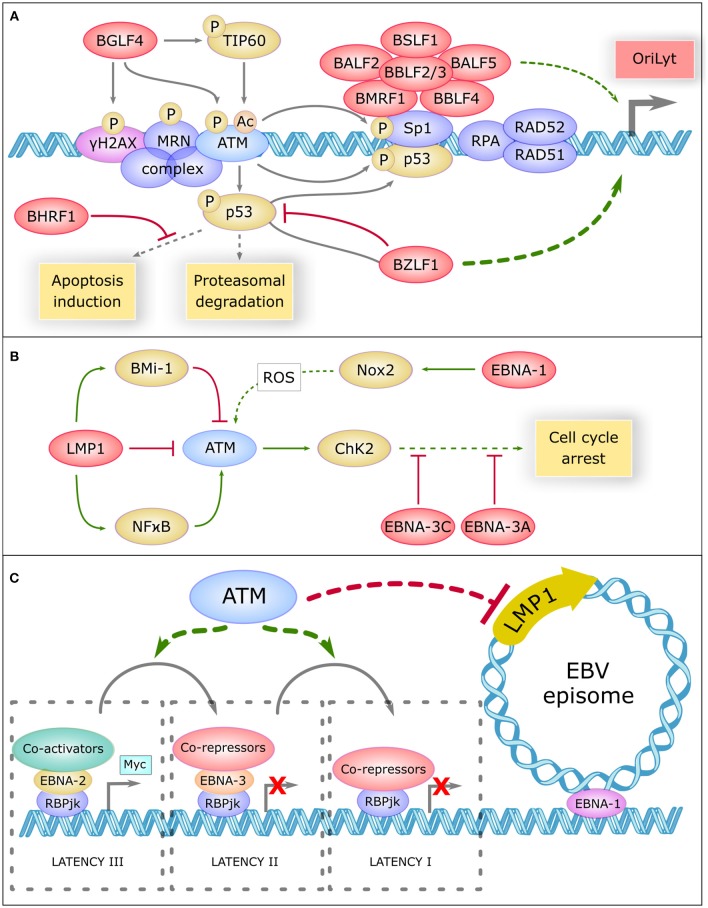
Epstein-Barr virus (EBV) is an ubiquitous herpesvirus with a tropism for epithelial cells (where lytic replication occurs) and B-cells (where latency is maintained). EBV persists throughout life and chronic infection is asymptomatic in most individuals. However, immunocompromised patients may be unable to control EBV infection and are at increased risk of EBV-related malignancies, such as diffuse large B-cell lymphomas or Hodgkin's lymphomas. Ataxia telangiectasia (AT) is a primary immunodeficiency caused by mutations in the gene and associated with an increased incidence of cancers, particularly EBV-associated lymphomas. However, the immune deficiency present in AT patients is often too modest to explain the increased incidence of EBV-related malignancies. The ATM defect in these patients could therefore impair the normal regulation of EBV latency in B-cells, thus promoting lymphomagenesis. This suggests that ATM plays a role in the normal regulation of EBV latency. ATM is a serine/threonine kinase involved in multiple cell functions such as DNA damage repair, cell cycle regulation, oxidative stress, and gene expression. ATM is implicated in the lytic cycle of EBV, where EBV uses the activation of DNA damage repair pathway to promote its own replication. ATM regulates the latent cycle of the EBV-related herpesvirus KSHV and MHV68. However, the contribution of ATM in the control of the latent cycle of EBV is not yet known. A better understanding of the regulation of EBV latency could be harnessed in the conception of novel therapeutic strategies in AT and more generally in all ATM deficient EBV-related malignancies.
EBV 是一种普遍存在的疱疹病毒,其对上皮细胞(发生裂解复制的部位)和 B 细胞(维持潜伏感染的部位)具有亲嗜性。EBV 可在一生中持续存在,在大多数个体中慢性感染无症状。然而,免疫功能低下的患者可能无法控制 EBV 感染,并且存在 EBV 相关恶性肿瘤的风险增加,例如弥漫性大 B 细胞淋巴瘤或霍奇金淋巴瘤。共济失调毛细血管扩张症(AT)是一种由 基因突变引起的原发性免疫缺陷病,与癌症的发病率增加有关,特别是 EBV 相关的淋巴瘤。然而,AT 患者的免疫缺陷通常不足以解释 EBV 相关恶性肿瘤发病率的增加。因此,这些患者中的 ATM 缺陷可能会损害 EBV 在 B 细胞中潜伏的正常调节,从而促进淋巴瘤的发生。这表明 ATM 在 EBV 潜伏的正常调节中发挥作用。ATM 是一种丝氨酸/苏氨酸激酶,参与多种细胞功能,如 DNA 损伤修复、细胞周期调控、氧化应激和基因表达。ATM 参与 EBV 的裂解周期,EBV 通过激活 DNA 损伤修复途径来促进自身复制。ATM 调节 EBV 相关疱疹病毒 KSHV 和 MHV68 的潜伏周期。然而,ATM 在 EBV 潜伏周期控制中的作用尚不清楚。更好地了解 EBV 潜伏的调节可能有助于在 AT 中以及更普遍地在所有 ATM 缺陷 EBV 相关恶性肿瘤中设计新的治疗策略。