Comprehensive Laboratory, Changzhou Key Lab of Individualized Diagnosis and Treatment Associated with High Technology Research, The Third Affiliated Hospital of Soochow University, Changzhou, Jiangsu 213003, P.R. China.
Division of Clinical Chemistry and Pharmacology, Department of Laboratory Medicine, Lund University Hospital, S‑221 85 Lund, Sweden.
Mol Med Rep. 2019 Mar;19(3):2077-2086. doi: 10.3892/mmr.2019.9843. Epub 2019 Jan 10.
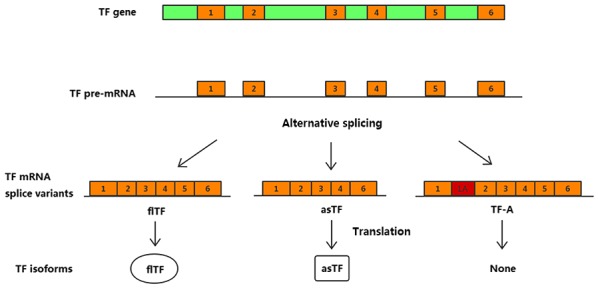
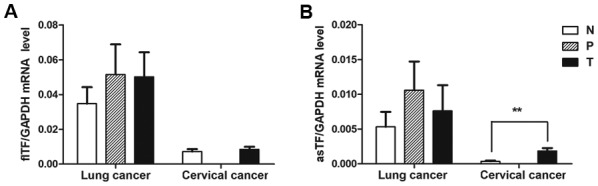
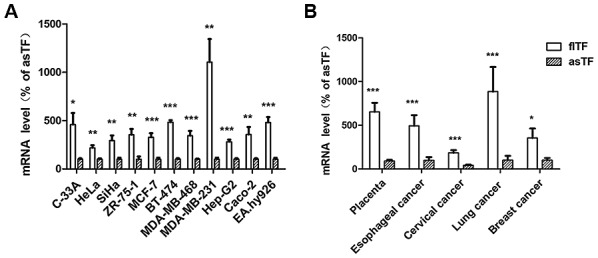
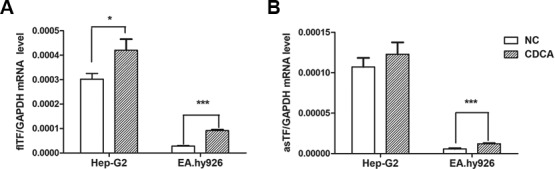
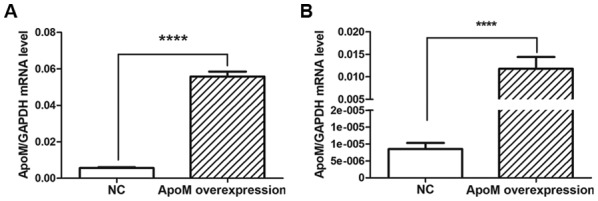
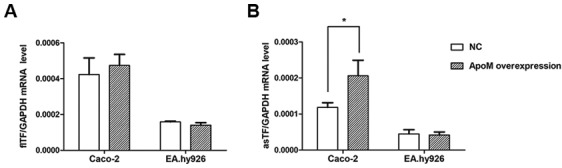
Tissue factor (TF) expressed at the protein level includes two isoforms: The membrane‑bound full‑length TF (flTF) and the soluble alternatively spliced TF (asTF). flTF is the major thrombogenic form of TF, whereas asTF is more closely associated with tumor growth, angiogenesis, metastasis and cell growth. In order to further investigate the different expression and functions of TF splice variants, the expression of these two splice variants were detected in numerous cell strains and tissues in the present study. Quantitative polymerase chain reaction was used to measure the transcript levels of the TF variants in 11 human cell lines, including cervical cancer, breast cancer, hepatoblastoma, colorectal cancer and umbilical vein cells, and five types of tissue specimen, including placenta, esophageal cancer, breast cancer, cervical cancer (alongside normal cervical tissues) and non‑small cell lung cancer (alongside adjacent and normal tissues). Furthermore, the effects of chenodeoxycholic acid (CDCA) and apolipoprotein M (apoM) on the two variants were investigated. The results demonstrated that flTF was the major form of TF, and the mRNA expression levels of flTF were higher than those of asTF in all specimens tested. CDCA significantly upregulated the mRNA expression levels of the two variants. Furthermore, overexpression of apoM promoted the expression levels of asTF in Caco‑2 cells. The mRNA expression levels of asTF in cervical cancer tissues were significantly higher than in the corresponding normal tissues. To the best of our knowledge, the present study is the first to compare the expression of flTF and asTF in various samples. The results demonstrated that CDCA and apoM may modulate TF isoforms in different cell lines, and suggested that asTF may serve a role in the pathophysiological mechanism underlying cervical cancer development. In conclusion, the TF isoforms serve important and distinct roles in pathophysiological processes.
组织因子(TF)在蛋白质水平上包括两种异构体:膜结合全长 TF(flTF)和可溶的选择性剪接 TF(asTF)。flTF 是 TF 的主要促血栓形成形式,而 asTF 与肿瘤生长、血管生成、转移和细胞生长更密切相关。为了进一步研究 TF 剪接变体的不同表达和功能,本研究检测了多种细胞株和组织中这两种剪接变体的表达。采用定量聚合酶链反应检测 11 个人类细胞系(包括宫颈癌、乳腺癌、肝母细胞瘤、结直肠癌和脐静脉细胞)和 5 种组织标本(包括胎盘、食管癌、乳腺癌、宫颈癌(伴正常宫颈组织)和非小细胞肺癌(伴相邻和正常组织)中 TF 变体的转录水平。此外,还研究了鹅去氧胆酸(CDCA)和载脂蛋白 M(apoM)对这两种变体的影响。结果表明,flTF 是 TF 的主要形式,在所有检测的标本中,flTF 的 mRNA 表达水平均高于 asTF。CDCA 显著上调了两种变体的 mRNA 表达水平。此外,apoM 的过表达促进了 Caco-2 细胞中 asTF 的表达水平。宫颈癌组织中 asTF 的 mRNA 表达水平明显高于相应的正常组织。据我们所知,本研究首次比较了各种样本中 flTF 和 asTF 的表达。结果表明,CDCA 和 apoM 可能在不同的细胞系中调节 TF 异构体,并提示 asTF 可能在宫颈癌发展的病理生理机制中发挥作用。总之,TF 异构体在病理生理过程中发挥着重要而独特的作用。