Henderson Macey L, Thomas Alvin G, Eno Ann K, Waldram Madeleine M, Bannon Jaclyn, Massie Allan B, Levan Michael A, Segev Dorry L, Bingaman Adam W
Department of Surgery, Johns Hopkins University School of Medicine, Baltimore, MD, United States.
Department of Acute and Chronic Care, Johns Hopkins School of Nursing, Baltimore, MD, United States.
JMIR Res Protoc. 2019 Jan 15;8(1):e11000. doi: 10.2196/11000.
Every year, more than 5500 healthy people in the United States donate a kidney for the medical benefit of another person. The Organ Procurement and Transplantation Network (OPTN) requires transplant hospitals to monitor living kidney donors (LKDs) for 2 years postdonation. However, the majority (115/202, 57%) of transplant hospitals in the United States continue to fail to meet nationally mandated requirements for LKD follow-up. A novel method for collecting LKD follow-up is needed to ease both the transplant hospital-level and patient-level burden. We built mKidney-a mobile health (mHealth) system designed specifically to facilitate the collection and reporting of OPTN-required LKD follow-up data. The mKidney mobile app was developed on the basis of input elicited from LKDs, transplant providers, and thought leaders.
The primary objective of this study is to evaluate the impact of the mKidney smartphone app on LKD follow-up rates.
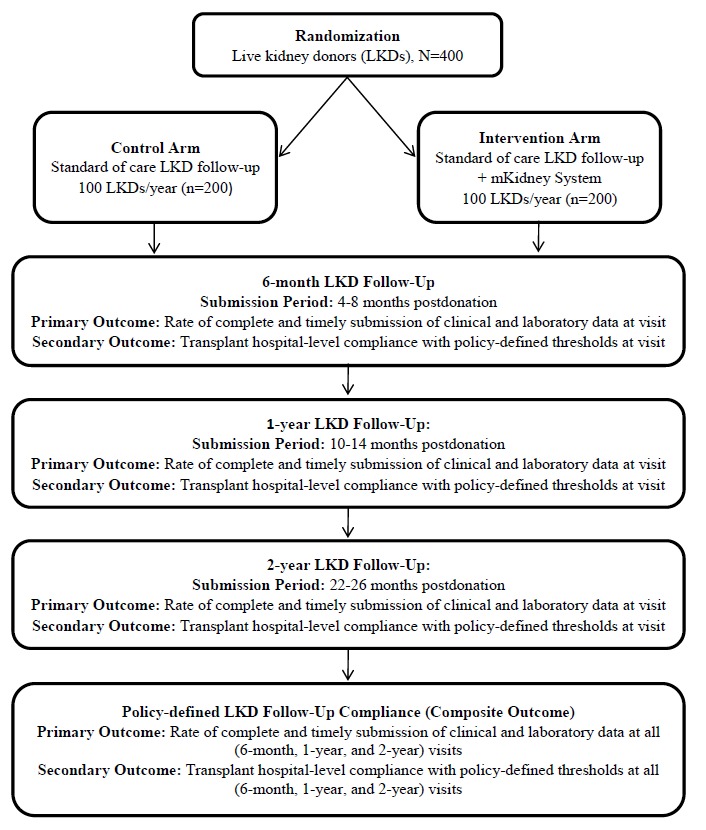
We will conduct a two-arm randomized controlled trial (RCT) with LKDs who undergo LKD transplantation at Methodist Specialty and Transplant Hospital in San Antonio, Texas. Eligible participants will be recruited in-person by a study team member at their 1-week postdonation clinical visit and randomly assigned to the intervention or control arm (1:1). Participants in the intervention arm will receive the mHealth intervention (mKidney), and participants in the control arm will receive the current standard of follow-up care. Our primary outcome will be policy-defined complete (all components addressed) and timely (60 days before or after the expected visit date) submission of LKD follow-up data at required 6-month, 1-year, and 2-year visits. Our secondary outcome will be hospital-level compliance with OPTN reporting requirements at each visit. Data analysis will follow the intention-to-treat principle. Additionally, we will collect quantitative and qualitative process data regarding the implementation of the mKidney system.
We began recruitment for this RCT in May 2018. We plan to enroll 400 LKDs over 2 years and follow participants for the 2-year mandated follow-up period.
This pilot RCT will evaluate the impact of the mKidney system on rates of LKD and hospital compliance with OPTN-mandated LKD follow-up at a large LKD transplant hospital. It will provide valuable information on strategies for implementing such a system in a clinical setting and inform effect sizes for future RCT sample size calculations.
INTERNATIONAL REGISTERED REPORT IDENTIFIER (IRRID): DERR1-10.2196/11000.
在美国,每年有超过5500名健康人捐献肾脏以造福他人。器官获取与移植网络(OPTN)要求移植医院在活体肾捐献者(LKD)捐献后对其进行2年的监测。然而,美国大多数(202家医院中的115家,占57%)移植医院仍未达到国家规定的LKD随访要求。需要一种新的LKD随访数据收集方法,以减轻移植医院层面和患者层面的负担。我们开发了mKidney——一种专门设计用于促进收集和报告OPTN要求的LKD随访数据的移动健康(mHealth)系统。mKidney移动应用程序是根据LKD、移植提供者和思想领袖提供的意见开发的。
本研究的主要目的是评估mKidney智能手机应用程序对LKD随访率的影响。
我们将在得克萨斯州圣安东尼奥市卫理公会专科与移植医院接受LKD移植的LKD中进行双臂随机对照试验(RCT)。符合条件的参与者将在捐献后1周的临床访视时由研究团队成员亲自招募,并随机分配到干预组或对照组(1:1)。干预组的参与者将接受移动健康干预(mKidney),对照组的参与者将接受当前的随访护理标准。我们的主要结局将是政策定义的完整(所有组件均有涉及)且及时(预期访视日期前后60天内)在要求的6个月、1年和2年访视时提交LKD随访数据。我们的次要结局将是每次访视时医院层面符合OPTN报告要求的情况。数据分析将遵循意向性分析原则。此外,我们将收集有关mKidney系统实施的定量和定性过程数据。
我们于2018年5月开始招募该RCT的参与者。我们计划在2年内招募400名LKD,并在2年的法定随访期内对参与者进行随访。
这项试点RCT将评估mKidney系统对一家大型LKD移植医院中LKD随访率以及医院遵守OPTN规定的LKD随访情况的影响。它将提供有关在临床环境中实施此类系统的策略的有价值信息,并为未来RCT样本量计算的效应量提供参考。
国际注册报告识别码(IRRID):DERR1-10.2196/11000。