School of Life and Environmental Sciences, Charles Perkins Centre, University of Sydney, University of Sydney, Australia.
JMIR Mhealth Uhealth. 2016 Jun 22;4(2):e78. doi: 10.2196/mhealth.5768.
The unprecedented rise in obesity among young adults, who have limited interaction with health services, has not been successfully abated.
The objective of this study was to assess the maintenance outcomes of a 12-week mHealth intervention on prevention of weight gain in young adults and lifestyle behaviors at 9 months from baseline.
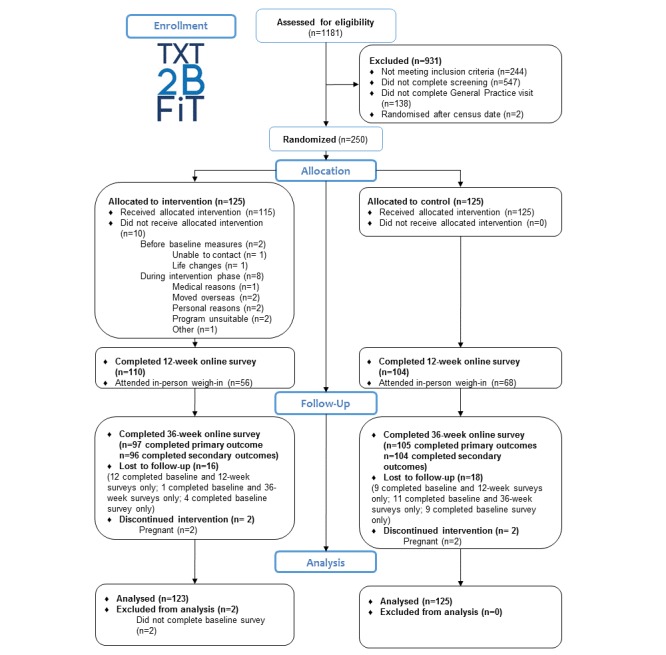
A two-arm, parallel, randomized controlled trial (RCT) with subjects allocated to intervention or control 1:1 was conducted in a community setting in Greater Sydney, Australia. From November 2012 to July 2014, 18- to 35-year-old overweight individuals with a body mass index (BMI) of 25-31.99 kg/m2 and those with a BMI ≥ 23 kg/m2 and a self-reported weight gain of ≥ 2 kg in the past 12 months were recruited. A 12-week mHealth program "TXT2BFiT" was administered to the intervention arm. This included 5 coaching calls, 96 text messages, 12 emails, apps, and downloadable resources from the study website. Lifestyle behaviors addressed were intake of fruits, vegetables, sugar-sweetened beverages (SSBs), take-out meals, and physical activity. The control group received 1 phone call to introduce them to study procedures and 4 text messages over 12 weeks. After 12 weeks, the intervention arm received 2 further coaching calls, 6 text messages, and 6 emails with continued access to the study website during 6-month follow-up. Control arm received no further contact. The primary outcome was weight change (kg) with weight measured at baseline and at 12 weeks and self-report at baseline, 12 weeks, and 9 months. Secondary outcomes were change in physical activity (metabolic equivalent of task, MET-mins) and categories of intake for fruits, vegetables, SSBs, and take-out meals. These were assessed via Web-based surveys.
Two hundred and fifty young adults enrolled in the RCT. Intervention participants weighed less at 12 weeks compared with controls (model β=-3.7, 95% CI -6.1 to -1.3) and after 9 months (model β=- 4.3, 95% CI - 6.9 to - 1.8). No differences in physical activity were found but all diet behaviors showed that the intervention group, compared with controls at 9 months, had greater odds of meeting recommendations for fruits (OR 3.83, 95% CI 2.10-6.99); for vegetables (OR 2.42, 95% CI 1.32-4.44); for SSB (OR 3.11, 95% CI 1.47-6.59); and for take-out meals (OR 1.88, 95% CI 1.07-3.30).
Delivery of an mHealth intervention for prevention of weight gain resulted in modest weight loss at 12 weeks with further loss at 9 months in 18- to 35-year-olds. Although there was no evidence of change in physical activity, improvements in dietary behaviors occurred, and were maintained at 9 months. Owing to its scalable potential for widespread adoption, replication trials should be conducted in diverse populations of overweight young adults.
Australian and New Zealand Clinical Trials Registry (ANZCTR): ACTRN12612000924853; (Archived by WebCite at http://www.webcitation.org/6i6iRag55).
年轻人中肥胖率的空前上升,这些年轻人与健康服务的互动有限,尚未得到成功遏制。
本研究旨在评估一项为期 12 周的移动健康干预措施对预防年轻成年人体重增加和生活方式行为的维持效果,随访时间为基线后 9 个月。
在澳大利亚大悉尼的社区环境中进行了一项两臂、平行、随机对照试验(RCT),将受试者按 1:1 的比例分配到干预组或对照组。2012 年 11 月至 2014 年 7 月,招募了体重指数(BMI)为 25-31.99 kg/m2 的超重个体和 BMI≥23 kg/m2 且过去 12 个月体重增加≥2 kg 的个体。干预组接受了为期 12 周的移动健康计划“TXT2BFiT”。这包括 5 次教练电话、96 条短信、12 封电子邮件、应用程序和可从研究网站下载的资源。解决的生活方式行为包括摄入水果、蔬菜、含糖饮料(SSB)、外卖餐和体力活动。对照组在 12 周内仅接受 1 次电话介绍研究程序和 4 条短信。12 周后,干预组在 6 个月的随访期间接受了另外 2 次教练电话、6 条短信和 6 封电子邮件,并继续访问研究网站。对照组不再接受任何联系。主要结局是体重变化(kg),体重在基线和 12 周时测量,并在基线、12 周和 9 个月时自我报告。次要结局是体力活动变化(代谢当量任务,MET-min)和水果、蔬菜、SSB 和外卖餐的摄入量类别。这些通过基于网络的调查进行评估。
共有 250 名年轻成年人参加了 RCT。与对照组相比,干预组参与者在 12 周时体重减轻(模型β=-3.7,95%CI-6.1 至-1.3),9 个月后体重减轻(模型β=-4.3,95%CI-6.9 至-1.8)。未发现体力活动的差异,但所有饮食行为均表明,与对照组相比,干预组在 9 个月时更有可能满足水果(OR 3.83,95%CI 2.10-6.99)、蔬菜(OR 2.42,95%CI 1.32-4.44)、SSB(OR 3.11,95%CI 1.47-6.59)和外卖餐(OR 1.88,95%CI 1.07-3.30)的推荐摄入量。
提供预防体重增加的移动健康干预措施可在 12 周时导致适度的体重减轻,并且在 18 至 35 岁的人群中在 9 个月时进一步减轻体重。尽管体力活动没有变化的证据,但饮食行为有所改善,并且在 9 个月时保持不变。由于其具有广泛采用的可扩展性潜力,应该在超重年轻成年人的不同人群中进行复制试验。
澳大利亚和新西兰临床试验注册处(ANZCTR):ACTRN12612000924853;(由 WebCite 存档,http://www.webcitation.org/6i6iRag55)。
