Department of Rehabilitation, Physical Therapy, Sendai Seiyo Gakuin Junior College, Sendai, Japan.
Department of International and Community Oral Health, Tohoku University Graduate School of Dentistry, 4-1, Seiryo-machi, Aoba-ku, Sendai, Miyagi, 980-8575, Japan.
Int J Equity Health. 2019 Jan 21;18(1):15. doi: 10.1186/s12939-019-0918-1.
Low back pain is an important public health issue across the world. However, it is unclear whether socioeconomic status (SES) is associated with low back pain. This study determines an association between SES and low back pain among older people.
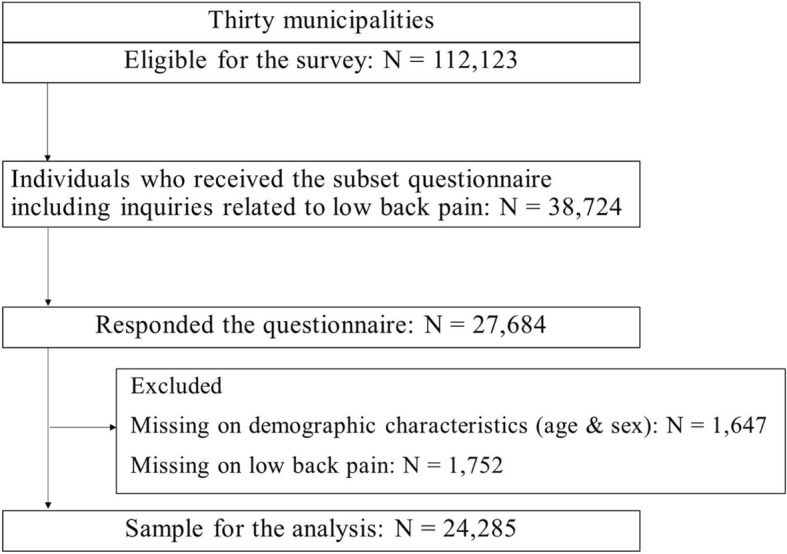
We used cross-sectional data derived from the year 2013 across 30 Japanese municipalities. The survey was conducted between October 2013 to December 2013. Functionally independent community-dwelling older adults aged 65 and above (n = 26,037) were eligible for the study. Multilevel Poisson regression analysis with a robust variance estimator was used to examine the association between SES and low back pain. Self-reported low back pain in the past year was used as a dependent variable. Educational attainment, past occupation, equivalized household income, wealth, and subjective economic situation represented SES and were separately analyzed as independent variables, adjusted for covariates including age and sex.
The prevalence of low back pain was 63.4%. Overall, lower SES were more likely to suffer from low back pain compared with that for the highest. First, as for the educational attainment, the prevalence ratio (PR) (95% credible interval (CI)) for the lowest level was 1.07 (1.02-1.12). Second, as for the past occupation, the PR (95% CI) for the blue-collared workers compared with professionals was 1.06 (1.01-1.11). Third, as for the equalized household income, the PRs (95% CI) for lower middle and the lowest income levels were 1.08 (1.02-1.13) and 1.16 (1.10-1.23), respectively. Fourth, as for the wealth, the PRs (95% CI) for lower middle and the lowest wealth levels were 1.11 (1.04-1.19) and 1.18 (1.11-1.27), respectively. Fifth, as for the subjective economic situation, the PRs (95% CI) for lower middle and the lowest financial conditions were 1.18 (1.10-1.26) and 1.32 (1.22-1.44), respectively.
Significant socioeconomic inequalities were observed in low back pain among older individuals in Japan. Policymakers and clinicians must understand the nature of these inequalities.
腰痛是全世界一个重要的公共卫生问题。然而,社会经济地位(SES)是否与腰痛有关尚不清楚。本研究旨在确定 SES 与老年人腰痛之间的关系。
我们使用了来自 2013 年日本 30 个市町村的横断面数据。调查于 2013 年 10 月至 12 月进行。符合条件的研究对象为年龄在 65 岁及以上、功能独立的社区居住老年人(n=26037)。采用具有稳健方差估计的多级泊松回归分析来检验 SES 与腰痛之间的关联。以过去一年报告的腰痛为因变量。教育程度、过去职业、家庭等效收入、财富和主观经济状况代表 SES,并分别作为自变量进行分析,调整了年龄和性别等混杂因素。
腰痛的患病率为 63.4%。总体而言,较低 SES 的人群比最高 SES 的人群更容易患腰痛。首先,就教育程度而言,最低水平的患病率比(PR)(95%可信区间(CI))为 1.07(1.02-1.12)。其次,就过去职业而言,蓝领工人与专业人员相比的 PR(95%CI)为 1.06(1.01-1.11)。第三,就家庭等效收入而言,中下等和最低收入水平的 PRs(95%CI)分别为 1.08(1.02-1.13)和 1.16(1.10-1.23)。第四,就财富而言,中下等和最低财富水平的 PRs(95%CI)分别为 1.11(1.04-1.19)和 1.18(1.11-1.27)。第五,就主观经济状况而言,中下等和最低财务状况的 PRs(95%CI)分别为 1.18(1.10-1.26)和 1.32(1.22-1.44)。
在日本,老年人腰痛存在显著的社会经济不平等。政策制定者和临床医生必须了解这些不平等的性质。