Mancina Rosellina Margherita, Ferri Flaminia, Farcomeni Alessio, Molinaro Antonio, Maffongelli Angela, Mischitelli Monica, Poli Edoardo, Parlati Lucia, Burza Maria Antonella, De Santis Adriano, Attilia Fabio, Rotondo Claudia, Rando Maria Margherita, Attilia Maria Luisa, Ceccanti Mauro, Ginanni Corradini Stefano
Department of Molecular and Clinical Medicine, The Sahlgrenska Academy at the University of Gothenburg, Wallenberg Laboratory, Göteborg, Sweden,
Department of Translational and Precision Medicine, Sapienza University of Rome, Rome, Italy,
Appl Clin Genet. 2019 Jan 10;12:1-10. doi: 10.2147/TACG.S187922. eCollection 2019.
Alcoholic cirrhosis represents 1% of all cause-of-deaths worldwide. Its incidence is higher in males and results from the combination of environmental and genetic factors. Among all the genetic determinants of alcoholic cirrhosis, the patatin-like phospholipase domain protein 3 () rs738409 represents the most widely validated determinant. Recent cross-sectional studies on alcohol abusers identified transmembrane-6 superfamily member 2 () rs58542926, membrane bound O-acyltransferase domain containing 7 () rs641738, and cluster of differentiation 14 () rs2569190 as new genetic risk factors for alcoholic cirrhosis. We aimed to develop a gene-based risk score to predict the incidence of alcoholic cirrhosis in males with at-risk alcohol consumption.
A total of 416 male at-risk alcohol drinkers were retrospectively examined. The association between alcoholic cirrhosis incidence and , , , and variants was tested. Age at onset of at-risk alcohol consumption, age, and body mass index (BMI) were included as covariates to determine the prediction score for alcoholic cirrhosis incidence by evaluating time-dependent receiver operating characteristic curves.
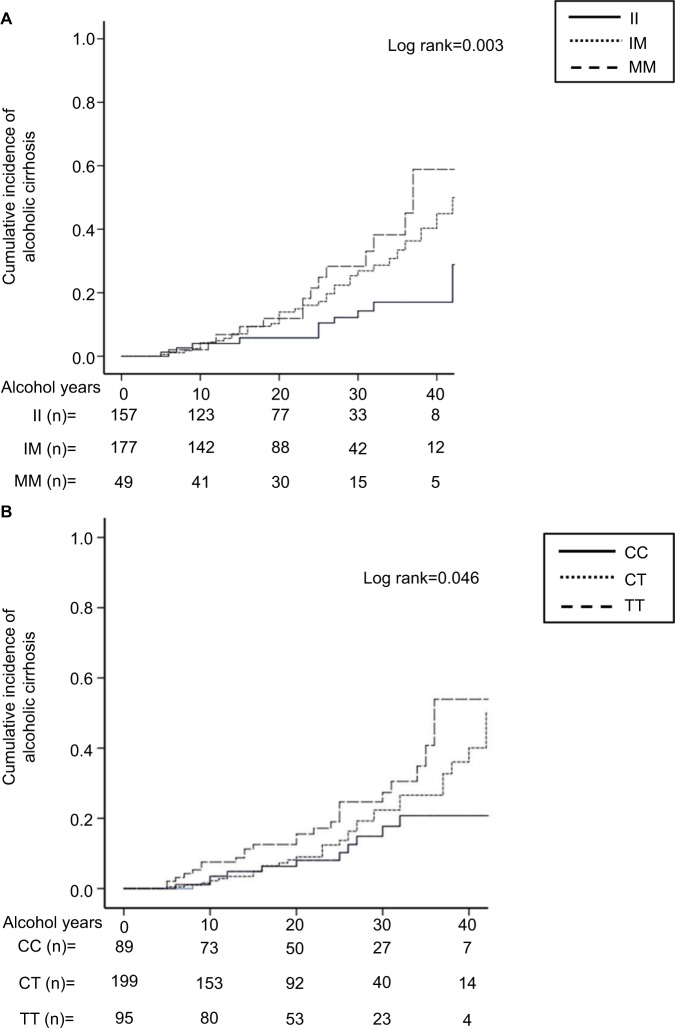
We found that , , and were associated with alcoholic cirrhosis prevalence. and were also associated with its incidence. The best predictive score formula was (age at onset of at-risk alcohol consumption × 0.1) + (number of allele T) + (number of allele M) + (BMI × 0.1). A threshold of 7.27 was identified as cutoff for the predictive risk of alcoholic cirrhosis development in 36 years from the onset of at-risk alcohol consumption with 70.1% sensitivity and 78.7% specificity.
We developed the first score for alcoholic cirrhosis prediction that combines clinical and genetic factors.
酒精性肝硬化占全球所有死因的1%。其发病率在男性中更高,是环境和遗传因素共同作用的结果。在酒精性肝硬化的所有遗传决定因素中,类Patatin磷脂酶结构域蛋白3()rs738409是最广泛验证的决定因素。最近对酗酒者的横断面研究确定跨膜6超家族成员2()rs58542926、含膜结合O-酰基转移酶结构域7()rs641738和分化簇14()rs2569190为酒精性肝硬化的新遗传风险因素。我们旨在开发一种基于基因的风险评分,以预测有饮酒风险的男性患酒精性肝硬化的发生率。
对416名有饮酒风险的男性进行回顾性检查。测试酒精性肝硬化发病率与、、和变异之间的关联。将有饮酒风险开始时的年龄、年龄和体重指数(BMI)作为协变量,通过评估时间依赖性受试者工作特征曲线来确定酒精性肝硬化发病率的预测评分。
我们发现、和与酒精性肝硬化患病率相关。和也与其发病率相关。最佳预测评分公式为(有饮酒风险开始时的年龄×0.1)+(等位基因T的数量)+(等位基因M的数量)+(BMI×0.1)。确定7.27为从有饮酒风险开始36年内酒精性肝硬化发生预测风险的临界值,敏感性为70.1%,特异性为78.7%。
我们开发了首个结合临床和遗传因素的酒精性肝硬化预测评分。