Department of Ecology, Evolution, and Environmental Biology, Columbia University, New York, NY, USA.
Department of Biological Sciences, University at Albany, Albany, NY, USA.
Mol Microbiol. 2019 Apr;111(4):868-882. doi: 10.1111/mmi.14209. Epub 2019 Feb 27.
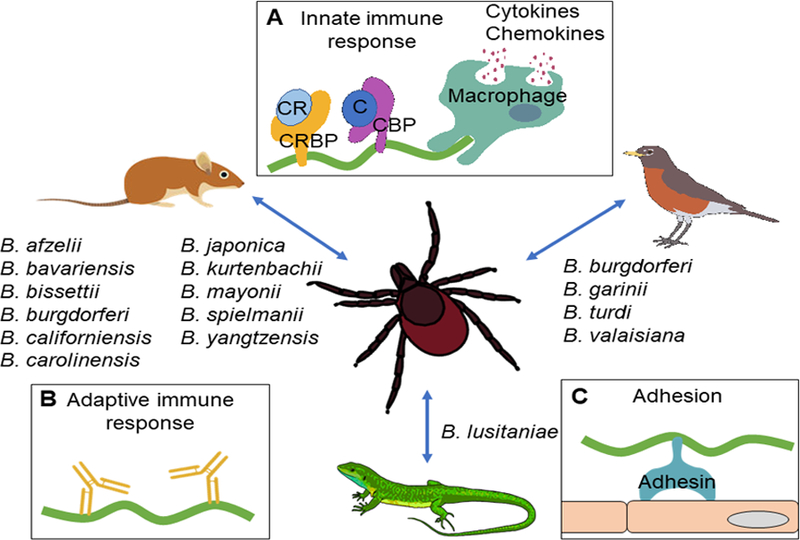
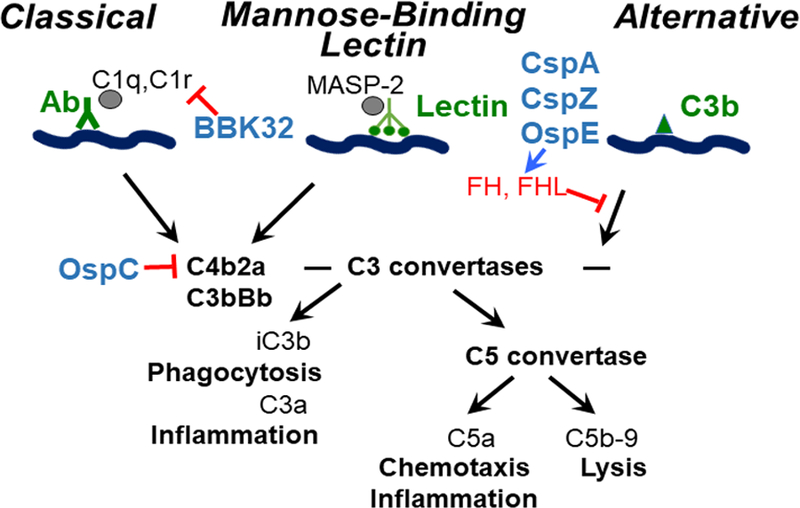
Lyme borreliosis is caused by multiple species of the spirochete bacteria Borrelia burgdorferi sensu lato. The spirochetes are transmitted by ticks to vertebrate hosts, including small- and medium-sized mammals, birds, reptiles, and humans. Strain-to-strain variation in host-specific infectivity has been documented, but the molecular basis that drives this differentiation is still unclear. Spirochetes possess the ability to evade host immune responses and colonize host tissues to establish infection in vertebrate hosts. In turn, hosts have developed distinct levels of immune responses when invaded by different species/strains of Lyme borreliae. Similarly, the ability of Lyme borreliae to colonize host tissues varies among different spirochete species/strains. One potential mechanism that drives this strain-to-strain variation of immune evasion and colonization is the polymorphic outer surface proteins produced by Lyme borreliae. In this review, we summarize research on strain-to-strain variation in host competence and discuss the evidence that supports the role of spirochete-produced protein polymorphisms in driving this variation in host specialization. Such information will provide greater insights into the adaptive mechanisms driving host and Lyme borreliae association, which will lead to the development of interventions to block pathogen spread and eventually reduce Lyme borreliosis health burden.
莱姆病是由多种伯氏疏螺旋体细菌引起的。螺旋体通过蜱传播给脊椎动物宿主,包括小型和中型哺乳动物、鸟类、爬行动物和人类。已经记录了菌株对特定宿主的感染性的变异性,但驱动这种分化的分子基础仍不清楚。螺旋体具有逃避宿主免疫反应和在宿主组织中定植以在脊椎动物宿主中建立感染的能力。反过来,当不同物种/菌株的莱姆螺旋体入侵宿主时,宿主会产生不同程度的免疫反应。同样,莱姆螺旋体在宿主组织中的定植能力在不同的螺旋体物种/菌株之间也有所不同。一种潜在的机制是驱动这种菌株间免疫逃避和定植的变异性,即莱姆螺旋体产生的多态性外表面蛋白。在这篇综述中,我们总结了宿主易感性的菌株间变异性研究,并讨论了支持螺旋体产生的蛋白多态性在驱动宿主特化这种变异性中的作用的证据。这些信息将提供对驱动宿主和莱姆螺旋体关联的适应性机制的更深入了解,从而导致开发干预措施来阻止病原体的传播,并最终减少莱姆病的健康负担。