School of Science and Education, Genecology Research Centre, University of the Sunshine Coast, Maroochydore DC, Queensland, Australia.
Department of Biology, St. Francis Xavier University, Antigonish, Nova Scotia, Canada.
PLoS Negl Trop Dis. 2019 Jan 22;13(1):e0006948. doi: 10.1371/journal.pntd.0006948. eCollection 2019 Jan.
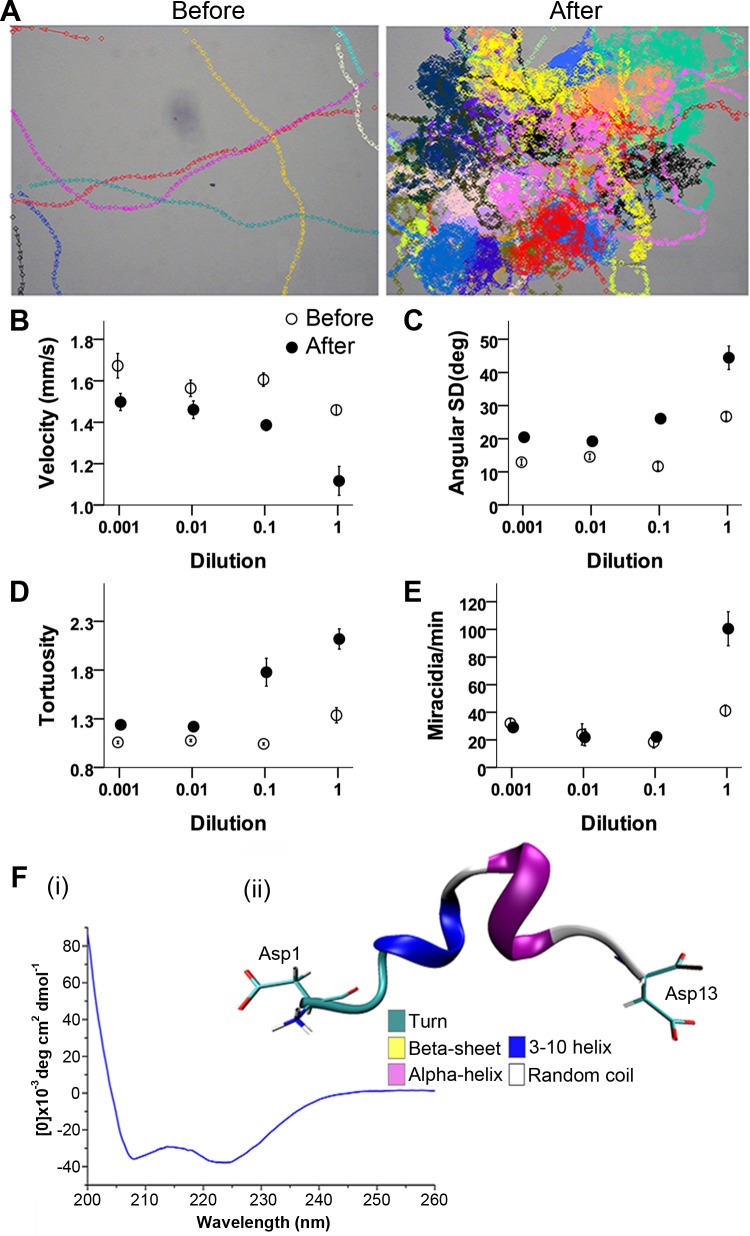
The human disease schistosomiasis (or bilharzia) is caused by the helminth blood fluke parasite Schistosoma mansoni, which requires an intermediate host, the freshwater gastropod snail Biomphalaria glabrata (the most common intermediate host). The free-swimming parasite miracidia utilise an excellent chemosensory sense to detect and locate an appropriate host. This study investigated the biomolecules released by the snail that stimulate changes in the behaviour of the aquatic S. mansoni miracidia. To achieve this, we have performed an integrated analysis of the snail-conditioned water, through chromatography and bioassay-guided behaviour observations, followed by mass spectrometry. A single fraction containing multiple putative peptides could stimulate extreme swimming behaviour modifications (e.g. velocity, angular variation) similar to those observed in response to crude snail mucus. One peptide (P12;-R-DITSGLDPEVADD-KR-) could replicate the stimulation of miracidia behaviour changes. P12 is derived from a larger precursor protein with a signal peptide and multiple dibasic cleavage sites, which is synthesised in various tissues of the snail, including the central nervous system and foot. P12 consists of an alpha helix secondary structure as indicated by circular dichroism spectroscopy. This information will be helpful for the development of approaches to manipulate this parasites life cycle, and opens up new avenues for exploring other parasitic diseases which have an aquatic phase using methods detailed in this investigation.
人类疾病血吸虫病(或血丝虫病)是由曼氏血吸虫这种寄生虫引起的,它需要一个中间宿主,即淡水腹足纲蜗牛玻氏巴蜗牛(最常见的中间宿主)。自由游动的寄生虫尾蚴利用出色的化学感觉来检测和定位合适的宿主。本研究调查了蜗牛释放的生物分子,这些生物分子刺激了水生曼氏血吸虫尾蚴的行为变化。为了实现这一目标,我们通过色谱和生物测定指导的行为观察,对蜗牛条件水进行了综合分析,随后进行了质谱分析。含有多种假定肽的单一馏分可以刺激极端游泳行为的改变(例如速度、角度变化),类似于对粗蜗牛粘液的反应。一种肽(P12;-R-DITSGLDPEVADD-KR-)可以复制刺激尾蚴行为变化。P12 来自一个带有信号肽和多个双碱性切割位点的较大前体蛋白,该蛋白在蜗牛的各种组织中合成,包括中枢神经系统和足部。圆二色性光谱表明 P12 由α螺旋二级结构组成。这些信息将有助于开发操纵这种寄生虫生命周期的方法,并为使用本研究中详述的方法探索其他具有水生阶段的寄生虫病开辟新途径。